

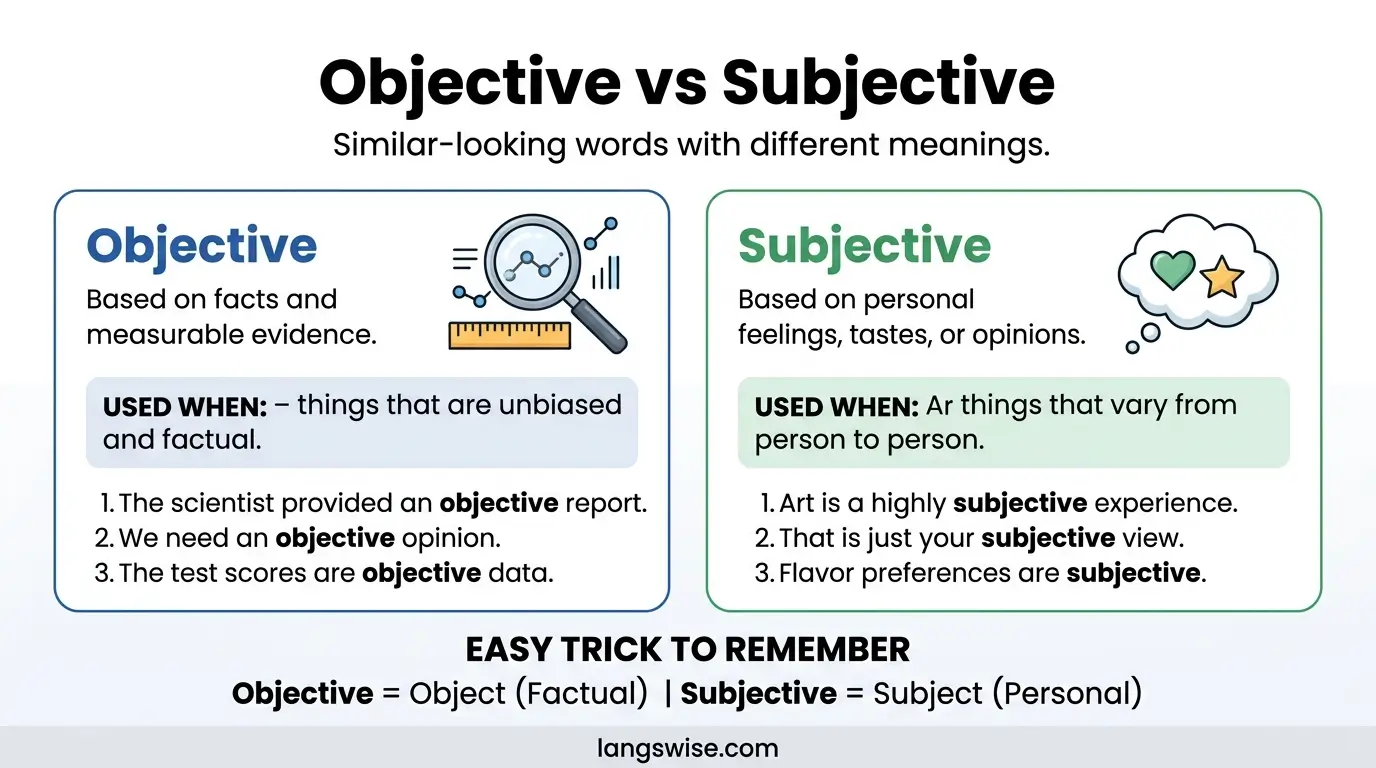
Have you ever wondered whether a statement is objective or subjective? You are not alone. These two words appear in school essays, news reports, reviews, research, workplace writing, and everyday conversations.
They are often used as opposites, but many people still confuse their meanings.The simple rule is this: objective means based on facts or evidence, while subjective means based on personal opinions, feelings, or experiences.
For example, “The meeting starts at 10 a.m.” is objective because it can be checked. “The meeting was boring” is subjective because it reflects a personal view.
People also search for “objective or subjective” because they want to know which word is correct, how the words are spelled, and whether British and American English use different forms. The good news is that the spelling is the same in both forms of English.
This guide explains the difference, word origins, spelling rules, common mistakes, real examples, usage trends, and professional advice.
Objective or Subjective Quick Answer
Objective means based on facts, evidence, or information that can be checked.
Subjective means based on personal feelings, opinions, tastes, or experiences.
Simple examples
- Objective: The book has 300 pages.
- Subjective: The book is exciting.
- Objective: The temperature is 25°C.
- Subjective: The weather feels perfect.
- Objective: The company hired 20 new workers.
- Subjective: The company is a great place to work.
A useful test is to ask:
Can the statement be checked with evidence, or does it depend on someone’s personal view?
If it can be checked, it is usually objective. If it depends on personal judgment, it is usually subjective.
However, the difference is not always absolute. A single article can contain both objective facts and subjective opinions. A news report, for example, may give factual information and then quote someone’s personal opinion.
The Origin of Objective or Subjective
The words objective and subjective have roots in Latin and became important terms in philosophy, logic, and discussions about knowledge and perception.
Objective is related to the Latin obiectum, meaning something placed before or presented to the mind.
Over time, the word developed meanings connected with things considered independently of a person’s personal feelings or viewpoint.
Subjective comes from Latin subiectus, related to something placed under or connected with a subject. Its modern meaning developed around the idea of experience as perceived by an individual.
The two words later became closely linked in philosophical discussions. They offered a useful way to distinguish between something considered independently of personal perception and something connected to an individual’s experience.
Today, the distinction is much simpler in everyday English:
- Objective = fact, evidence, measurement
- Subjective = opinion, feeling, personal experience
Modern dictionaries also show several meanings for these words. For example, objective can mean a goal or target, while subjective can describe something affected by personal views or experience.
Why do spelling differences cause confusion?
English has many British and American spelling differences. Examples include:
- colour / color
- organise / organize
- realise / realize
- analyse / analyze
Because of this, some writers assume that objective and subjective may also have different UK and US spellings.
They do not.
Both words are spelled the same in British English and American English.
British English vs American English Spelling
There is no British vs American spelling difference for objective or subjective.
| Word | British English | American English | Difference |
| Objective | objective | objective | No |
| Subjective | subjective | subjective | No |
| Colour | colour | color | Yes |
| Organise | organise | organize | Yes |
| Realise | realise | realize | Yes |
| Analyse | analyse | analyze | Yes |
So, whether you write for readers in London, New York, Toronto, Sydney, or elsewhere, objective and subjective keep the same spelling.
The main issue is not spelling. It is meaning.
Objective vs subjective: side-by-side comparison
| Feature | Objective | Subjective |
| Main meaning | Based on facts | Based on personal views |
| Based on | Evidence and observation | Feelings and experience |
| Can it be checked? | Usually yes | Usually not in the same way |
| Depends on the person? | Usually no | Usually yes |
| Common in | Research, reports, news | Reviews, opinions, personal writing |
| UK spelling | objective | subjective |
| US spelling | objective | subjective |
| Example | The car weighs 1,500 kg. | The car looks beautiful. |
Which Spelling Should You Use?
The answer is easy: use objective and subjective exactly as spelled above.
Your choice depends on the meaning, not your country.
For US English
Use objective when discussing facts, data, evidence, or an impartial approach.
The report provides an objective analysis of the results.
Use subjective when discussing personal opinion or experience.
Her opinion about the design is subjective.
For UK and Commonwealth English
The same spellings and meanings apply.
The study uses objective measurements.
Beauty is often a subjective matter.
This also applies to many other English-speaking audiences, including readers in Canada, Australia, New Zealand, India, and Pakistan.
For global English
Keep the explanation simple.
Instead of:
The subjective nature of aesthetic judgment varies according to individual perception.
You could write:
People have different opinions about what looks beautiful.
The second version is easier for international readers.
For academic writing
The distinction matters.
Use objective for evidence, measurable results, and neutral analysis.
Use subjective for personal responses, interpretations, preferences, and experiences.
Oxford notes that academic writing can vary in how objective or subjective its language and register appear.
Common Mistakes with Objective or Subjective
Mistake 1: Thinking subjective means wrong
A subjective statement is not automatically false.
“Chocolate ice cream tastes better than vanilla.”
This is subjective. It reflects personal taste. That does not make the person’s experience false.
Mistake 2: Calling every opinion objective
Some people say:
“Objectively, this is the best movie ever.”
Unless there is a clear standard and evidence supporting that claim, it is still largely an opinion.
Better:
“In my opinion, this is the best movie ever.”
Mistake 3: Thinking objective means absolutely perfect
Objective writing aims to rely on evidence and avoid personal bias. It does not mean that every conclusion is automatically perfect.
Evidence can be incomplete, and people can make mistakes when interpreting it.
Mistake 4: Confusing objective with objective
Objective has another common meaning: a goal or target.
For example:
Our main objective is to increase sales.
Here, objective does not mean “based on facts.” It means “goal.”
Mistake 5: Assuming a whole article must be objective or subjective
A piece of writing can contain both.
For example:
The film was released in 2026 and runs for two hours.
This is objective information.
I thought the film was too long.
This is subjective.
Good writing often separates facts from opinions clearly.
Objective or Subjective in Everyday Examples
In emails
Objective:
The meeting is scheduled for Monday at 2 p.m.
Subjective:
I think Monday’s meeting will be very useful.
The first gives information that can be checked. The second gives a personal view.
In news
News writing often aims for an objective presentation of facts.
The company reported a 10% increase in sales.
That is a factual claim that can be checked against company data.
A quoted person’s statement may be subjective:
The CEO said the new strategy was “the best decision” for the company.
The opinion belongs to the CEO, not necessarily the journalist.
On social media
Social media is full of subjective statements.
This is the best restaurant in the city!
That is usually an opinion.
A more objective post might say:
The restaurant opened in 2024 and has 50 seats.
In formal writing
Academic and professional writing often separates evidence from personal opinion.
Objective:
The survey included 500 participants.
Subjective:
The results appear encouraging.
The first states a measurable fact. The second gives an interpretation.
In reviews
Reviews often combine both types.
The phone has a 6.7-inch display. (Objective)
The display looks excellent. (Subjective)
A strong review makes it clear which claims are facts and which are personal judgments.
Objective or Subjective Google Trends & Usage Data
Search interest in “objective or subjective” and related phrases such as “objective vs subjective” comes from several different needs.
The most common contexts include:
- Education — students learning the difference between fact and opinion.
- Writing — people trying to make essays, reports, and articles more objective.
- Reviews — readers deciding whether a judgment is based on facts or taste.
- Workplaces — professionals discussing objective assessments and subjective opinions.
- Philosophy and science — people exploring how facts, perception, and interpretation differ.
Search results also show strong interest in the topic from English learners and writers.
Google Trends reports relative search interest, rather than a simple worldwide number of searches. Interest can also change by country, time, and search wording. Therefore, terms such as “objective vs subjective,” “objective or subjective,” and “difference between objective and subjective” should be treated as related but separate searches.
The important usage pattern is clear: people usually search these terms because they want to separate facts from opinions or choose the correct word in a particular sentence.
Objective or Subjective Variations: Comparison Table
| Variation | Meaning | Example |
| Objective | Based on facts or evidence | The test score was 90%. |
| Subjective | Based on personal opinion | The test was difficult. |
| Objectively | In a fact-based or impartial way | The results can be objectively measured. |
| Subjectively | From a personal point of view | She judged the design subjectively. |
| Objectivity | Quality of being objective | The report aims for objectivity. |
| Subjectivity | Quality of being subjective | Art often involves subjectivity. |
| Objective | A goal or target | Our objective is to improve service. |
FAQs About Objective or Subjective
What is the difference between objective and subjective?
Objective means based on facts, evidence, or measurable information. Subjective means based on personal opinions, feelings, or experiences.
Is “objective or subjective” spelled differently in British and American English?
No. Both objective and subjective have the same spelling in British and American English.
Is an opinion objective or subjective?
An opinion is normally subjective because it reflects a person’s judgment, preference, or viewpoint. However, an opinion can be informed by objective evidence.
Is science objective or subjective?
Science aims to be objective by using evidence, testing, measurement, and methods that others can examine. However, individual choices about research questions and interpretation can involve judgment.
Can something be both objective and subjective?
Yes. A review can contain objective facts and subjective opinions.
For example:
The phone weighs 180 grams. Objective
The phone feels too heavy. Subjective
How can I tell whether a statement is objective or subjective?
Ask whether the statement can be checked against evidence or measurement.
If it can, it is likely objective.
If it mainly depends on personal taste, feelings, or judgment, it is likely subjective.
Does objective always mean unbiased?
Not necessarily. Objective usually describes an attempt to rely on facts and avoid personal bias. A person may believe they are being objective while still making a poor judgment.
Conclusion
Understanding objective or subjective is easier when you focus on one simple difference: objective relates to facts and evidence, while subjective relates to personal views and experiences.
An objective statement can usually be checked. For example, “The train arrived at 8:30” is based on information that can be verified. A subjective statement depends on personal judgment: “The train journey was comfortable.”
There is also no British or American spelling difference between objective and subjective. Both forms use exactly the same spelling. The real challenge is choosing the word that matches your meaning.
Use objective language when you need to present facts, data, measurements, or evidence. Use subjective language when discussing opinions, preferences, feelings, or personal experiences. Remember, too, that one piece of writing can contain both.
Finally, do not assume that subjective means incorrect. Opinions can be useful when they are clearly presented as opinions. The key is to tell your reader where facts end and personal judgment begins.
That simple habit will make your emails, essays, reports, reviews, and professional writing clearer and more trustworthy.
