

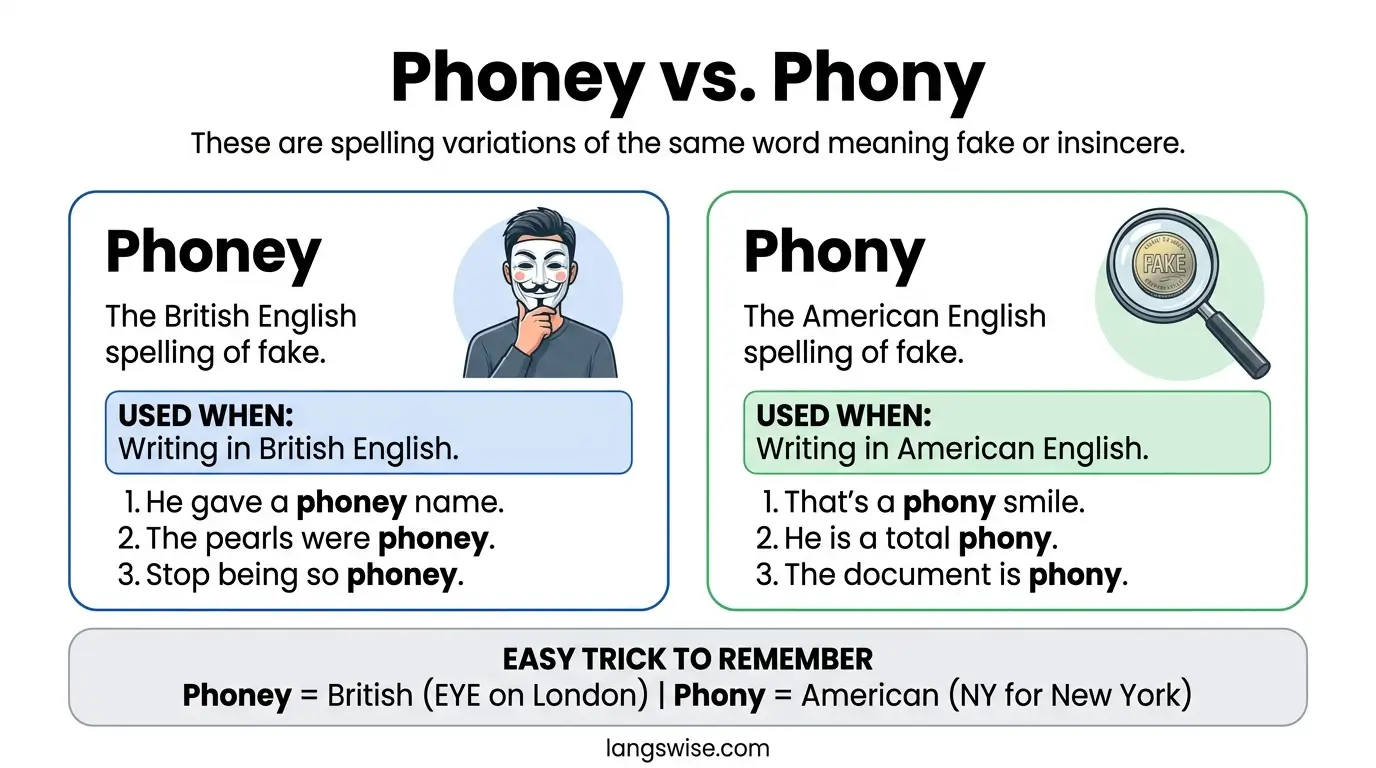
Have you ever typed “phoney or phony” and stopped to ask which spelling is correct? You are not alone. Both forms appear in English writing, and both mean the same thing: fake, false, not genuine, or insincere.
The main difference is regional spelling. Phony is the preferred form in American English, while phoney is the traditional form in British English.
However, both spellings are understood across the English-speaking world. Major dictionaries list both forms, so choosing one is usually a matter of audience and style, not meaning.
This guide answers the common question “phoney or phony?” in simple terms. You will learn where the word came from, how British and American English spell it, which form you should use, and how to avoid common mistakes.
We will also look at examples, usage patterns, and country-level data to help you make the right choice.
Phoney or Phony Quick Answer
Both “phoney” and “phony” are correct.
- Phony = preferred in American English.
- Phoney = traditional and common in British English.
- Both mean fake, false, counterfeit, or insincere.
- Both can be used as an adjective or noun.
Examples
American English:
That website looks phony.
British English:
That website looks phoney.
As a noun:
He is a phony.
or:
He is a phoney.
The meaning does not change. The spelling mainly reflects regional English preferences. Cambridge lists phony as the US form and phoney as the UK form, while also noting the alternative spelling.
Quick comparison
| Variation | Main use | Meaning |
| phony | American English | fake or insincere |
| phoney | British English | fake or insincere |
| phoniness | Mainly American | the quality of being phony |
| phoneyness | British variant | the quality of being phoney |
So, if you are writing for a US audience, phony is usually the safest choice. For a UK audience, phoney is a natural choice.
The Origin of Phoney or Phony
The history of phoney/phony is unusual.
The word appeared in English in the late 19th century. Merriam-Webster gives 1889 as the first known use of phony.
The exact origin is not certain. One leading theory connects the word with fawney, an old slang word linked to a ring. The word may have been connected with the “fawney rig,” a confidence trick in which a cheap ring was presented as valuable.
Over time, the idea of something being falsely presented as valuable may have helped produce the modern meaning of phony.
The spelling later developed into phony and phoney. The extra e became strongly associated with British usage.
Importantly, phoney is not related to the Greek-based suffix “-phony” found in words such as “telephone” or “polyphony.” The similar spelling can be misleading.
The uncertain origin also explains why dictionaries sometimes give slightly different accounts. Modern dictionaries agree on the meaning but describe the etymology as uncertain or probable rather than completely proven.
British English vs American English Spelling
The biggest difference is simple:
American English usually prefers “phony.” British English traditionally prefers “phoney.”
Cambridge lists phony as a US spelling and phoney as a UK spelling. Collins similarly describes phony as especially American and phoney as the preferred British spelling.
Comparison table
| Feature | American English | British English |
| Main spelling | phony | phoney |
| Meaning | Fake or insincere | Fake or insincere |
| Example | a phony smile | a phoney smile |
| Noun | a phony | a phoney |
| Comparative | phonier | phonier |
| Superlative | phoniest | phoniest |
| Related noun | phoniness | phoneyness |
| Pronunciation | /ˈfoʊni/ | /ˈfəʊni/ |
The spelling difference is similar to many other differences between US and UK English. However, unlike words such as color/colour or center/centre, both forms are widely recognized internationally.
There is also some overlap. British readers understand phony, and American readers understand phoney. Neither spelling is normally confusing in context.
Which Spelling Should You Use?
Choose the spelling that matches your readers.
For American readers
Use phony.
Examples:
- phony excuse
- phony address
- phony smile
- phony product
- a phony
This is the normal choice for US websites, newspapers, business documents, and academic writing.
For British and Commonwealth readers
Use phoney if you want to follow traditional British spelling.
Examples:
- phoney excuse
- phoney address
- phoney smile
- phoney product
- a phoney
British English is also used as a reference style in many Commonwealth settings, although individual countries can have their own preferences.
For global websites
Either spelling can work, but consistency matters most.
If your website targets several countries, choose one spelling and use it consistently. If your main audience is American, use phony. If your main audience is British, use phoney.
For SEO, you can mention both forms naturally. This helps answer searches such as “phoney or phony,” “phony or phoney,” and “is phoney correct?” without making the text awkward.
Common Mistakes with Phoney or Phony
1. Thinking one spelling is wrong
Incorrect idea: “Phoney is wrong.”
Better: Both phoney and phony are accepted spellings. Regional preference is the main difference.
2. Mixing styles in the same document
Using both forms randomly can make your writing look inconsistent.
Better:
The company received several complaints about a phony website.
Keep using phony if you are following American English.
3. Confusing “phony” with “phone”
The word phony is not simply a form of phone. Its history is separate and is linked to older slang, although its spelling can make the connection look obvious.
4. Using “phonies” incorrectly
The plural of the noun is:
phonies
Example:
The article exposed several phonies.
Phoney can also form the plural phoneys, although phonies is common in dictionaries as an alternative. Merriam-Webster lists both plural forms.
5. Using “phony” when you mean “phone”
These words have different meanings:
- phone = a telephone or to call someone
- phony = fake or false
Example:
I left my phone at home.
The advertisement was phony.
Phoney or Phony in Everyday Examples
The word is common in informal and everyday English. It can describe people, objects, claims, stories, documents, smiles, names, and excuses.
In emails
American English:
Please be careful. This may be a phony payment request.
British English:
Please be careful. This may be a phoney payment request.
For professional emails, fake, fraudulent, or false may sometimes sound more formal.
In news writing
Police said the suspect used a phony identity.
Or:
Police said the suspect used a phoney identity.
The word often appears when a person, claim, document, or product is presented as real when it is not.
On social media
That profile looks phony.
Or:
That account looks phoney.
Social media users often use the word to describe fake accounts, false claims, staged behavior, or people who seem insincere.
In formal writing
Phony and phoney are both understandable, but they are somewhat informal and can sound judgmental.
Instead of:
The company made a phony claim.
A formal report might say:
The company made a false claim.
Or:
The claim was found to be fraudulent.
Choose the word based on tone and context.
Phoney or Phony Google Trends & Usage Data
Search and usage patterns show why people encounter both spellings.
The broad pattern is clear: phony is strongly associated with American English, while phoney is strongly associated with British English. Dictionary sources also reflect this regional distinction.
Country-level usage data compiled by Sapling shows phony leading in the United States, while phoney has a stronger position in some British English contexts.
The same dataset shows variation in countries such as India, Canada, Australia, Ireland, and New Zealand, which reflects the mixed nature of English usage around the world.
Older corpus research also found a strong British-American split. One study reported that phoney was much more common in British National Corpus data, while phony was overwhelmingly more common in its American data.
It also found roughly balanced use in Canada and Australia in older reference sources.
This means search interest does not tell the whole story. People may search “phoney or phony” because they have seen both forms online or because their spelling checker prefers a different regional style.
What this means for SEO
If you publish content for an international audience, include both forms naturally:
- phoney or phony
- phony vs phoney
- is phoney correct?
- is phony correct?
- phoney meaning
- phony meaning
Do not repeat the keyword unnaturally. Clear, useful content is more important than keyword repetition.
Phoney vs Phony: Comparison Table
| Word | Preferred region | Meaning | Example |
| phony | US English | Fake or insincere | That is a phony claim. |
| phoney | UK English | Fake or insincere | That is a phoney claim. |
| phoniness | US English | Quality of being phony | I dislike his phoniness. |
| phoneyness | UK English | Quality of being phoney | She noticed his phoneyness. |
The core meaning remains the same. The main difference is spelling and regional style.
FAQs About Phoney or Phony
Is “phoney” a correct word?
Yes. Phoney is a correct English spelling. It is especially associated with British English.
Is “phony” a correct word?
Yes. Phony is correct and is the preferred spelling in American English.
Is phony or phoney more common in America?
Phony is more common in American English.
Is phony or phoney more common in Britain?
Phoney is the traditional British spelling, although phony is also understood and used.
Do phony and phoney mean the same thing?
Yes. Both mean fake, false, not genuine, or insincere.
What is the plural of phony?
The usual plural is phonies.
Example:
The police arrested two phonies.
Phoneys is also recorded as a plural variant.
Which spelling should I use for SEO?
Use the spelling that matches your target audience. For US readers, use phony. For UK readers, phoney is a natural choice. For global SEO, you can use both terms naturally while keeping your main spelling consistent.
Conclusion
So, phoney or phony? The answer is simple: both are correct. The difference is mainly regional.
Phony is the preferred form in American English. Phoney is the traditional British English spelling. Both words mean fake, false, counterfeit, or insincere. Major dictionaries recognize both forms.
When choosing between them, think about your readers. Write phony for a mainly American audience and phoney when following British English.
For international content, either form is understood, but keeping one spelling consistent will make your writing look more polished.
The word has an interesting history, probably linked to old slang involving a confidence trick and a supposedly valuable ring. Its uncertain origin also helps explain why its spelling developed in more than one form.
If you are writing for search engines, do not worry about treating one spelling as “wrong.” Instead, answer the real search intent: explain both forms, show the regional difference, give useful examples, and use the preferred spelling for your target audience.
