

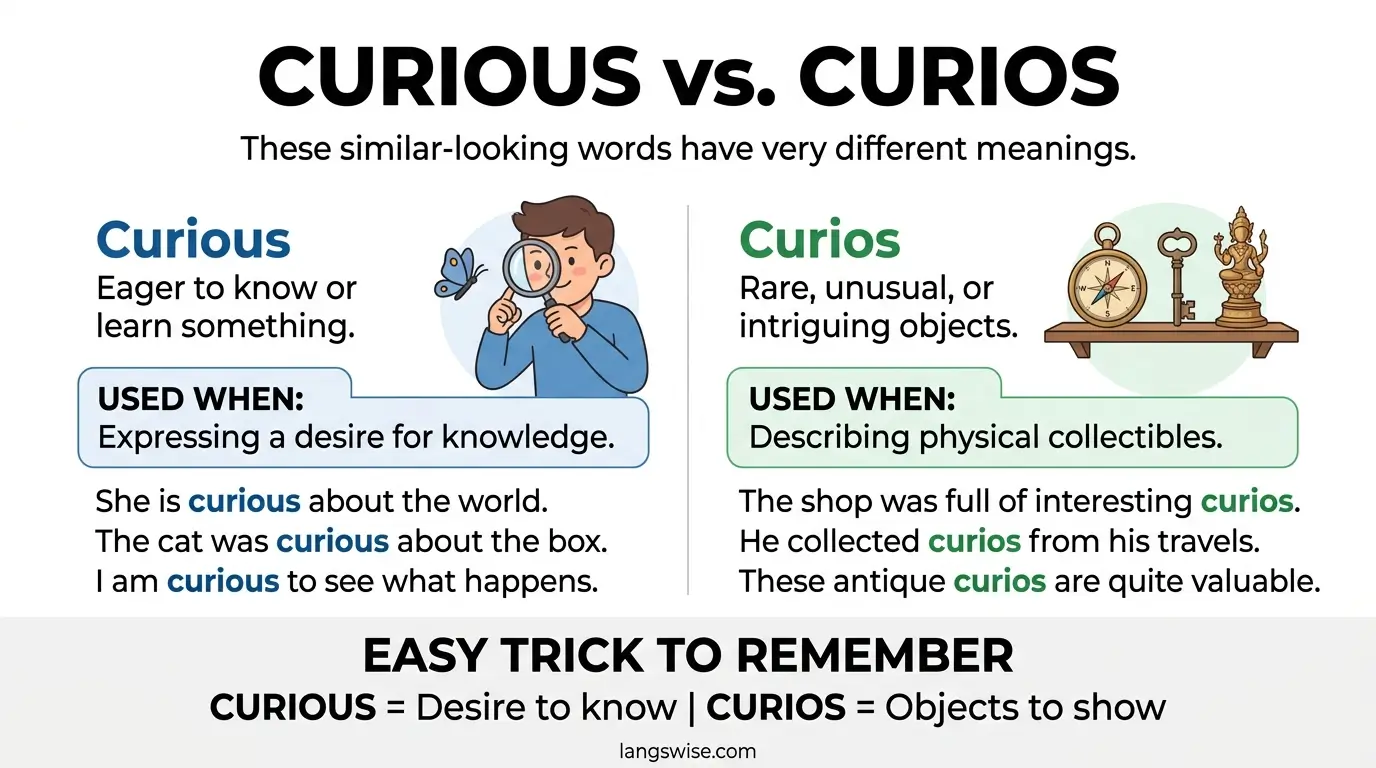
Have you ever typed “curios” when you meant “curious”? You are not alone. The two words look almost the same, sound similar in some contexts, and are easy to mix up when writing quickly. But they do not mean the same thing.
If you want to say that someone wants to know more, the correct word is curious. For example, “I am curious about the answer.”
Curios, however, is also a real English word. It is the plural of curio, meaning unusual or interesting objects, often collected or displayed.
This small spelling difference can change the meaning of a sentence. That is why people search for “curios or curious” when checking an email, school assignment, article, social media post, or other written content.
This guide explains the difference in simple terms. You will learn the correct spelling, word origins, British and American usage, common mistakes, examples, and practical advice for professional writing.
Curios or Curious Quick Answer
If you mean wanting to know or learn something, use curious.
Correct:
- I am curious about the results.
- She was curious to know what happened.
- The child is curious about space.
Curios is a different word. It is the plural of curio, which means an unusual or interesting object.
Example:
- The shop sells antiques and curios.
- The museum displayed several rare curios.
So, the quick rule is:
Curious = eager to know or learn
Curios = more than one unusual object
There is no British-versus-American spelling difference here. Curious is the standard spelling in both British and American English.
The Origin of Curios or Curious
The words curious and curio have a related history, but they developed into different English words.
Curious comes from Latin curiosus, meaning careful, diligent, or eager to inquire. It entered English through Old French.
English records show the word in use from the 14th century. Over time, its meaning developed toward the modern idea of being eager to know or learn something.
The word curio has a much later history. It is a shortened form of curiosity, dating from the 19th century. A curio is an unusual or rare object that attracts interest. Its plural form is curios.
This explains why the words look so similar:
- curious → adjective
- curio → noun
- curios → plural noun
The spelling confusion happens because curios looks like a shortened version of curious. However, it is not the normal spelling of the adjective.
British English vs American English Spelling
There is no major spelling difference between British English and American English for curious.
Both use:
curious
The same is true for curio and its plural curios.
The main differences may appear in pronunciation, not spelling. Cambridge lists different British and American pronunciations for curio, while the spelling remains the same.
| Word | British English | American English | Meaning |
| curious | curious | curious | Wanting to know or learn |
| curio | curio | curio | An unusual or interesting object |
| curios | curios | curios | More than one curio |
| curiosity | curiosity | curiosity | A desire to know or an unusual thing |
Simple examples
British English:
I am curious about the new policy.
American English:
I am curious about the new policy.
The spelling stays the same.
Therefore, do not treat curios as a British spelling of curious. It is a different word.
Which Spelling Should You Use?
The answer depends on what you want to say.
For US English
Use curious when describing someone who wants to know something.
I am curious about your opinion.
Use curios only when you mean several unusual objects.
The antique store sells curios.
For UK and Commonwealth English
The same rule applies.
She was curious about the new project.
The museum contains several historical curios.
Countries such as the UK, Canada, Australia, and New Zealand do not use curios as an alternative spelling of curious.
For global English
If you write for an international audience, use curious whenever you mean “wanting to know.”
This is especially important in:
- Business emails
- Websites
- Blog posts
- School assignments
- Academic writing
- Social media
- Customer communication
If you mean unusual objects, use curios.
Common Mistakes with Curios or Curious
The most common mistake is dropping the u from curious.
Mistake 1: “I am curios.”
Incorrect:
I am curios about the answer.
Correct:
I am curious about the answer.
Mistake 2: “She is curios to know.”
Incorrect:
She is curios to know what happened.
Correct:
She is curious to know what happened.
Mistake 3: Treating “curios” as an adjective
Incorrect:
He is a very curios person.
Correct:
He is a very curious person.
Curios is normally a plural noun meaning unusual objects.
Mistake 4: Thinking “curios” is always wrong
This is also incorrect.
Curios is a valid English word when it is the plural of curio.
The collector owns many rare curios.
Dictionaries such as Cambridge, Oxford, and Collins list curios as the plural of curio.
Easy memory trick
Think:
curi + ous = curious
The ending -ous is part of the adjective.
You can also connect curious with curiosity:
curious → curiosity
Curios or Curious in Everyday Examples
Understanding the difference is easier when you see the words in real situations.
In emails
Correct:
I am curious to learn more about your proposal.
Incorrect:
I am curios to learn more about your proposal.
For professional emails, always use curious when you mean interested in learning more.
In news writing
Curious:
Investigators are curious about the sudden change.
Curios:
The museum displayed several ancient curios.
The first describes a feeling or state of mind. The second describes objects.
On social media
Curious:
I am curious to see what happens next.
Curios:
Found some amazing curios at this old market.
In formal writing
Curious:
Researchers remain curious about the cause of the change.
Curios:
The exhibition contains several historical curios.
Comparison table
| Variation | Word type | Meaning | Example |
| curious | Adjective | Wanting to know | I am curious about it. |
| curio | Noun | An unusual object | The curio was very old. |
| curios | Plural noun | Unusual objects | The shop sells curios. |
| curiosity | Noun | Desire to know | Her curiosity grew. |
| curiously | Adverb | In a curious way | He looked curiously at it. |
Curios or Curious Google Trends & Usage Data
Search data can help explain why people ask about “curios or curious.” However, Google Trends should be read carefully.
Google Trends measures relative search interest, not the exact number of searches. A score of 100 represents the highest interest for the selected term, location, and time period. It does not mean 100 searches.
For this keyword, there is an important problem: curios has a genuine dictionary meaning. A search for “curios” can therefore refer to antique objects, collectibles, museums, shops, or the spelling mistake.
By contrast, searches for curious often relate to:
- Word meaning
- Spelling
- Vocabulary
- Grammar
- Education
- General interest
- Questions and explanations
Google Trends supports comparisons across countries and regions, making it useful for studying how search interest changes by location. Google has expanded Trends to cover more than 100 countries and regions.
For SEO, this means you should not assume that every search for curios means someone is asking about the spelling of curious.
Practical SEO insight
If your page targets the spelling question, include related phrases such as:
- curios or curious
- curios vs curious
- is curios correct?
- is curious spelled with a u?
- curious correct spelling
- curios meaning
- curious meaning
- curious or curios which is correct
This covers both search intent and the real meaning of curios.
FAQs About Curios or Curious
Is “curios” the correct spelling of “curious”?
No. If you mean “wanting to know or learn,” the correct spelling is curious.
Is “curios” a real word?
Yes. Curios is the plural of curio, which means unusual or interesting objects.
What is the difference between curious and curios?
Curious is an adjective. It describes someone who wants to know something. Curios is usually a plural noun for unusual objects.
Should I write “I am curious” or “I am curios”?
Write “I am curious.” This is the correct form when talking about your desire to know something.
Is “curios” British English?
No. Curios is not a British spelling of curious. It is the plural of curio in both British and American English.
What is the plural of curio?
The plural is curios.
One curio
Two curios
Cambridge and Oxford both list curios as the plural form.
How can I remember the spelling of curious?
Remember the ending:
curi + ous = curious
Also connect it with:
curious → curiosity
If you mean “wanting to know,” choose curious.
Conclusion
The difference between curios or curious is simple once you know what each word means.
Use curious when you mean interested, inquisitive, or eager to know something. For example, “She is curious about the results.” This spelling is correct in both British and American English.
Use curios when you mean more than one curio. A curio is an unusual, rare, or interesting object. For example, “The shop sells antique curios.”
The two words are related in history, but they are not interchangeable. Curious comes from an older word linked to carefulness and inquiry, while curio developed later as a shortened form of curiosity.
For everyday, business, academic, and SEO writing, the key rule is easy: if you mean wanting to know, write curious. If you mean unusual objects, write curios.
Remember: curious has the “u”; curios is the plural of curio.
