

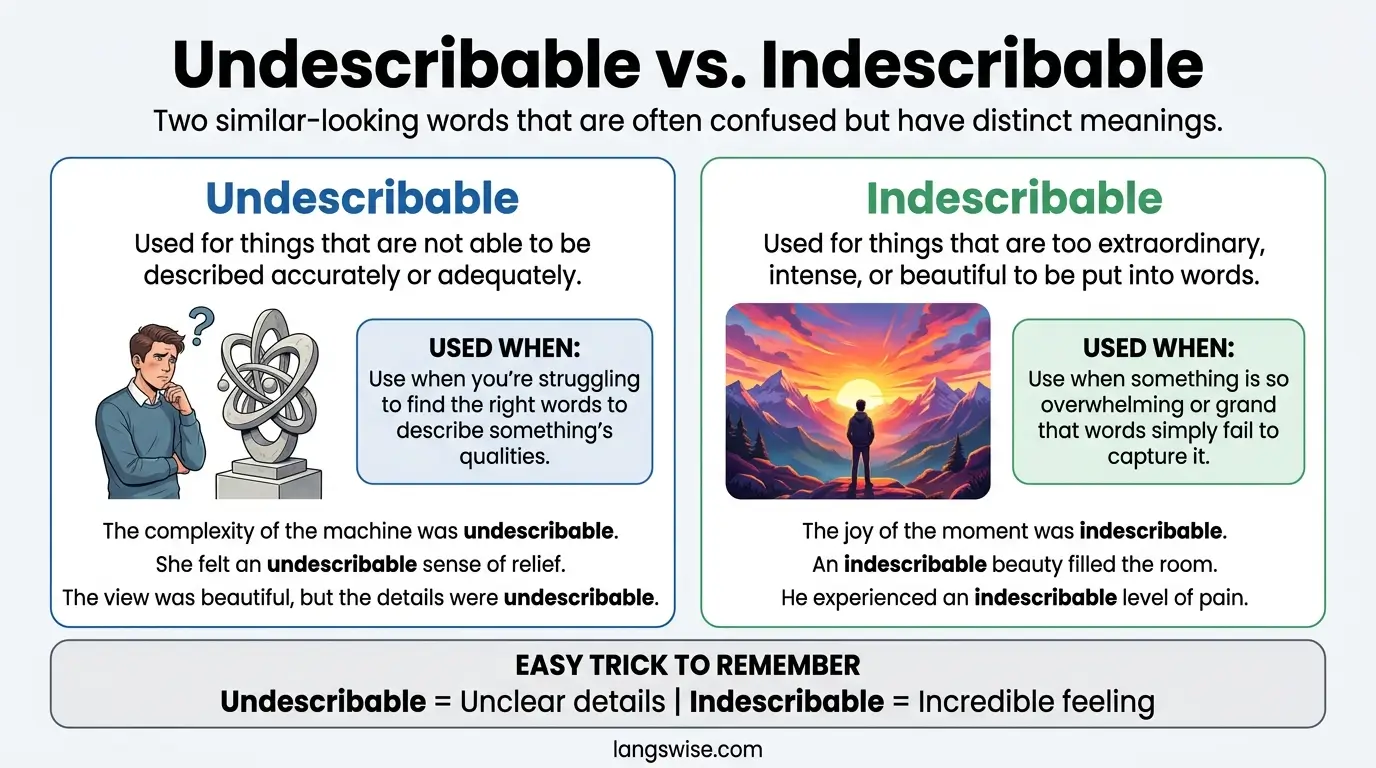
Have you ever written “undescribable” and stopped to wonder if it should be “indescribable”? You are not alone. Both forms look natural, and both have appeared in English. That makes the choice confusing, especially when you want your writing to look correct and professional.
The good news is simple: indescribable is the standard and preferred spelling in modern English. It means something is so extreme, unusual, beautiful, painful, or powerful that it is almost impossible to describe in words.
Oxford gives examples such as “indescribable pain” and “indescribable relief.”Undescribable is also a real English word. Cambridge lists it and gives it as a synonym of indescribable. Collins describes it as a variant of indescribable.
So, why do two spellings exist? The answer comes from English word formation. Understanding the difference will help you choose the right form for emails, essays, websites, social media, and professional writing.
Undescribable or Indescribable Quick Answer
Indescribable is the spelling you should normally use.
It means impossible or extremely difficult to describe with words.
Examples:
- The view was indescribable.
- She felt indescribable joy.
- The pain was indescribable.
- His reaction was indescribable.
Undescribable is not simply a spelling mistake. It is a recognized alternative form. Cambridge lists it as a word, while Collins calls it a variant of indescribable.
However, indescribable is the safer choice for most modern writing.
Quick comparison
| Word | Status | Meaning | Best choice? |
| indescribable | Standard | Impossible or very difficult to describe | Yes |
| undescribable | Alternative/variant | Impossible to describe | Usually no |
| indescribably | Standard adverb | In an indescribable way | Yes |
| indescribability | Standard noun | The quality of being indescribable | Yes, when needed |
| describable | Standard adjective | Able to be described | Yes |
The key point is this: “indescribable” is not the only possible form, but it is the normal form to choose.
The Origin of Undescribable or Indescribable
The word indescribable is built from three parts:
in- + describe + -able
The prefix in- can mean “not,” while -able means “capable of being.” So indescribable means something that is not able to be described.
Etymonline dates indescribable to 1726, formed from in- plus describable. Collins gives the first recorded period as 1785–95, showing that historical dating can vary between reference sources depending on the evidence and method used.
The related word describable is much older. Etymonline dates it to the 1670s.
So where did undescribable come from?
English also uses un- to create negative words. For example:
- happy → unhappy
- known → unknown
- clear → unclear
- able → unable
It is therefore easy to think:
describe → undescribable
That pattern is logical, but English does not always follow one simple rule when choosing between in- and un-.
Linguistic research notes that English has competing negative prefixes and specifically lists indescribable/undescribable as a pair with little difference in meaning.
Historical examples also show that undescribable has been used for centuries. Wiktionary records an example from Sir Walter Scott’s 1825 novel The Betrothed.
This explains why you may still see undescribable today.
British English vs American English Spelling
There is no major British-versus-American spelling difference here.
Both British English and American English normally use:
indescribable
The same spelling is used by major dictionaries for both varieties. Oxford provides the word in its British and American English resources, and Collins gives the same core spelling in both varieties.
The less common undescribable also exists in English on both sides of the Atlantic. Cambridge lists it, and Collins identifies it as a British English variant.
British vs American comparison
| Feature | British English | American English |
| Preferred spelling | indescribable | indescribable |
| Alternative | undescribable | undescribable |
| Meaning | Almost impossible to describe | Almost impossible to describe |
| Common professional form | indescribable | indescribable |
| Major spelling difference? | No | No |
This is different from words such as colour/color, centre/center, and travelling/traveling, where British and American spelling rules often differ.
For indescribable, you do not need to change the spelling based on your audience’s country.
Which Spelling Should You Use?
For most writers, the answer is easy:
If you write for a US audience
Use indescribable.
Example:
The experience was indescribable.
It is the clearest choice for American readers.
If you write for a UK or Commonwealth audience
Use indescribable here too.
Example:
The beauty of the countryside was indescribable.
There is no need to switch to undescribable because of British English.
If you write for a global audience
Choose indescribable.
This is especially important for:
- websites
- blogs
- academic writing
- business documents
- job applications
- reports
- professional emails
- educational content
What about creative writing?
Creative writers have more freedom.
You may encounter undescribable in older literature, creative work, or unusual modern usage. Historical writing shows that the form has existed for a long time.
Still, if your goal is natural modern English, indescribable is the better choice.
Common Mistakes with Undescribable or Indescribable
Mistake 1: Thinking “undescribable” is always wrong
This is too strong.
Undescribable is a recognized word, although it is less common than indescribable. Cambridge lists it, and Collins calls it a variant.
Better advice: Use indescribable in normal modern writing.
Mistake 2: Using the wrong spelling in formal writing
You may see:
The results were undescribable.
A safer version is:
The results were indescribable.
Mistake 3: Confusing “indescribable” with “undescribed”
These words do not mean the same thing.
Indescribable means something is difficult or impossible to describe.
Undescribed means something has not been described.
For example:
The beauty of the scene was indescribable.
But:
The species was previously undescribed.
Mistake 4: Confusing “indescribable” with “indescriptive”
These are different words.
- indescribable = impossible or very difficult to describe
- indescriptive = not descriptive
The first is the word you usually want when talking about a powerful experience or feeling.
Mistake 5: Writing “in describable”
Do not write:
The view was in describable.
Use:
The view was indescribable.
Undescribable or Indescribable in Everyday Examples
The word is common in situations where normal words do not seem strong enough.
In emails
Professional:
Thank you for your support. The opportunity was an indescribable experience.
Personal:
The feeling of seeing everyone again was indescribable.
In news writing
A news report may describe a person’s reaction:
Witnesses described the scene as indescribable.
In formal news writing, however, specific facts are often stronger than vague emotional words. Instead of saying something was indescribable, a journalist may explain exactly what happened.
On social media
The word is common in short emotional posts:
An indescribable day with the people I love.
Or:
The sunset tonight was absolutely indescribable.
Social media allows more expressive language, so this use is natural.
In formal writing
The word can work in formal writing, but use it with care.
For example:
The researchers reported an indescribable level of complexity.
A more precise academic sentence might be:
The researchers reported a level of complexity that was difficult to express using existing models.
The second sentence gives the reader more information.
Common word combinations
Oxford lists combinations such as indescribable joy and indescribable pain.
Other natural combinations include:
- indescribable beauty
- indescribable sadness
- indescribable happiness
- indescribable horror
- indescribable excitement
- indescribable relief
- indescribable experience
- indescribable feeling
Undescribable or Indescribable Google Trends & Usage Data
Search interest around “undescribable or indescribable” comes from a real spelling problem: both forms are possible in English, but they do not have equal status or everyday use.
Public search-trend tools can show relative search interest, but they should not be treated as exact word-frequency counts.
Google Trends, for example, measures search interest rather than the total number of times people use a word in books, conversations, or published writing.
Dictionary and language evidence gives a clearer picture:
- Indescribable is the standard form in major learner dictionaries.
- Undescribable is recognized but treated as a variant or synonym.
- Historical evidence shows that both forms have been used for a long time.
- Modern linguistic research describes undescribable as the less common form.
Country and audience context
The important point is that country does not create a major spelling split here.
| Audience | Recommended form | Why |
| United States | indescribable | Standard modern form |
| United Kingdom | indescribable | Standard modern form |
| Canada | indescribable | Clear global choice |
| Australia | indescribable | Clear global choice |
| New Zealand | indescribable | Clear global choice |
| International English | indescribable | Widely understood and standard |
If your goal is SEO, professional communication, or educational content, indescribable should be your main target spelling.
You can mention undescribable as the alternative form to capture the spelling question without presenting it as the preferred choice.
Undescribable vs Indescribable: Comparison Table
| Variation | Meaning | Status | Recommended use |
| indescribable | Impossible or very difficult to describe | Standard | Use normally |
| undescribable | Impossible to describe | Variant | Use mainly when quoting or discussing the variant |
| indescribably | In an indescribable way | Standard adverb | Use normally |
| indescribability | The quality of being indescribable | Standard noun | Formal or specialized writing |
| describable | Able to be described | Standard | Use for the opposite meaning |
| undescribed | Not yet described | Different word | Do not use as a synonym |
FAQs About Undescribable or Indescribable
Is it “undescribable” or “indescribable”?
Indescribable is the standard and preferred spelling. Undescribable is a recognized variant, but it is less common.
Is “undescribable” a real word?
Yes. Cambridge lists undescribable, and Collins describes it as a variant of indescribable.
What does “indescribable” mean?
It means so extreme, unusual, powerful, or remarkable that it is almost impossible to describe in words.
Is “indescribable” correct in American English?
Yes. Indescribable is the normal spelling in American English.
Is “indescribable” correct in British English?
Yes. British English also uses indescribable. There is no British spelling change to undescribable.
Is “undescribable” wrong?
Not exactly. It is a recognized alternative form. However, indescribable is the better choice for most modern readers and formal writing.
What is the opposite of indescribable?
The simplest opposite is describable, meaning something that can be described.
Depending on the context, expressible, explainable, or definable may also work.
What is the adverb form of indescribable?
The adverb is indescribably.
Example:
The mountain was indescribably beautiful.
Oxford lists indescribably as the adverb form.
Conclusion
When choosing between undescribable or indescribable, the safest answer is indescribable. It is the standard form used in modern English and is the best choice for most readers, websites, emails, essays, reports, and professional documents.
Oxford defines indescribable as something so extreme or unusual that it is almost impossible to describe.
That does not mean undescribable is meaningless or always wrong. Major dictionaries recognize it as a real alternative or variant. Its history also shows that English has used both forms for a long time.
The difference is mainly one of standard usage and preference, not meaning. If you want your writing to sound natural and clear, choose indescribable.
Use undescribable mainly when discussing the word itself, quoting older or unusual writing, or explaining the spelling variation.
In short: indescribable is the spelling to remember. It is clear, widely accepted, and the strongest choice for modern English.
