

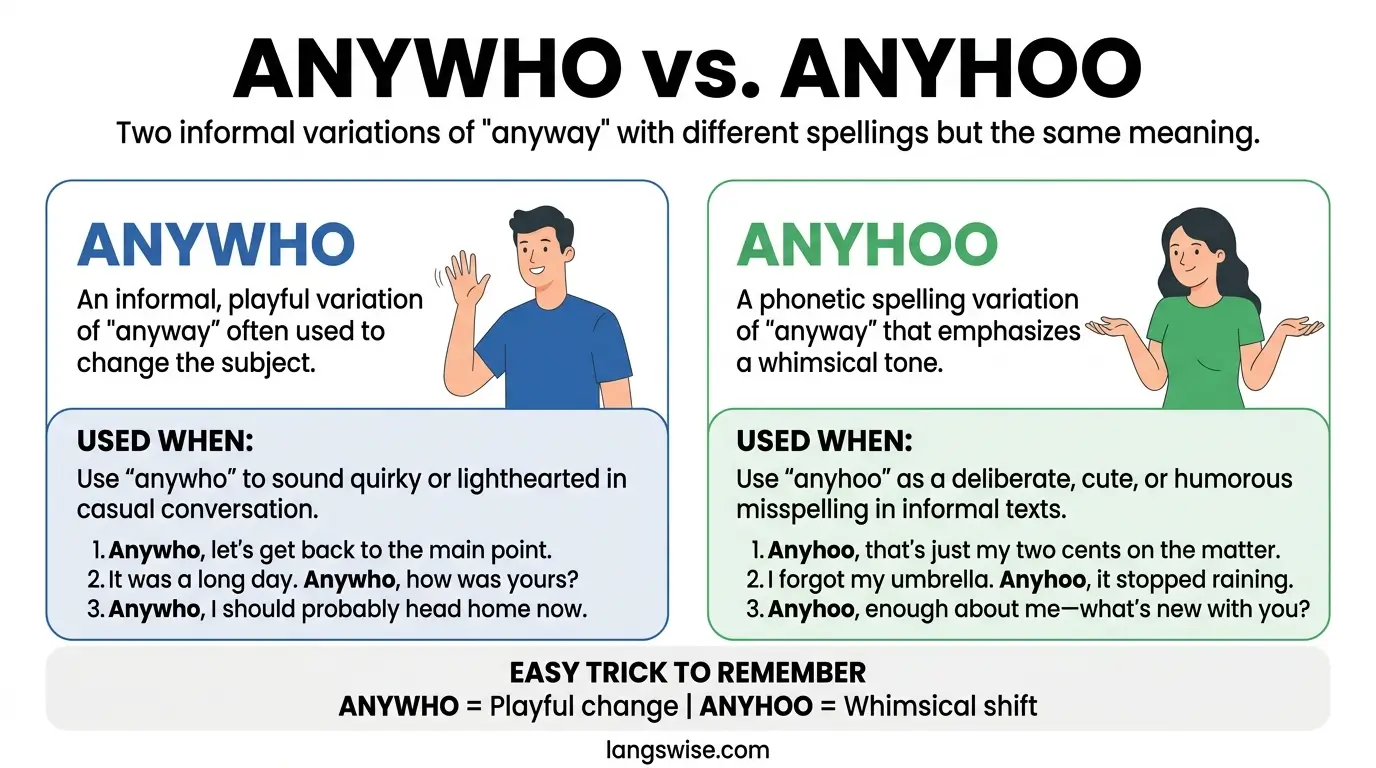
Have you ever typed “anywho” and wondered if “anyhoo” is the better spelling? You are not alone.
People often search for anywho or anyhoo because both forms appear in chats, social media, blogs, and casual speech. They sound almost the same, but their spelling can feel confusing.
The short answer is simple: anywho and anyhoo are both informal forms of anyhow. They can mean “anyway,” “in any case,” or “to return to the main point.”
Cambridge Dictionary lists anyhoo as an informal term, mainly used in US English, and notes anywho as another form.
However, neither spelling is the best choice for formal writing. If you are writing a business email, school paper, report, or professional article, anyhow or anyway is usually safer.
This guide explains anywho vs anyhoo, where the forms came from, which spelling works best in different English varieties, and how to use them naturally.
Anywho or Anyhoo Quick Answer
Anywho and anyhoo are informal, humorous forms of anyhow. They normally mean “anyway” or “in any case.”
Examples:
- Anywho, what were we talking about?
- Anyhoo, let’s get back to work.
- Anyhow, let’s get back to work.
All three sentences can express a similar idea.
The main difference is tone, not meaning.
| Variation | Meaning | Tone | Best use |
| anyhow | anyway; in any case | Standard | Formal and everyday writing |
| anywho | anyway; in any case | Informal, playful | Casual speech and online writing |
| anyhoo | anyway; in any case | Informal, humorous | Casual speech and playful writing |
| anyway | in any case; regardless | Standard | Almost all situations |
Merriam-Webster describes anyhoo as chiefly US, informal, and humorous, while listing anywho as a less common variant.
So, if you need a professional choice, use anyhow or anyway.
The Origin of Anywho or Anyhoo
The story starts with the standard word anyhow.
Anyhow comes from any + how. Historical sources date its use to the 18th century. Etymonline records anyhow from around 1740, while Merriam-Webster gives a first known use of 1678.
Over time, speakers began using playful versions of the word. Anyhoo is one such form.
Merriam-Webster says anyhoo probably began as a humorous adoption of the Scots and Ulster form onie-hoo anyhow. It records a first known use of anyhoo in 1850.
Other dictionaries give a later first-recorded date. Dictionary.com describes anyhoo as a humorous alteration of anyhow and dates its first recorded use to 1945–50.
This difference does not mean one source is wrong. Historical dictionaries can use different evidence and standards for what counts as the earliest recorded use.
Why Does “Anywho” Exist?
Anywho is another playful spelling.
The spelling may have been influenced by the familiar word who. Wiktionary describes anywho as an alternative spelling of anyhoo and notes that its spelling was influenced by who.
The American Heritage Dictionary also describes anywho and anyhoo as humorous alterations of anyhow.
In simple terms:
anyhow → anyhoo → anywho
These forms developed because people play with sounds and spelling in casual English.
British English vs American English Spelling
There is an important point here: anywho and anyhoo are not really British-versus-American spelling rules like “color” and “colour.”
They are informal variants.
Cambridge Dictionary labels anyhoo as informal and mainly US, while also listing anywho.
Collins similarly describes anyhoo as informal and says it is especially associated with US and Canadian English.
Comparison Table
| Feature | American English | British English |
| Anyhow | Standard | Standard |
| Anyway | Standard | Standard |
| Anyhoo | Informal, familiar | Understood, but informal |
| Anywho | Informal, playful | Understood, less standard |
| Formal writing | Use anyhow/anyway | Use anyhow/anyway |
| Casual conversation | All may appear | Anyhoo/anywho may appear |
The safest rule is simple:
Do not treat anywho and anyhoo as official US/UK spelling differences. Treat them as informal variants.
For formal international English, anyhow or anyway is the better choice.
Which Spelling Should You Use?
Your audience should decide.
For US readers
Anyhoo and anywho can sound natural in casual conversation, social media, blogs, and humorous writing. Cambridge specifically describes anyhoo as mainly US.
Example:
Anyhoo, what are we doing tonight?
For UK and Commonwealth readers
Both forms can be understood, but they are still informal. If you want neutral English, choose anyway or anyhow.
Example:
Anyway, let’s continue with the meeting.
For a global audience
Use anyway.
It is short, clear, familiar, and suitable across major varieties of English.
For professional writing
Avoid both anywho and anyhoo unless you are deliberately creating a relaxed or humorous voice.
Use:
- Anyway
- Anyhow
- In any case
- Regardless
For example:
Casual:
Anyhoo, let’s talk about the next step.
Professional:
Anyway, let’s discuss the next step.
More formal:
In any case, let’s discuss the next step.
Common Mistakes with Anywho or Anyhoo
Mistake 1: Treating “anyhoo” as a formal spelling
Anyhoo is a real dictionary word, but it is informal. Cambridge and Merriam-Webster both mark it as informal.
Better for formal writing:
Anyway, we should continue.
Mistake 2: Assuming “anywho” means “any person”
In some contexts, anywho can look like any + who, but when used as the informal adverb, it normally means anyhow/anyway.
Correct:
Anywho, let’s move on.
Meaning:
Anyway, let’s move on.
Mistake 3: Using both forms in the same formal document
Avoid switching between anywho and anyhoo without a reason.
For a consistent casual style, pick one.
For professional writing, use anyway or anyhow throughout.
Mistake 4: Thinking one is the only correct spelling
There is no need to call anywho simply “wrong.” Major dictionaries recognize it as a variant. Merriam-Webster lists anywho as a less common variant of anyhoo.
The better question is which form fits your audience and tone?
Anywho or Anyhoo in Everyday Examples
In Emails
For a friendly personal email:
Anyhoo, I hope you have a great weekend!
For a work email:
Anyway, I hope you have a great weekend.
The second version sounds more professional.
In News Writing
A journalist may use anyhoo when quoting a person or showing a casual voice. Merriam-Webster gives examples from news sources, including Yahoo News, NBC News, and The Guardian.
Example:
“Anyhoo, back to the main story…”
Here, the spelling helps show a casual voice.
On Social Media
These forms work well on social platforms because they sound relaxed.
Examples:
Anywho, here is what happened next.
Anyhoo, that was my weekend.
Anywho… moving on.
The choice can also show personality.
Anyhoo often feels more playful because the “hoo” ending highlights the sound.
In Formal Writing
Avoid:
Anyhoo, the results show a clear change.
Prefer:
The results show a clear change.
Or:
Anyway, the results show a clear change.
In academic and professional writing, removing the informal connector may be even better.
Anywho or Anyhoo Google Trends & Usage Data
People searching for anywho or anyhoo are usually trying to solve one of three problems:
- Which spelling is correct?
- What does the word mean?
- Is the word formal or informal?
Search interest can change by country and over time. Google Trends is useful for comparing search interest, but it measures relative search interest, not the total number of words people use.
For this reason, it is better not to claim that one spelling is universally “more popular” without checking a specific date range, country, and search category.
Dictionary evidence gives a clearer language picture. Cambridge labels anyhoo as mainly US and informal, while Merriam-Webster lists anywho as a less common variant.
Usage also depends on context:
- Professional writing: anyway and anyhow dominate.
- Casual writing: anywho and anyhoo can appear.
- Humorous writing: anyhoo can add a playful voice.
- Social media: either informal spelling can work.
- International English: anyway is usually the clearest option.
Anywho vs Anyhoo: Quick Comparison
| Word | Meaning | Formal? | Tone | Main use |
| Anywho | Anyway | No | Casual | Speech, chats, social media |
| Anyhoo | Anyway | No | Casual/playful | Humor, speech, social media |
| Anyhow | Anyway/in any case | Yes | Neutral | General and formal writing |
| Anyway | In any case/regardless | Yes | Neutral | General, business, academic writing |
The key point is that anywho and anyhoo are style choices, not formal spelling alternatives to any different meaning.
FAQs About Anywho or Anyhoo
Is “anywho” a real word?
Yes. Dictionaries recognize anywho as an informal variant associated with anyhoo and anyhow.
Is “anyhoo” a real word?
Yes. Anyhoo appears in major dictionaries. It is an informal and often humorous form of anyhow.
Which is correct: anywho or anyhoo?
Both can be correct when used as informal forms of anyhow. Anyhoo is the form more directly tied to the sound of anyhow, while anywho is another recognized variant.
Is anywho or anyhoo formal English?
No. Both are informal. For business, academic, or professional writing, anyway or anyhow is a better choice.
Is anyhoo mainly American English?
Yes. Cambridge describes it as informal and mainly US. Collins also associates it especially with US and Canadian English.
Does anyhoo mean anyway?
Yes. Anyhoo can mean “anyway” or “in any case.” It is also commonly used to change the subject or return to an earlier point.
Which word should I use in a professional email?
Use anyway, anyhow, or in any case.
For example:
Anyway, I will send the updated report tomorrow.
This is clearer and more professional than:
Anyhoo, I will send the updated report tomorrow.
Conclusion
The answer to “anywho or anyhoo” is simple: both are accepted informal forms of “anyhow.” They can mean “anyway,” “in any case,” or help a speaker move back to the main topic.
Anyhoo is especially associated with informal US English, while anywho is another recognized variant.
Major dictionaries list both forms, but they do not have the same status as standard words such as anyway and anyhow.
The best spelling depends on your audience. Use anywho or anyhoo for casual messages, humorous posts, friendly conversations, and informal creative writing. Use anyway or anyhow when you need clear, neutral English.
If you are writing for a global audience, anyway is usually the safest choice. It is familiar, simple, and works in both casual and professional contexts.
So, when you wonder “anywho or anyhoo?”, remember: both are playful variants. For formal writing, choose anyway or anyhow instead.
