

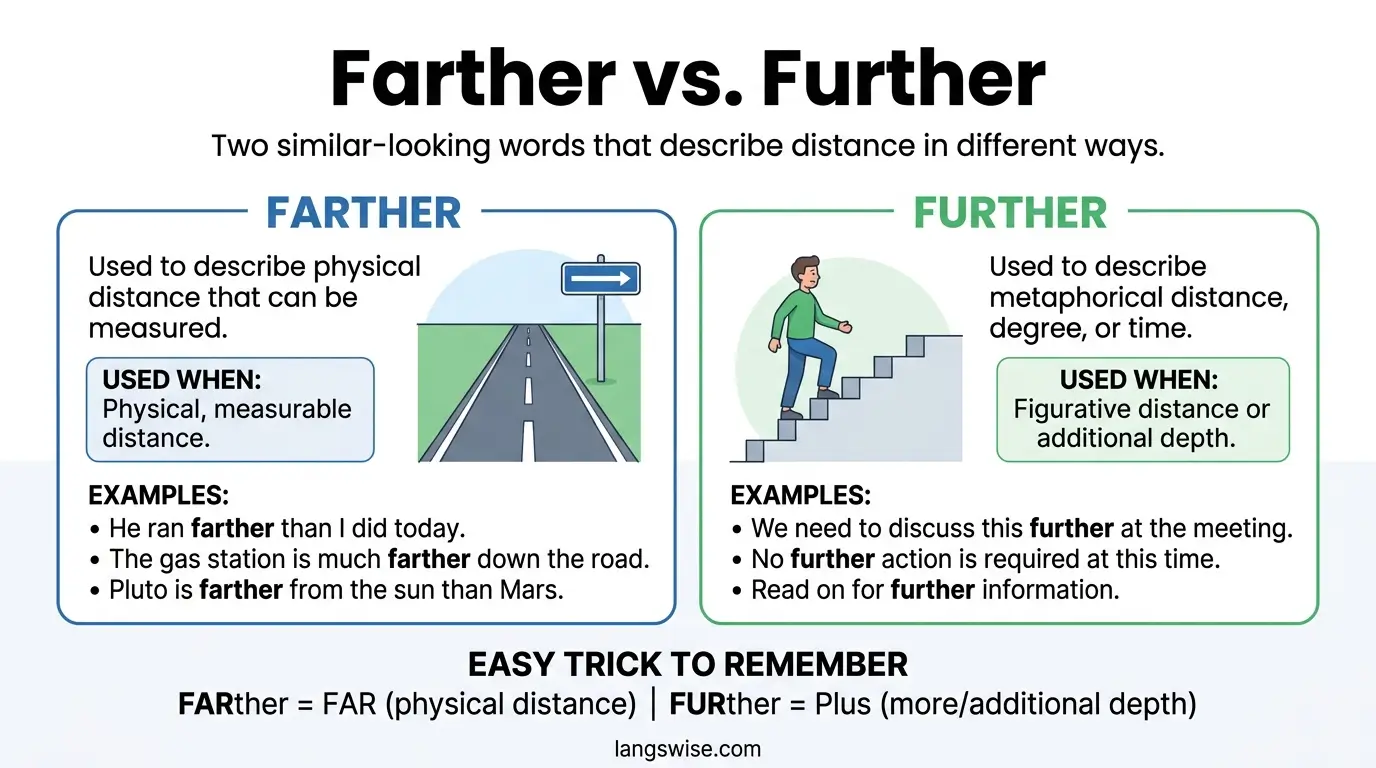
Have you ever typed “furthest or farthest” and stopped because you were not sure which word was correct? You are not alone. Both farthest and furthest are correct English words, and both are superlative forms of far.
The main confusion comes from differences between British and American English. In American English, farthest is often preferred for physical distance. In British English, furthest is more common and can be used for both physical and figurative meanings.
Oxford also notes that further and furthest are more common in British English, while farther and farthest are more common in North American English.
This guide explains furthest or farthest, including their meanings, history, spelling differences, common mistakes, and everyday examples. By the end, you will know which form to use in American, British, and international English.
Furthest or Farthest Quick Answer
Farthest and furthest are both correct.
They are superlative forms of far and mean “at, to, or covering the greatest distance.” Cambridge lists both forms as correct and says there is no difference in meaning when they describe distance.
Examples
- What is the farthest planet we can see?
- What is the furthest planet we can see?
- She ran the farthest in the race.
- She ran the furthest in the race.
Both versions can be correct.
A useful rule is:
- American English: farthest is often preferred for distance.
- British English: furthest is often more common.
- Figurative meaning: furthest is often preferred, especially in phrases about degree, progress, or extent.
For example:
The farthest village is 20 miles away.
This is the furthest we can go with the project.
The first example describes physical distance. The second describes progress or extent.
The Origin of Furthest or Farthest
The history of farthest and furthest is surprisingly old.
Both words developed from older forms of English used to describe distance and advancement. Historical records show forms of farthest in Middle English, including ferthest.
Collins traces farthest to Middle English ferthest, while the World English Historical Dictionary records older forms such as ferþest and ferdest.
Furthest also has a long history. Historical records show forms related to furthest from the Middle English period. The word developed alongside further, which itself has connections with older words meaning “forward” or “onward.”
Over time, English developed two related patterns:
- far → farther → farthest
- far → further → furthest
The two patterns have remained in modern English.
The spelling difference is not simply an American spelling versus a British spelling. Both forms have existed for centuries. However, modern regional usage developed different preferences. Oxford says further/furthest are more common in British English, while farther/farthest are more common in North American English.
British English vs American English Spelling
The biggest difference is frequency and preference, not correctness.
American English commonly uses farther and farthest for physical distance. British English commonly uses further and furthest for both physical and figurative distance.
| Meaning or use | American English | British English |
| Greatest physical distance | farthest | furthest often preferred |
| Greatest degree or extent | furthest | furthest |
| Comparative physical distance | farther | further often preferred |
| Additional information | further | further |
| Most advanced point | furthest | furthest |
| “The greatest distance” | farthest/furthest | furthest/farthest |
Examples
American English:
New York is the farthest I have traveled by car.
British English:
New York is the furthest I have travelled by car.
Both sentences are understandable and grammatically acceptable.
Cambridge notes that farthest and furthest have no difference in meaning when used for distance, although furthest is more common in its British English grammar guidance.
Which Spelling Should You Use?
Your audience should guide your choice.
If you write for Americans
Use farthest when talking about physical distance if you want to follow common American usage.
Example:
Alaska is one of the farthest places I have visited.
You can still use furthest, especially for figurative meanings.
If you write for the UK or Commonwealth
Furthest is a natural choice in British English.
Example:
That was the furthest we travelled during our holiday.
British English commonly favors further/furthest, while American English commonly favors farther/farthest for distance.
If you write for a global audience
Either form can work.
The most important thing is consistency. If your website uses American English, choose farthest more often for physical distance. If it uses British English, furthest may sound more natural.
For international SEO, you can also mention both terms naturally. This helps readers who search for either spelling.
Common Mistakes with Furthest or Farthest
Mistake 1: Thinking “furthest” is wrong
It is not wrong.
Furthest is a standard English word and is listed by major dictionaries.
Correct:
This is the furthest point we reached.
Mistake 2: Thinking “farthest” is only American
This is also incorrect.
Farthest is used in British English too. The difference is mainly one of frequency and preference.
Mistake 3: Using “farthest” for every meaning
For figurative meanings, furthest is often the better choice.
Better:
We need to investigate this further.
This idea takes the argument furthest.
Mistake 4: Confusing “farthest” with “farther”
Remember:
- farther/further = comparative
- farthest/furthest = superlative
For example:
John ran farther than Mark.
John ran the farthest of everyone.
Mistake 5: Assuming one form is always correct
English usage depends on region and context.
Both farthest and furthest are valid. Your audience and meaning should guide your choice.
Furthest or Farthest in Everyday Examples
In emails
Physical distance:
This location is the farthest branch from our main office.
Additional information:
Please contact me if you need any further information.
Notice that further information is standard. Farthest information would not work here.
In news writing
News articles may use either form depending on the publication’s style.
Example:
Scientists have reached the farthest point of their research expedition.
Or:
Scientists have reached the furthest point of their research expedition.
Both can describe the greatest physical distance.
On social media
Informal writing often uses furthest:
This is the furthest I’ve ever traveled!
American users may also naturally write:
This is the farthest I’ve ever traveled!
Both are clear.
In formal writing
Choose the form that matches your variety of English.
American English:
The spacecraft traveled to the farthest point of its planned route.
British English:
The spacecraft travelled to the furthest point of its planned route.
For abstract ideas, furthest is usually more natural:
The study takes the discussion furthest by examining the long-term effects.
Furthest or Farthest Google Trends & Usage Data
Google Trends can help show relative search interest, but it should not be treated as a dictionary or grammar authority. Google Trends compares search interest over time and by location rather than giving an exact count of all searches.
For “furthest or farthest,” the search itself reflects a common grammar question: users want to know whether the two forms are different, whether one is American or British, and which one they should use.
Usage also varies by region.
| Region | Common preference | Typical context |
| United States | farthest | Physical distance |
| Canada | farther/farthest common | Distance |
| United Kingdom | further/furthest common | Distance and figurative use |
| Australia | further/furthest common | General English |
| New Zealand | further/furthest common | General English |
| International English | Both | Depends on style |
Oxford specifically identifies a North American preference for farther/farthest and a British preference for further/furthest.
Cambridge likewise states that furthest is more common in its British English guidance, while both forms are correct.
Important SEO point
People may search for:
- furthest or farthest
- farthest or furthest
- is furthest correct?
- is farthest correct?
- furthest vs farthest
- farther vs further
- farthest meaning
- furthest meaning
Using these related phrases naturally can help an article meet different search intents without repeating the same keyword too often.
Furthest or Farthest: Comparison Table
| Word | Grammar | Main meaning | Common preference |
| far | Base form | At a great distance | Universal |
| farther | Comparative | At a greater distance | North American English |
| further | Comparative | At a greater distance or to a greater extent | British English; also general use |
| farthest | Superlative | At the greatest distance | North American English |
| furthest | Superlative | At the greatest distance or greatest extent | British English; common globally |
The important point is that farthest and furthest are not different spellings of two unrelated words. They are alternative superlative forms associated with far.
FAQs About Furthest or Farthest
Is “furthest” or “farthest” correct?
Both are correct. Farthest and furthest are superlative forms of far. Regional usage affects which one sounds more natural.
Is “farthest” American or British?
Farthest is used in both American and British English. However, American English tends to favor farthest for physical distance, while British English more often uses furthest.
Is “furthest” British English?
Furthest is especially common in British English, but it is not limited to Britain. It is also used in American English and other varieties of English.
Which is better: “furthest” or “farthest”?
Neither is universally better. Use farthest if you are following common American usage for physical distance. Use furthest if you are following British usage or are talking about degree or extent.
What is the difference between “farther” and “further”?
Both can mean a greater distance. Further also has meanings such as “additional” or “to a greater extent.”
For example:
How much farther is the airport?
Do you need any further information?
Cambridge confirms that further has uses that farther does not, including the meaning “additional.”
What is the superlative of “far”?
The common superlative forms are farthest and furthest.
The related comparative forms are farther and further.
Can I use “furthest” for physical distance?
Yes. Furthest can describe physical distance.
Example:
That is the furthest village we can reach today.
Cambridge and Oxford both recognize this use.
Conclusion
So, furthest or farthest? The simple answer is that both are correct.
Farthest and furthest are superlative forms of far. They can both describe the greatest distance. The main difference is regional preference and context.
American English often prefers farthest for physical distance. British English commonly prefers furthest, and furthest is also widely used for figurative meanings such as degree, progress, and extent.
If you write for an American audience, farthest is a safe choice when discussing physical distance. If you write for a British or Commonwealth audience, furthest will often sound more natural.
Do not worry if you see both forms. Neither is automatically wrong. Instead, consider your audience, meaning, and regional style. Most importantly, keep your writing consistent.
When in doubt, remember this simple guide: farthest is common for physical distance in American English, while furthest is common in British English and works well for both distance and figurative meaning.

Langswise explains English grammar, spelling and vocabulary in simple, practical guides.