

Have you ever typed “piece or peice” and stopped to wonder which spelling is right? You are not alone. This is a common spelling question because piece and peice contain the same letters, but the i and e are easy to reverse.
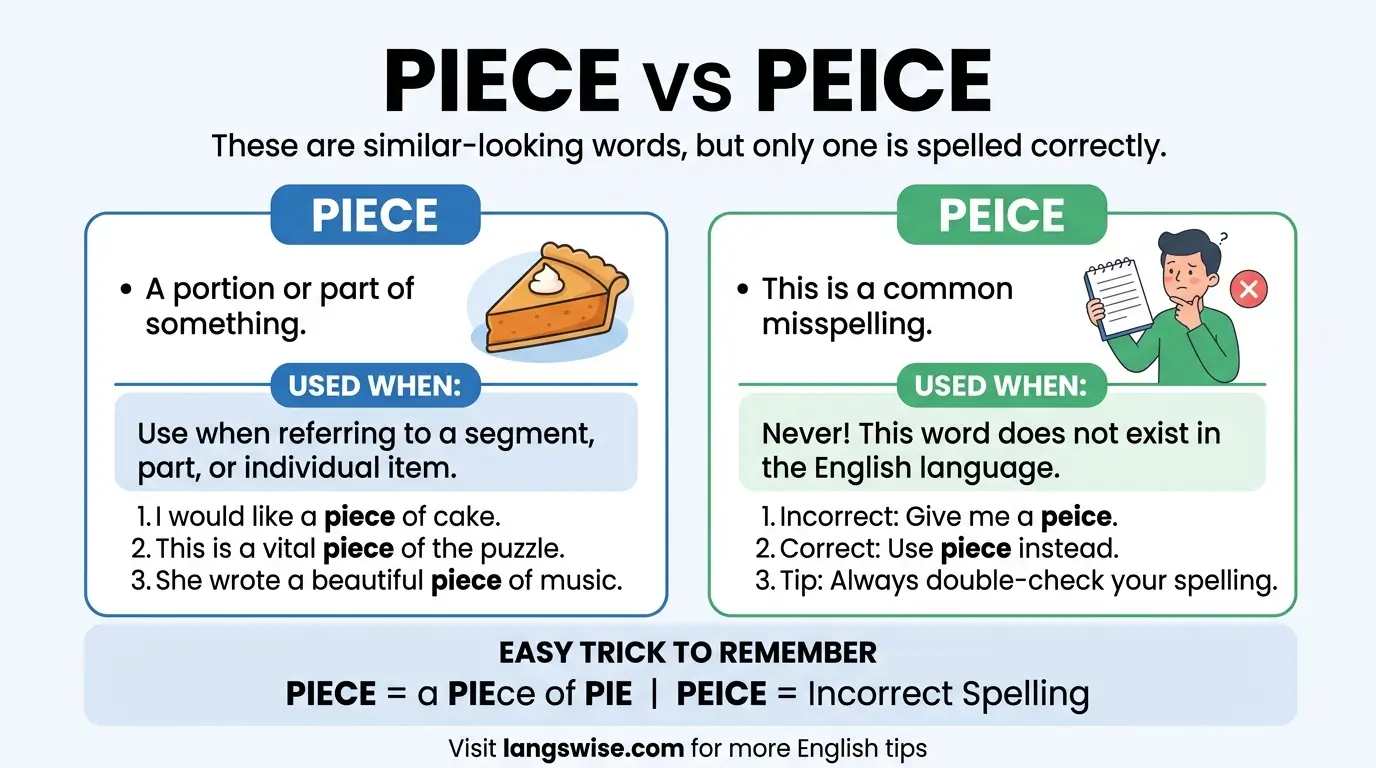
The answer is simple: piece is the correct spelling in standard English. Peice is a misspelling. There is no separate British or American spelling rule that makes “peice” correct.
People often search for this keyword when writing emails, school assignments, social media posts, articles, or professional documents. They may also want to know whether “peice” is an accepted alternative spelling or simply a typing mistake.
This guide explains the correct spelling, meaning, history, British and American usage, common mistakes, examples, and search behavior. It also gives you an easy way to remember the spelling.
If you only need the quick answer, remember this:
P-I-E-C-E = correct.
P-E-I-C-E = incorrect.
Piece or Peice Quick Answer
Piece is the correct spelling.
Peice is a common spelling mistake and should not be used in standard English.
Examples:
- Correct: “I ate a piece of cake.”
- Correct: “She wrote a beautiful piece of music.”
- Incorrect: “I ate a peice of cake.”
- Incorrect: “She wrote a beautiful peice of music.”
The word piece can mean a part of something, an item, a portion, or a work of art, music, or writing. Dictionaries also record other meanings, including a chess piece and a coin.
Quick comparison
| Spelling | Correct? | Use |
| piece | Yes | Standard English |
| peice | No | Common spelling error |
| pieces | Yes | Plural of piece |
| pieced | Yes | Past tense of piece |
| piecing | Yes | Present participle |
Easy memory trick
Think of PIE inside PIECE:
PIE + CE = PIECE
If you remember “a pie is in a piece,” it becomes easier to place i before e in this word.
The Origin of Piece or Peice
The word piece has a long history. It entered Middle English from Old French piece, which came from Medieval or Vulgar Latin forms such as pettia. Its deeper origin is uncertain, although some sources connect it with Celtic words meaning “thing” or “piece.”
The word was already being used in English around the early 13th century. Early meanings included a portion, part, or fragment of something. Over time, its meaning expanded.
Today, piece can refer to:
- A part of something
- A portion of food
- An individual item
- A work of writing
- A work of music
- A work of art
- A chess piece
- A coin
- A piece of furniture
Historical English also contained forms such as pece, peece, and peice. This helps explain why the letters may sometimes appear in different orders in older texts. However, modern standard English uses piece.
The spelling peice that people use today is generally not an accepted modern variant. It is usually the result of reversing i and e.
British English vs American English Spelling
There is no British-versus-American spelling difference between piece and peice.
Both British English and American English use:
piece
For example:
- British English: “I need a piece of paper.”
- American English: “I need a piece of paper.”
The spelling stays the same.
This is different from words such as:
- colour / color
- centre / center
- organise / organize
Those words can have recognized regional spelling differences. Piece does not.
Comparison table
| Feature | British English | American English |
| Correct spelling | piece | piece |
| Incorrect spelling | peice | peice |
| Pronunciation | /piːs/ | /piːs/ |
| Plural | pieces | pieces |
| Past tense | pieced | pieced |
| Present participle | piecing | piecing |
Cambridge gives the pronunciation as /piːs/ and lists meanings such as a part, item, and work created by an artist or writer.
So, whether your audience is in London, New York, Toronto, Sydney, or elsewhere, piece is the standard spelling.
Which Spelling Should You Use?
Use piece in every form of standard English.
If you write for a US audience
Use piece.
Example:
“Please send me a piece of the report.”
If you write for a UK or Commonwealth audience
Use piece.
Example:
“She bought a piece of furniture.”
If you write for a global audience
Use piece.
This is especially important for:
- Websites
- Business emails
- Academic writing
- CVs and résumés
- News articles
- Product descriptions
- Social media
- Schoolwork
There is no need to change piece to peice for a particular country.
Common Mistakes with Piece or Peice
1. Writing “peice”
Wrong: “I need one peice of paper.”
Correct: “I need one piece of paper.”
This is the most direct spelling error.
2. Reversing “ie”
People often remember the sound but not the letter order.
Wrong: peice
Correct: piece
A useful memory aid is:
PIE + CE = PIECE
3. Confusing “piece” and “peace”
These words sound alike but have different meanings.
- piece = a part or portion
- peace = a state without conflict
Example:
“I want a piece of cake.”
But:
“They hope to live in peace.”
4. Writing “piece of mind”
This is another common mistake.
If you mean a calm or worry-free mental state, write:
peace of mind
Example:
“The insurance gives me peace of mind.”
If you literally mean a part of someone’s mind, piece of mind could have a different meaning, but that is uncommon.
5. Confusing singular and plural
Singular:
“I bought one piece.”
Plural:
“I bought three pieces.”
Piece or Peice in Everyday Examples
The word piece appears in many types of writing.
In emails
“Please send me a piece of the information you discussed.”
A more natural version may be:
“Please send me the information you discussed.”
But when referring to a physical part or individual item, piece works naturally.
In news writing
“The newspaper published a new piece about the local economy.”
Here, piece can mean an article or written work. Dictionaries recognize this use for literary and journalistic compositions.
In social media
“This is my favorite piece of art.”
Or:
“I finally finished this piece!”
In formal writing
“The researcher published a detailed piece on language development.”
In everyday speech
“Can I have a piece of cake?”
“I found a piece of glass on the floor.”
“She gave me a piece of advice.”
Notice the common phrase:
a piece of advice
Not:
an advice
Piece or Peice Google Trends & Usage Data
People searching “piece or peice” are usually trying to solve a spelling problem. Search interest can come from students, English learners, writers, editors, and people checking a word before publishing it.
However, exact Google Trends numbers can change by date, country, search type, and selected comparison terms. Google Trends also reports relative search interest, not a direct count of searches.
The broader word piece has far more uses than the spelling question itself. It can refer to parts, objects, food portions, artwork, music, writing, chess, coins, and other meanings.
Search interest for spelling questions is therefore best understood as language-help intent, rather than evidence that “peice” is an accepted spelling.
Typical search contexts
| Search context | Likely intent |
| “piece or peice” | Check correct spelling |
| “how to spell piece” | Spelling help |
| “piece meaning” | Vocabulary definition |
| “piece pronunciation” | Pronunciation help |
| “piece vs peace” | Meaning and usage difference |
| “piece of mind or peace of mind” | Common phrase correction |
Search results for this spelling question commonly focus on correcting peice to piece, while dictionary sources consistently list piece as the standard word.
Piece Variations Side by Side
| Variation | Status | Example |
| piece | Correct | “A piece of cake.” |
| peice | Incorrect | Avoid this spelling. |
| pieces | Correct plural | “Three pieces of paper.” |
| pieced | Correct | “She pieced the parts together.” |
| piecing | Correct | “He is piecing the puzzle together.” |
| peace | Different word | “We want peace.” |
The key point is simple: peice is not a British spelling, American spelling, or accepted modern alternative to piece.
FAQs About Piece or Peice
Is “piece” or “peice” correct?
Piece is correct. Peice is a spelling mistake.
Is “peice” a British spelling?
No. British English uses piece, just like American English.
How do you spell piece?
Spell it:
P-I-E-C-E
Why do people spell piece as peice?
The most common reason is that the i and e are reversed. The two spellings look very similar, so the error is easy to make.
Is “piece” pronounced like “peace”?
Yes. Piece and peace are normally pronounced /piːs/. They are homophones, but their meanings and spellings are different.
What is the plural of piece?
The plural is pieces.
Example:
“She broke the cookie into two pieces.”
Is “piece of mind” correct?
Usually, no. If you mean freedom from worry, the correct phrase is peace of mind.
Conclusion
The answer to “piece or peice” is straightforward: piece is the correct spelling in standard English. Peice is a common spelling mistake caused by reversing the i and e.
The spelling does not change between British and American English. Whether you are writing for readers in the United States, United Kingdom, Canada, Australia, or another English-speaking region, use piece.
The word itself has a long history. It came into English through Old French and earlier Latin forms and has developed many meanings over the centuries. Today, it can describe a part, portion, object, article, artwork, musical composition, chess figure, coin, and more.
For an easy memory trick, remember PIE + CE = PIECE. If you are writing an email, assignment, article, social post, or professional document, choose piece.
Most importantly, do not treat peice as a regional spelling. It is simply an error in modern standard English.

Langswise explains English grammar, spelling and vocabulary in simple, practical guides.