

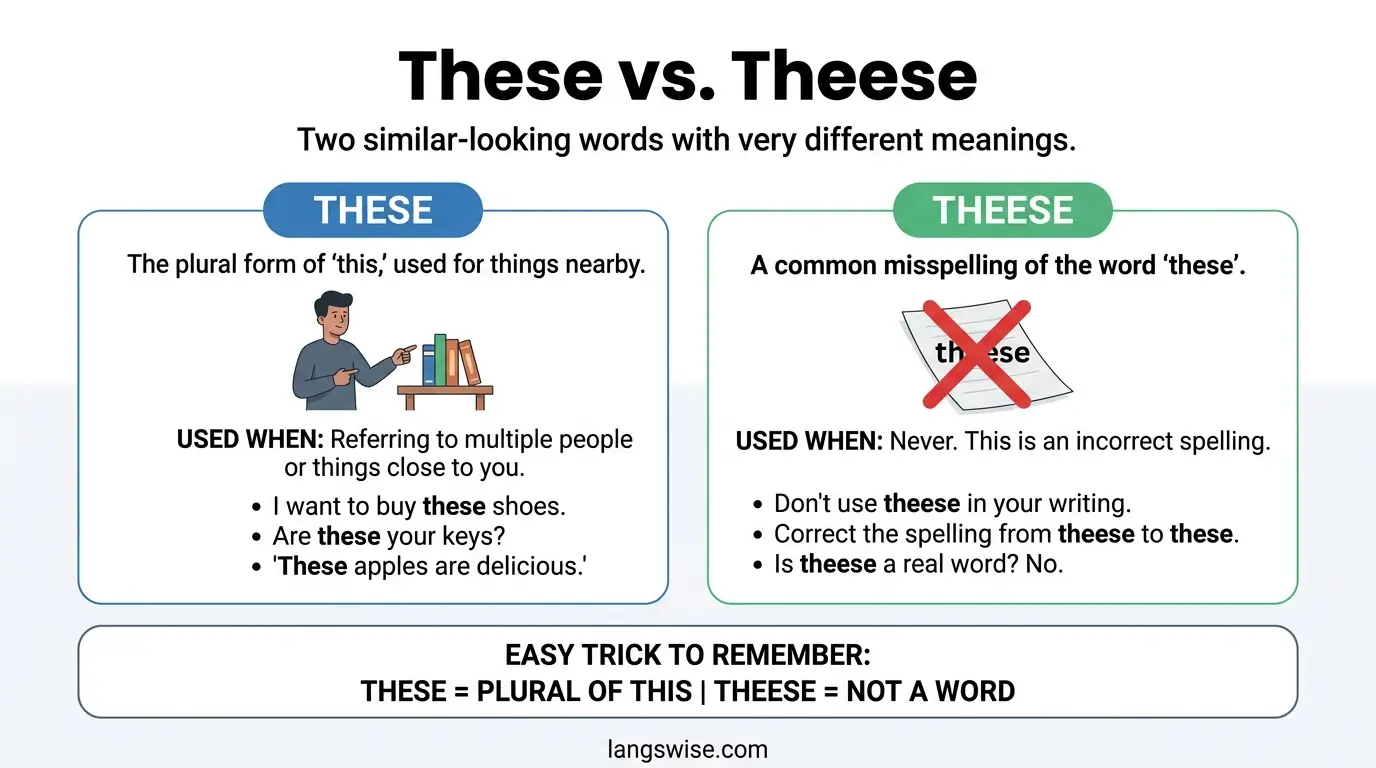
Have you ever typed “theese” and wondered if it is correct? You are not alone. Many English learners and native speakers search for “theese or these” because the two spellings can sound very similar when spoken. The extra e feels natural, especially because English has many words with double vowels.
The good news is simple: “these” is the correct spelling. “Theese” is a misspelling.
This small spelling question matters because “these” is a very common word. You may use it in emails, school assignments, business writing, social media posts, and everyday messages. A spelling error can make otherwise clear writing look less polished.
In this guide, you will learn why these is correct, where the word comes from, whether British and American English spell it differently, and how to avoid the common “theese” mistake. You will also see practical examples, a spelling comparison table, usage information, and answers to common questions.
If you need a quick answer, remember this: these = correct; theese = incorrect.
Theese or These Quick Answer
The correct spelling is these.
Theese is not the standard spelling of the word.
| Spelling | Correct? | Example |
| these | ✅ Yes | These books are mine. |
| theese | ❌ No | Theese books are mine. |
These is the plural form of this. It can work as a demonstrative determiner or pronoun.
Examples:
- These shoes are new.
- These are my keys.
- I like these flowers.
- Can you read these instructions?
A simple memory trick is to connect this and these. Both use one e in the spelling pattern.
The pronunciation can cause confusion. These is commonly pronounced /ðiːz/, which sounds like it has a long “ee” sound. This may lead people to add another e when spelling it. However, standard English spells the word these, not theese.
The Origin of Theese or These
The correct word these has a long history in English.
Modern English developed from earlier forms of English, including Old English. Historical forms related to these include Old English demonstrative forms such as þās and þēs. Over time, spelling and pronunciation changed as English developed.
The spelling these became established in English. It is related to the demonstrative system that also gives us words such as:
- this
- that
- these
- those
The extra e in theese is not a modern British or American spelling choice. It is generally a spelling error.
Interestingly, historical English was not always consistent. Older texts contain different spellings. The Dictionary of the Older Scottish Tongue, for example, records historical forms such as theese, theis, thes, and others. A historical spelling, however, does not make theese the standard spelling in modern English.
So, if you are writing modern English today, use these.
British English vs American English Spelling
There is no British-American spelling difference between these and theese.
Both British English and American English use:
these
The word has the same standard spelling in both varieties.
Some English words do have different British and American spellings. For example:
| Meaning | British English | American English |
| Colour | colour | color |
| Centre | centre | center |
| Organise | organise | organize |
| Travelling | travelling | traveling |
| Correct demonstrative | these | these |
So, unlike colour/color or centre/center, you do not need to choose between British these and American these.
Comparison Table: Theese vs These
| Variation | Standard English? | Meaning | Recommended use |
| these | ✅ Yes | Plural form of “this” | Use it everywhere |
| theese | ❌ No | Usually a misspelling of “these” | Avoid it |
| this | ✅ Yes | Singular form | Use for one item |
| those | ✅ Yes | Plural, usually referring to things farther away | Use when appropriate |
For example:
- This book is interesting.
- These books are interesting.
- That book is over there.
- Those books are over there.
Which Spelling Should You Use?
Use these regardless of whether you write for a US, UK, Canadian, Australian, or international audience.
For US readers
Use:
These results are important.
Not:
Theese results are important.
For UK and Commonwealth readers
Use:
These documents are ready.
Not:
Theese documents are ready.
For a global audience
Use these. It is the standard spelling across major varieties of modern English.
This makes the choice easy. You do not need to check which English variety your reader uses. The spelling these works in all standard forms of English.
If you are writing professionally, academic writing, business emails, website content, or applications, always use these.
Common Mistakes with Theese or These
The most common mistake is adding an extra e:
❌ Theese are my notes.
✅ These are my notes.
Another mistake is confusing these with this.
❌ These book is useful.
✅ This book is useful.
Use this for one thing:
This book is useful.
Use these for more than one:
These books are useful.
You can also confuse these with those.
These usually points to people or things that are close or currently being discussed.
These shoes are mine.
Those usually points to people or things that are farther away.
Those shoes are yours.
Quick correction guide
| Incorrect | Correct |
| Theese are my books. | These are my books. |
| I like theese shoes. | I like these shoes. |
| Theese ideas are useful. | These ideas are useful. |
| Can you check theese files? | Can you check these files? |
| Theese results look good. | These results look good. |
A useful spelling trick is to remember that these already has the long “ee” sound. You do not need to add another e.
Theese or These in Everyday Examples
The word these appears in many types of writing.
In emails
Please review these documents before the meeting.
I have attached these files for your reference.
In business writing
These changes will improve the customer experience.
These results support the main findings.
In news writing
These new figures show a change in consumer behavior.
In social media
These photos are from our weekend trip.
I love these new features!
In formal writing
These findings suggest that further research is needed.
In everyday conversation
Can you pass me these books?
These are my friends.
The word can appear before a plural noun:
these books
these people
these ideas
these problems
It can also stand alone as a pronoun:
These are expensive.
I want these.
Theese or These Google Trends & Usage Data
People searching “theese or these” are usually looking for spelling help rather than choosing between two standard English words.
This is an important distinction. These is a standard English word, while theese is generally treated as an incorrect spelling in modern standard English. Spelling websites commonly identify these as correct and theese as incorrect.
Google Trends measures search interest, not the number of times people use a word correctly in writing. Therefore, a search for “theese or these” should be understood as a spelling-query signal, not proof that “theese” is common standard English.
Search interest can also come from different contexts:
- English learners checking spelling
- Students checking homework
- Writers proofreading text
- People using spell-check searches
- Non-native English speakers
- Users who hear these and are unsure how to spell it
Country-level search interest can change over time and depends on the exact Google Trends settings, date range, language, and search type. For that reason, fixed claims such as “country X uses theese more than country Y” should not be made without a specific current Trends dataset.
The practical conclusion is much simpler: search interest in “theese or these” reflects spelling confusion, while “these” is the standard form used in modern English.
Theese or These: Side-by-Side Comparison
| Feature | These | Theese |
| Correct modern spelling | ✅ Yes | ❌ No |
| Standard English word | ✅ Yes | ❌ No |
| Plural of “this” | ✅ Yes | ❌ No |
| Used in British English | ✅ Yes | ❌ No |
| Used in American English | ✅ Yes | ❌ No |
| Suitable for formal writing | ✅ Yes | ❌ No |
| Common reason for confusion | Long “ee” sound | Extra “e” added because of pronunciation |
FAQs About Theese or These
Is “theese” a correct word?
No. Theese is not the standard modern spelling. The correct spelling is these.
Is it “theese” or “these”?
It is these.
Example:
These are my shoes.
Why do people spell “these” as “theese”?
The pronunciation can cause confusion. These has a long “ee” sound, so some people may expect two e letters. However, the standard spelling uses only one e in the middle.
Is “theese” used in British English?
No. Modern standard British English uses these.
Is “theese” used in American English?
No. Standard American English also uses these.
What is the plural of “this”?
The plural of this is these.
- This book.
- These books.
What is the difference between “these” and “those”?
These usually refers to things that are close or currently being discussed.
These books are on my desk.
Those usually refers to things that are farther away.
Those books are on the other desk.
Is “these” a pronoun?
Yes. These can be used as a demonstrative pronoun.
These are mine.
It can also work as a determiner before a noun:
These books are mine.
Is “these” the same in UK and US English?
Yes. The standard spelling is these in both British and American English.
How can I remember the spelling of “these”?
Connect it with this:
this → these
Remember: these has one e, not two.
Conclusion: Theese or These?
If you are wondering whether to write “theese” or “these,” the answer is clear: these is the correct spelling.
These is the plural form of this. It can refer to several people, objects, ideas, or things that are close or already being discussed. It can also work as a pronoun, as in “These are mine.”
The spelling does not change between British and American English. Writers in the UK, US, Canada, Australia, and other English-speaking regions use these in standard modern English.
The main reason for the mistake is likely pronunciation. These contains a long “ee” sound, which can make theese seem logical. However, adding the second e creates a misspelling.
For schoolwork, emails, business documents, websites, social media, and formal writing, always choose these.
The easiest rule is:
These = correct.
Theese = incorrect.
When in doubt, remember the pair this → these. That simple pattern will help you spell the word correctly every time.

Langswise explains English grammar, spelling and vocabulary in simple, practical guides.