

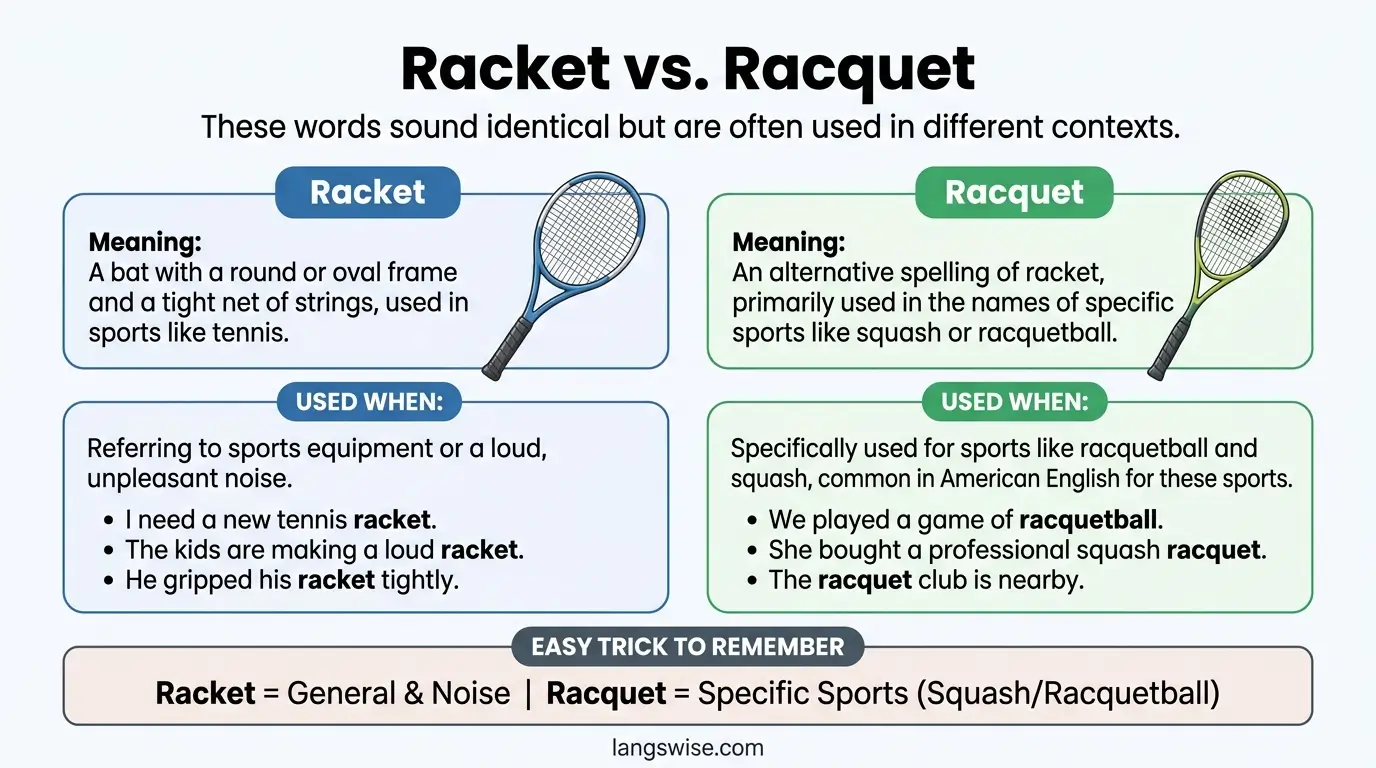
If you have ever typed “racket or racquet” into Google, you are not alone. Both spellings are correct, but they are used in different ways. This small spelling difference often causes confusion for tennis, badminton, squash, and other sports fans.
The word refers to the sports tool used to hit a ball or shuttlecock. In most cases, racket is the standard spelling in modern English. Racquet is also correct, but it is less common and often appears in sports-related names, traditional usage, or contexts linked to tennis and racquet sports.
So, why are there two spellings? The answer comes from the word’s long history and changes in English spelling. British and American English also developed different preferences.
This guide explains racket vs racquet in simple terms. You will learn where each spelling comes from, when to use it, common mistakes, regional differences, and real-life examples. By the end, you will know which spelling works best for your audience and writing style.
Racket or Racquet Quick Answer
Racket and racquet are both correct spellings.
- Racket is the more common modern spelling.
- Racquet is an accepted variant, especially in sports contexts.
- In American English, racket is widely used.
- In British English, racket is also common.
- Racquet often appears in phrases such as racquet sports or in the names of clubs and organizations.
Quick examples
I bought a new tennis racket.
She plays racquet sports.
He broke his racket during the match.
The key point is simple: you do not need to treat “racquet” as a spelling mistake.
Racket vs Racquet: At a Glance
| Variation | Correct? | Common use |
| racket | Yes | General and modern use |
| racquet | Yes | Sports and traditional use |
| tennis racket | Yes | Very common |
| tennis racquet | Yes | Also correct |
| badminton racket | Yes | Very common |
| badminton racquet | Yes | Also correct |
| racquet sports | Yes | Common sports term |
The Origin of Racket or Racquet
The history of racket and racquet is not completely simple. English adopted the word through European languages, and its exact early path is debated.
The modern word is linked to terms used for a frame with strings or a similar sports instrument. Over time, English speakers used several spellings, including forms similar to racquet and racket.
The spelling racquet was influenced by French spelling. English often borrowed words from French and kept or adapted French-looking forms.
The simpler spelling racket became widely established in English. It also developed another meaning: a loud or unpleasant noise.
For example:
The children were making a terrible racket.
This second meaning has nothing to do with tennis equipment.
The two spellings therefore survived together. Modern English allows both, although racket is generally the more common everyday spelling.
British English vs American English Spelling
There is no strict rule that says British English must use racket and American English must use racquet, or vice versa.
In fact, racket is widely used in both varieties of English.
Racquet is also used in both, especially in sports-related writing.
| Feature | British English | American English |
| Common spelling | racket | racket |
| Alternative | racquet | racquet |
| Tennis equipment | tennis racket | tennis racket |
| Sports term | racquet sports | racquet sports |
| General recommendation | racket | racket |
Examples
British English:
I need a new tennis racket.
American English:
I need a new tennis racket.
Both sentences are natural.
The important difference is not really British vs American spelling. Instead, it is often about context, style, and personal or organizational preference.
Comparison Table: Racket Variations
| Term | Meaning | Correct? | Typical context |
| racket | Sports equipment | Yes | General writing |
| racquet | Sports equipment | Yes | Sports writing |
| tennis racket | Tennis equipment | Yes | Everyday use |
| tennis racquet | Tennis equipment | Yes | Sports writing |
| racquet sport | Sport played with a racket | Yes | Formal/sports context |
| racket sport | Same general meaning | Yes | General English |
Which Spelling Should You Use?
For most readers, racket is the safest choice.
For a US audience
Use racket unless a particular sports organization, brand, or publication prefers racquet.
Example:
The player bought a new tennis racket.
For a UK or Commonwealth audience
Racket is also a clear and standard choice.
Example:
She left her badminton racket at home.
For sports websites
Either spelling can work. The best choice is consistency.
If your website uses racquet sports throughout, keep that spelling across headings, articles, product pages, and menus.
For SEO
If people search for both racket and racquet, you can naturally use both terms. Avoid forcing the alternative spelling into every sentence.
For example:
A tennis racket, also called a tennis racquet, is used to hit the ball.
This covers both search terms while keeping the sentence natural.
Common Mistakes with Racket or Racquet
Mistake 1: Thinking “racquet” is wrong
Incorrect assumption:
Racquet is a spelling error.
Correction:
Racquet is a valid spelling.
Mistake 2: Thinking “racket” is only British English
This is also incorrect.
Racket is widely used in American English too.
Mistake 3: Mixing spellings without reason
For example:
I bought a new racket. My racquet has a broken string.
There is nothing grammatically wrong here, but switching spellings without a reason can make professional writing look inconsistent.
Choose one form and use it consistently.
Mistake 4: Confusing “racket” with “racquet”
They can refer to the same sports equipment, but racket has another common meaning.
The street was full of noise and racket.
Here, racket means loud noise, not sports equipment.
Mistake 5: Assuming every sport uses the same terminology
Different sports and organizations may have their own style preferences. Always check the terminology used by the relevant governing body, brand, or publication when accuracy matters.
Racket or Racquet in Everyday Examples
In an email
Please remember to bring your tennis racket to practice tomorrow.
In sports news
The player changed rackets during the match.
On social media
New racket day! Ready for the weekend match.
In formal writing
The study examined how racket weight affects player performance.
In a product description
This lightweight tennis racket is designed for beginners and intermediate players.
In a sports article
Choosing the right racquet can improve comfort and control during play.
These examples show that both spellings can work. The most important rule is to match your chosen spelling to your audience and keep it consistent.
Racket or Racquet Google Trends & Usage Data
Search interest for racket and racquet can change by country, sport, and search intent.
In general, racket has broader everyday use because it has two major meanings:
- Sports equipment.
- A loud or unpleasant noise.
Racquet is more strongly connected with sports.
This creates an important SEO difference.
Someone searching for “racket” may mean tennis equipment. They may also be searching for the word’s other meaning.
Someone searching for “racquet” is more likely to have a sports-related meaning.
Search behavior can also vary between countries. Sports organizations, retailers, newspapers, and local traditions can influence which spelling people use.
For SEO, it is useful to include both forms naturally:
Racket or racquet both refer to the equipment used in sports such as tennis, badminton, and squash.
Rather than repeating both spellings too often, focus on useful content and natural language. Search engines can understand closely related spelling variations.
Racket vs Racquet: Side-by-Side Comparison
| Point | Racket | Racquet |
| Correct spelling | Yes | Yes |
| Sports meaning | Yes | Yes |
| Common in everyday English | Very common | Less common |
| Used in US English | Yes | Yes |
| Used in UK English | Yes | Yes |
| Used in tennis | Yes | Yes |
| Used in badminton | Yes | Yes |
| Used in squash | Yes | Yes |
| Used for “loud noise” | Yes | No |
| Good general SEO term | Yes | Useful variant |
FAQs About Racket or Racquet
Is “racket” or “racquet” correct?
Both are correct. Racket is the more common general spelling, while racquet is often used in sports contexts.
Is “racquet” British or American?
It is used in both British and American English. It is not exclusive to either variety.
Which is correct: tennis racket or tennis racquet?
Both are correct. Tennis racket is the more common general form, while tennis racquet is also widely understood.
Should I use racket or racquet for SEO?
Use racket as your main term if it fits your audience, and include racquet naturally as a related spelling. Do not keyword-stuff.
Is “badminton racquet” correct?
Yes. Badminton racquet is a valid phrase. Badminton racket is also correct.
Does “racket” have another meaning?
Yes. Racket can also mean a loud, unpleasant, or confusing noise.
Example:
The construction work made a lot of racket.
Should I use one spelling consistently?
Yes. In professional writing, consistency is usually better than switching between racket and racquet without a clear reason.
Conclusion
The question “racket or racquet?” has a simple answer: both spellings are correct. The main difference is usage and context, not correctness.
Racket is the more common general spelling. It works well in everyday English, sports writing, product descriptions, websites, and casual communication. It is also the word used for the separate meaning of loud noise.
Racquet is also correct. You will often see it in sports-related terms, club names, organization names, and traditional sports writing. It can refer to the same equipment as a racket.
For most writers, racket is the safest default. If your audience, publication, sports organization, or brand uses racquet, follow that style instead. The most important professional rule is consistency.
For SEO, you can target both racket and racquet naturally. Explain the relationship between the terms rather than repeating both spellings unnecessarily. That approach gives readers a clear answer while covering the different ways people search for this common sports term.

Langswise explains English grammar, spelling and vocabulary in simple, practical guides.