

Have you ever typed “weary or wary” and stopped because both words look right? You are not alone. These two words are easy to mix up because they look and sound similar. But they have very different meanings.
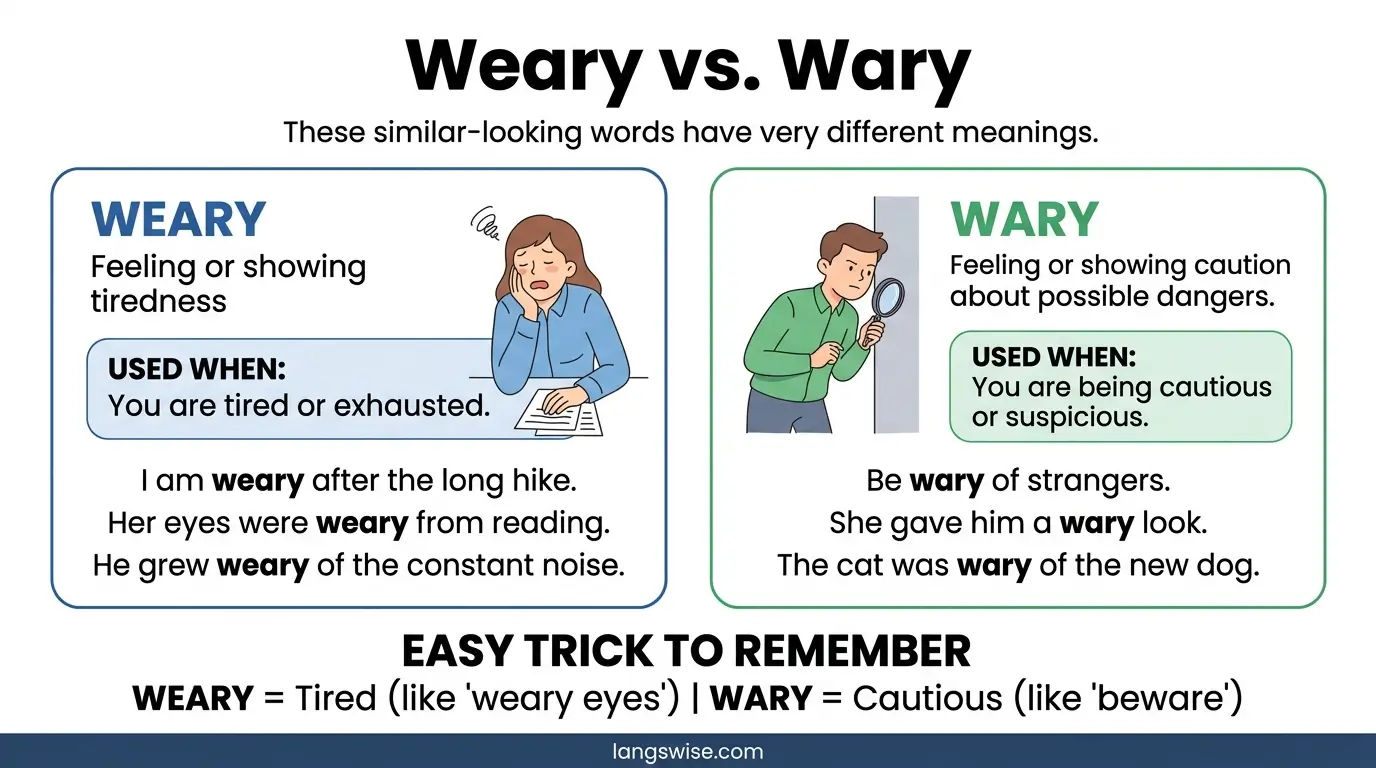
Weary means tired, exhausted, or worn out. Wary means careful, cautious, or alert to danger. So, you can be weary after a long day, but you can be wary of a risky offer.
People often search for “weary or wary” because spell-check does not always catch the mistake. Both words are correct English words. The problem is choosing the wrong word for the meaning you want.
This guide explains the difference between weary and wary in simple terms. You will learn where each word came from, whether British and American English spell them differently, how to avoid common errors, and which word to use in everyday writing.
Weary or Wary Quick Answer
Weary = tired or exhausted.
Wary = cautious or careful.
The easiest way to remember them is:
- Weary → worn out
- Wary → watchful
Examples
After walking all day, I felt weary.
The person is tired.
I am wary of websites that ask for too much personal information.
The person is cautious.
Here is another useful pair:
She grew weary of the constant complaints.
She became tired or annoyed by them.
She grew wary of the new business offer.
She became suspicious or cautious about it.
The words are not different British and American spellings. They are two separate words with different meanings.
The Origin of Weary or Wary
Weary is the older word.
It comes from Old English wērig, meaning tired or weary. It entered English more than a thousand years ago. Merriam-Webster records its first known use as before the 12th century.
Wary appeared much later. It comes from the older word ware, which was related to being aware or careful. Merriam-Webster dates its first known use to the 15th century.
Their similar spelling is one reason people confuse them. However, they do not share the same basic meaning or history.
| Word | Basic meaning | Historical source |
| weary | Tired or exhausted | Old English wērig |
| wary | Careful or cautious | ware + -y |
The difference is also easy to see in related words. Weariness means a state of tiredness. Warily means in a cautious way.
British English vs American English Spelling
There is an important point to remember: weary and wary are spelled the same in British and American English.
They are not like:
- colour / color
- organise / organize
- centre / center
There is no British spelling of weary that becomes wary, or vice versa.
The spelling stays the same. The meaning changes.
British vs American comparison
| Word | British English | American English | Meaning |
| weary | weary | weary | Tired or exhausted |
| wary | wary | wary | Careful or cautious |
| wearier | wearier | wearier | More tired |
| weariest | weariest | weariest | Most tired |
| warier | warier | warier | More cautious |
| wariest | wariest | wariest | Most cautious |
English teaching resources also list wary = cautious and weary = tired as commonly confused words.
Weary vs wary at a glance
| Feature | Weary | Wary |
| Meaning | Tired, exhausted | Cautious, alert |
| Part of speech | Adjective and verb | Adjective |
| Example | I am weary after work. | I am wary of the offer. |
| Related noun | weariness | wariness |
| US spelling | weary | wary |
| UK spelling | weary | wary |
Which Spelling Should You Use?
The answer depends on meaning, not location.
For US English
Use weary when you mean tired:
The workers were weary after the long shift.
Use wary when you mean cautious:
Investors are wary of the sudden change.
For UK and Commonwealth English
Use the same spellings:
The hikers were weary after the climb.
She was wary of the unfamiliar website.
The same rule applies in Canada, Australia, New Zealand, and other major English-speaking regions.
For global English
If your audience is international, focus on meaning.
Ask yourself:
“Am I talking about tiredness?”
If yes, use weary.
“Am I talking about caution or suspicion?”
If yes, use wary.
This rule works in business writing, academic writing, emails, social media, and everyday speech.
Common Mistakes with Weary or Wary
The most common mistake is using weary when the writer means wary.
Mistake 1
❌ I am weary of online scams.
This sounds like you are tired of online scams.
✅ I am wary of online scams.
This means you are cautious about them.
Mistake 2
❌ She was wary after the long journey.
If you mean she was tired, use weary.
✅ She was weary after the long journey.
Mistake 3
❌ The company is weary of financial risks.
If the meaning is caution, use wary.
✅ The company is wary of financial risks.
Mistake 4: Thinking one is a British spelling
❌ “Weary is British, while wary is American.”
This is incorrect.
Both words are used in both forms of English.
Mistake 5: Trusting spell-check
Spell-check may not catch this error because both weary and wary are correctly spelled words. The problem is meaning, not spelling.
Weary or Wary in Everyday Examples
In emails
Weary:
After several hours of meetings, the team was weary and ready to finish for the day.
Wary:
Please be wary of unexpected payment requests.
In news writing
Weary:
Residents grew weary after months of disruption.
Wary:
Investors remain wary of further market changes.
On social media
Weary:
I am so weary after traveling all day.
Wary:
Be wary of fake accounts asking for money.
In formal writing
Weary:
The prolonged dispute left both sides weary.
Wary:
Consumers remain wary of products with unclear claims.
In conversation
“You look weary.”
This means:
You look tired.
“You should be wary.”
This means:
You should be careful.
Weary or Wary Google Trends & Usage Data
Search interest in “weary or wary” reflects a common word-choice problem rather than a difference in regional spelling.
Searches usually come from people trying to decide which word fits a sentence. This makes the phrase especially useful for grammar websites, English-learning resources, editors, teachers, and content writers.
Usage examples also show that both words remain active in modern English. Dictionary sources continue to define weary as tired or exhausted and wary as cautious or on guard.
Online discussions also show that people still confuse the two words, especially when wary is intended but weary is written.
Usage by context
| Context | More likely word | Example |
| Physical tiredness | weary | Weary travelers arrived late. |
| Emotional exhaustion | weary | She grew weary of the argument. |
| Suspicion | wary | He was wary of the offer. |
| Danger | wary | Be wary of the loose step. |
| Business risk | wary | Investors are wary of uncertainty. |
| Long work | weary | The workers were weary after overtime. |
The key point is that usage depends on meaning and context, not British or American spelling.
Weary vs Wary: Comparison Table
| Weary | Wary | |
| Simple meaning | Tired | Careful |
| Main idea | Lack of energy | Awareness of danger |
| Pronunciation | Usually “WEER-ee” | Usually “WAIR-ee” |
| Example | I feel weary. | I feel wary. |
| Common phrase | weary of waiting | wary of strangers |
| Related word | weariness | wariness |
| Can be a verb? | Yes | No |
| British spelling | weary | wary |
| American spelling | weary | wary |
| Memory clue | Worn out | Watchful |
Frequently Asked Questions
What is the difference between weary and wary?
Weary means tired, exhausted, or worn out. Wary means cautious, careful, or alert to possible danger.
Is weary the British spelling of wary?
No. This is a common misunderstanding. Weary and wary are separate words, and both spellings are used in British and American English.
Is wary the American spelling of weary?
No. American English uses both wary and weary. The correct choice depends on the meaning.
Is it “weary of” or “wary of”?
Both phrases are correct, but they mean different things.
Weary of = tired or annoyed by something.
I am weary of waiting.
Wary of = cautious or suspicious about something.
I am wary of the offer.
How can I remember weary and wary?
Think:
Weary = worn out.
Wary = watchful.
If you are tired, choose weary. If you are careful, choose wary.
Can weary be a verb?
Yes. Weary can be a verb meaning to make or become tired.
The long journey wearied the children.
Wary is an adjective, not a standard verb.
Why do people confuse weary and wary?
They look and sound similar, and both can describe a person’s feelings or attitude. The similar sounds of wary and leery can add to the confusion.
Conclusion
The difference between weary and wary is simple once you connect each word with its meaning.
Weary means tired, exhausted, or worn out. You can feel weary after a long trip, a hard day’s work, or a stressful experience.
Wary means cautious, careful, or alert. You can be wary of a stranger, a suspicious email, a risky investment, or an unsafe situation.
The two words are not British and American spelling variants. Both weary and wary are spelled the same in British and American English. The real issue is choosing the word that matches your meaning.
For a quick memory trick, think weary = worn out and wary = watchful. If you mean tired, choose weary. If you mean careful or suspicious, choose wary.
Once you learn this simple difference, you can use both words confidently in emails, professional writing, news content, academic work, and everyday conversation.
