

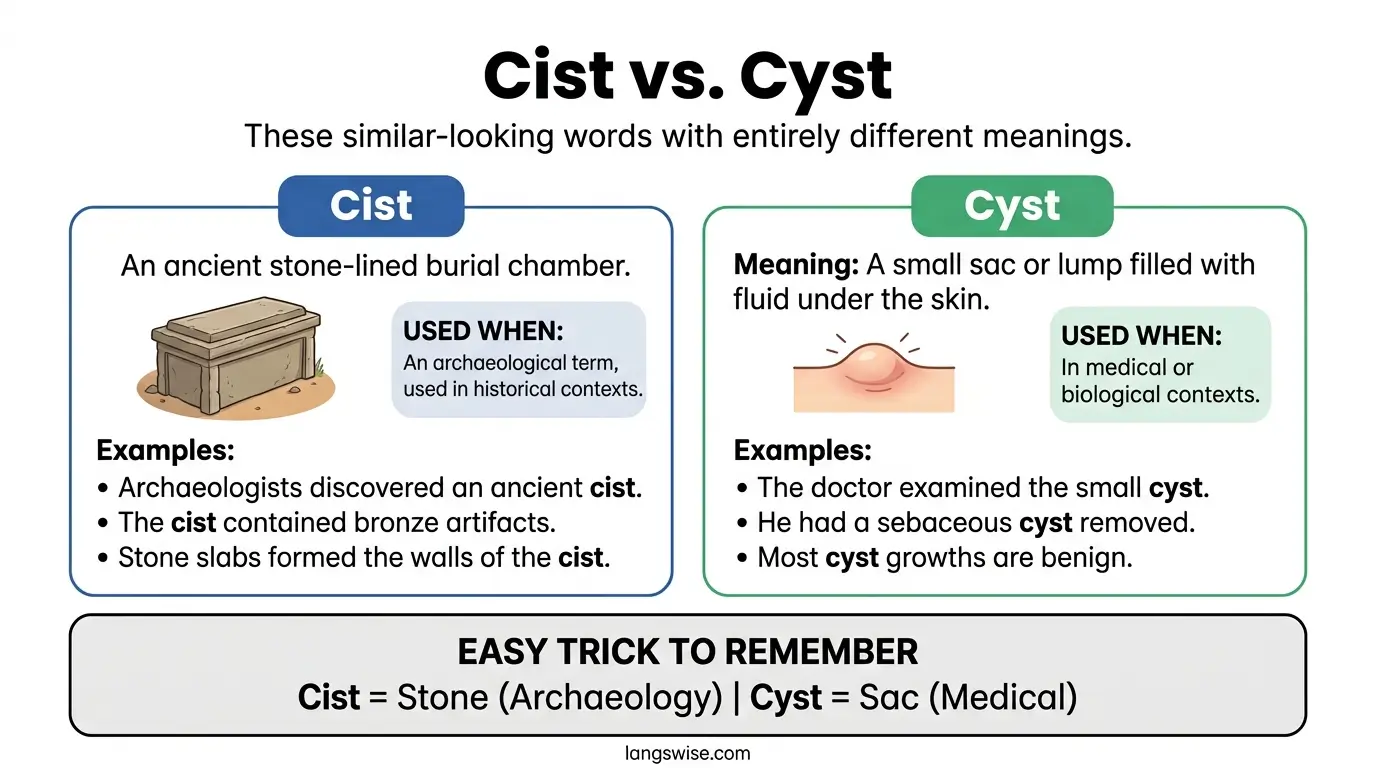
If you have ever typed “cist or cyst” into Google, you are not alone. These two words look almost the same and sound alike in common English. Yet they do not mean the same thing.
The confusion often appears when people write about a lump, sac, skin problem, ovarian growth, or another medical condition.
In these cases, the correct word is almost always cyst. A cyst is a closed, sac-like pocket that can contain fluid, air, pus, or other material.
The word cist is real, but it has a very different meaning. It is a specialist word used mainly in archaeology and history. A cist can describe an ancient stone burial chamber or a box used for sacred objects.
This guide explains cist or cyst, their origins, correct usage, common mistakes, and the spelling you should choose in professional writing.
Cist or Cyst Quick Answer
Cyst is the correct spelling when you mean a medical or biological sac or pocket in the body.
Examples:
- “The doctor found a cyst on my skin.”
- “An ovarian cyst can contain fluid.”
- “The scan showed a small cyst.”
- “Most simple cysts are benign.”
Cist is a different word. It usually refers to an ancient burial chamber or stone-lined tomb.
Example:
- “Archaeologists discovered a Bronze Age cist.”
So, if you are talking about a medical condition, use “cyst.” If you are talking about an ancient burial structure, “cist” may be correct.
Cist vs Cyst at a Glance
| Word | Main meaning | Common field | Example |
| cyst | A closed sac or pocket in the body | Medicine, biology | “The scan found a cyst.” |
| cist | An ancient burial chamber or container | Archaeology, history | “They found a stone cist.” |
| cystic | Relating to a cyst | Medicine | “The mass has cystic features.” |
| cists | Plural of cist | Archaeology | “Several cists were found.” |
| cysts | Plural of cyst | Medicine | “The patient has two cysts.” |
The Origin of Cist or Cyst
The words cist and cyst have different histories, although their stories are connected through very old words for containers and body sacs.
Cist entered English from older words connected with Latin cista, meaning a box, chest, or basket. The Latin word came from Greek kistē, also meaning a box or chest. In archaeology, cist developed as a term for a stone-built burial chamber or similar container.
The medical word cyst has a different direct history. It comes through Latin cystis from Greek kystis, meaning a bladder or sac. This sense fits its modern medical meaning: a closed sac or pocket in the body.
The similarity between the words is therefore not simply a British-versus-American spelling issue. Both words are linked to old ideas of containers or sacs, but modern English uses them for different meanings.
This is why changing the letter i to y can change the meaning completely.
British English vs American English Spelling
A common mistake is to assume that cist is British English and cyst is American English.
That is not correct.
Both British and American English use cyst for the medical term. Dictionaries in both varieties define cist as a separate historical or archaeological word.
Cambridge, for example, defines cist as a stone structure or container used in ancient times to bury bodies or bones.
Comparison Table
| Meaning | British English | American English |
| Medical sac or pocket | cyst | cyst |
| Ovarian growth | ovarian cyst | ovarian cyst |
| Skin growth | cyst | cyst |
| Ancient burial chamber | cist | cist |
| Archaeological stone tomb | cist | cist |
| Plural of cyst | cysts | cysts |
| Plural of cist | cists | cists |
There can be pronunciation differences for cist, especially in American English, where dictionaries give both /sɪst/ and /kɪst/ in some entries. Cyst, however, is normally pronounced /sɪst/.
The Main Rule
Do not choose cist or cyst based on whether your audience uses British or American English.
Choose the word based on meaning.
Which Spelling Should You Use?
For most readers, the answer is simple:
For medical writing: use “cyst”
Use cyst when discussing:
- ovarian cysts
- breast cysts
- skin cysts
- kidney cysts
- liver cysts
- pancreatic cysts
- dental cysts
- cysts in other organs or tissues
For example:
“The ultrasound showed a small ovarian cyst.”
Medical sources use cyst for this meaning. Mayo Clinic describes ovarian cysts as sacs, usually filled with fluid, that form in or on an ovary.
For archaeology: use “cist”
Use cist when writing about an ancient burial structure or historical container.
For example:
“Archaeologists uncovered a stone cist.”
Cambridge and Collins both use cist for this archaeological meaning.
For a global audience
If your website serves readers around the world, cyst is the word to use for medical content. Do not change it to cist for British readers.
This distinction is especially important for health websites, medical blogs, clinics, and educational content.
Common Mistakes with Cist or Cyst
Mistake 1: Writing “cist” for a medical condition
Incorrect:
“The doctor found a cist.”
Correct:
“The doctor found a cyst.”
Why? A medical sac or pocket is called a cyst.
Mistake 2: Assuming “cist” is the British spelling
Incorrect:
“Cist is British English, while cyst is American English.”
Correct:
“Cyst is used for the medical term in both British and American English.”
Mistake 3: Using “cyst” for an ancient burial chamber
Incorrect:
“The archaeologist found an ancient cyst.”
Correct:
“The archaeologist found an ancient cist.”
Mistake 4: Confusing plural forms
The plural of cyst is cysts.
The plural of cist is cists.
Examples:
- “The patient has several cysts.”
- “The site contains several ancient cists.”
Mistake 5: Treating the words as interchangeable
They are not interchangeable.
Cyst usually belongs to medical or biological writing.
Cist belongs mainly to archaeology and history.
Cist or Cyst in Everyday Examples
Seeing the words in context makes the difference easier to remember.
In an email
Medical:
“My doctor said the cyst is small and should be monitored.”
Archaeology:
“The museum team will discuss the newly discovered stone cist.”
In a news article
Medical:
“Doctors found a cyst during a routine scan.”
Archaeological:
“Researchers uncovered an ancient cist at the excavation site.”
On social media
Medical:
“I learned today that a cyst can form in many parts of the body.”
Archaeological:
“Amazing discovery of an ancient cist during the excavation!”
In formal writing
Medical:
“The imaging test identified a fluid-filled cyst.”
Archaeological:
“The excavation revealed a stone-lined cist believed to date from the prehistoric period.”
In academic writing
Medical:
“The patient presented with a benign cyst.”
Archaeological:
“The burial was placed inside a stone-built cist.”
The surrounding words usually make the intended meaning clear.
Cist or Cyst Google Trends & Usage Data
Search interest can be misleading for this keyword because cyst and cist represent very different subjects.
The word cyst has a broad medical meaning. People search for it when they want information about symptoms, diagnosis, treatment, ovarian cysts, skin cysts, breast cysts, and other health concerns. Medical sources describe cysts as sac-like pockets that can occur in many parts of the body.
The word cist has a much narrower use. It is mainly connected with archaeology, ancient burials, history, and ancient containers.
For SEO, this creates an important distinction:
| Search term | Main search intent | Typical context |
| cyst | Medical information | Health, symptoms, diagnosis |
| cist | Historical definition | Archaeology, ancient graves |
| cist or cyst | Spelling clarification | Grammar, vocabulary, search intent |
| cyst meaning | Definition | Medical education |
| cist meaning | Definition | Archaeology and history |
Google Trends reports relative search interest rather than a fixed number of searches. Therefore, trends can change by country, date range, and search category.
For a website targeting “cist or cyst,” the strongest SEO opportunity is to answer the spelling question directly and then explain the two different meanings.
The practical takeaway is simple: cyst has much broader everyday and medical relevance, while cist is a specialist historical term.
Cist vs Cyst: Side-by-Side Comparison
| Feature | Cist | Cyst |
| Spelling | c-i-s-t | c-y-s-t |
| Pronunciation | Usually “sist”; some dictionaries also list “kist” | “sist” |
| Main meaning | Ancient container or burial chamber | Closed sac or pocket |
| Common field | Archaeology and history | Medicine and biology |
| Medical use | No, in the usual modern sense | Yes |
| Archaeological use | Yes | No |
| Example | “A stone cist was discovered.” | “A cyst was found on the scan.” |
| Plural | cists | cysts |
| British spelling | cist | cyst |
| American spelling | cist | cyst |
FAQs About Cist or Cyst
Is “cist” a correct word?
Yes. Cist is a real English word. It is mainly used for an ancient box, container, or burial chamber, especially in archaeological writing.
Is “cist” the correct spelling of a medical cyst?
No. The medical word is cyst.
For example, write:
“The patient has an ovarian cyst.”
Do not write:
“The patient has an ovarian cist.”
Is “cyst” British or American English?
Cyst is used in both British and American English. It is not an American-only spelling.
What is the difference between cist and cyst?
A cyst is a sac-like pocket in the body or another biological structure. A cist is mainly an archaeological or historical container or burial chamber.
Are cist and cyst pronounced the same?
Usually, cyst is pronounced “sist.” Cist is also commonly pronounced “sist,” although some dictionaries list “kist” as an alternative pronunciation in certain varieties of English.
What is the plural of cyst?
The plural of cyst is cysts.
Example:
“The scan showed two small cysts.”
What is the plural of cist?
The plural of cist is cists.
Example:
“Several cists were found at the archaeological site.”
Why do people search for “cist or cyst”?
People often search this phrase because the two words look and sound very similar. Medical writers may also type cist by mistake when they mean cyst.
The search is useful because it reveals an important point: the words are not alternative spellings of the same medical term.
Conclusion
The answer to “cist or cyst” depends on what you mean. If you are talking about a medical sac, pocket, or growth, the correct spelling is cyst.
This spelling is used in both British and American English. A cyst can contain fluid, air, pus, or other material and can appear in many parts of the body.
Cist is also a valid English word, but it has a different meaning. It is mainly used in archaeology and history for an ancient stone burial chamber, tomb, or container.
So, do not treat cist and cyst as British and American spelling variants. They are separate words with separate meanings.
For medical websites, health articles, emails, schoolwork, and general writing about the body, choose cyst. Use cist only when the context is historical or archaeological.
The easiest rule to remember is: medical = cyst; ancient burial chamber = cist.
