

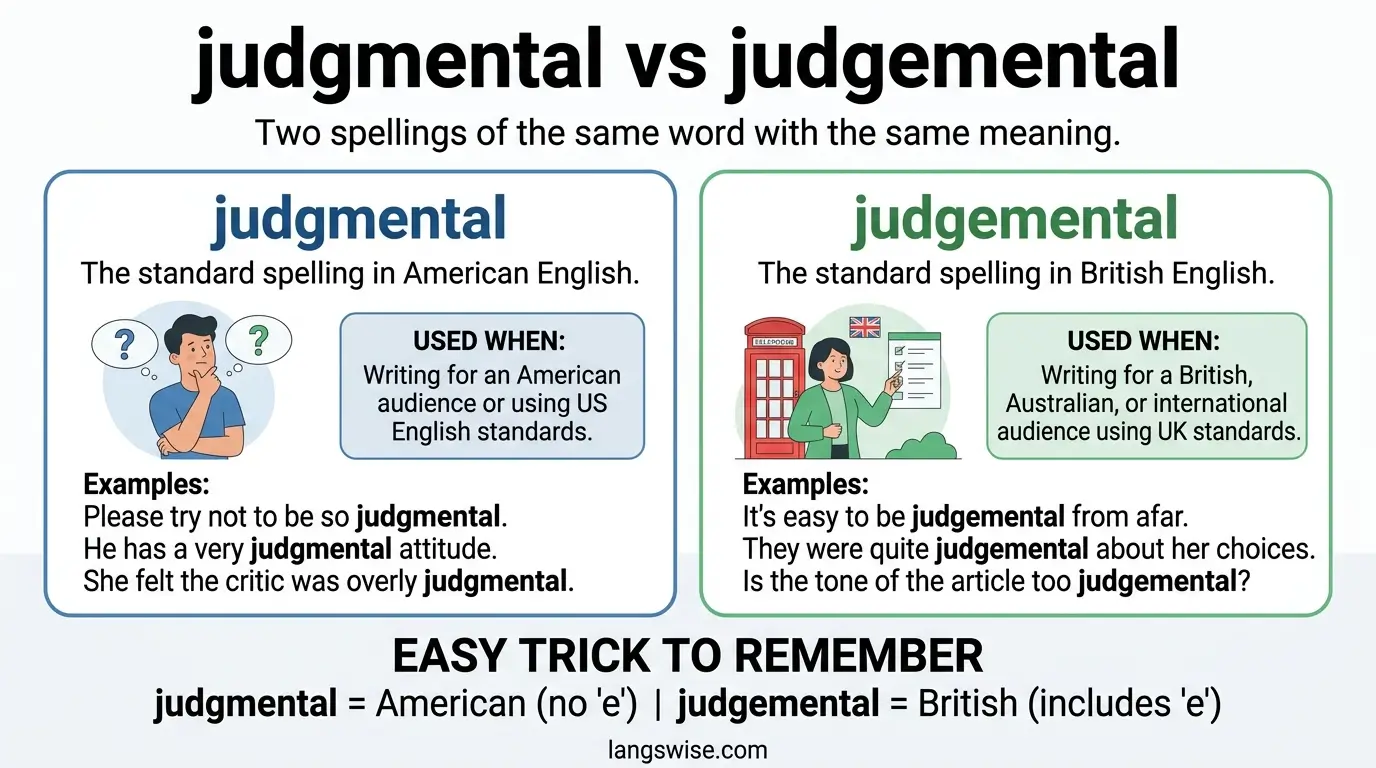
Is it judgmental or judgemental? If you have ever typed this word and paused before pressing “send,” you are not alone. Both spellings appear in books, websites, emails, newspapers, and social media. This makes the choice seem harder than it is.
The good news is simple: both “judgmental” and “judgemental” are correct. The main difference is regional. American English normally uses judgmental, while British English commonly uses judgemental.
Major dictionaries, including Cambridge and Oxford, recognize the two forms, with Oxford listing judgemental as especially British and judgmental as especially North American.
People search for this keyword because spelling tools may prefer one version, while websites or books use another. The confusion often comes from the related words judgment and judgement.
This guide gives you the quick answer first. It then explains the history, regional spelling rules, common mistakes, everyday examples, usage trends, and the best choice for professional writing.
Judgmental or Judgemental Quick Answer
Both spellings are correct.
- Judgmental — preferred in American English.
- Judgemental — common in British English.
- Both have the same meaning.
- Both have the same basic pronunciation.
Examples:
- US English: She can be very judgmental about other people’s choices.
- UK English: She can be very judgemental about other people’s choices.
The word means too quick to criticize or form negative opinions about people. Cambridge defines it as being too quick to criticize people.
A simple rule is:
Use “judgmental” for US English and “judgemental” for UK English.
If you are writing for a mixed international audience, judgmental is a practical choice because it is widely used in international digital content.
The Origin of Judgmental or Judgemental
The word judgmental comes from the noun judgment, with the suffix -al. Merriam-Webster gives the first known use of judgmental as 1834.
The deeper history goes back to the word judge, which entered English through Old French and ultimately has Latin roots connected with judging and deciding.
The spelling difference comes mainly from the noun:
- judgment → judgmental
- judgement → judgemental
British English traditionally keeps the e in judgement. American English normally drops it and uses judgment.
This is part of a larger pattern in English. American English often uses shorter spellings, while British English sometimes keeps older forms.
For example:
| American English | British English |
| judgment | judgement |
| acknowledgment | acknowledgement |
| color | colour |
| honor | honour |
However, do not assume that every British spelling simply adds an extra letter. English spelling has many separate historical rules.
The important point is that judgmental and judgemental are spelling variants, not different words. Collins also lists judgemental as a British form of judgmental.
British English vs American English Spelling
The biggest difference is regional preference.
American English
American English normally uses:
- judgment
- judgmental
- judgmentally
- nonjudgmental
For example:
The manager tried not to sound judgmental.
Merriam-Webster lists judgmental as its standard headword.
British English
British English commonly uses:
- judgement
- judgemental
- judgementally
- non-judgemental
For example:
The manager tried not to sound judgemental.
Oxford lists judgemental as especially British and notes judgmental as the North American form.
Comparison Table
| Feature | American English | British English |
| Noun | judgment | judgement |
| Adjective | judgmental | judgemental |
| Adverb | judgmentally | judgementally |
| Opposite | nonjudgmental | non-judgemental |
| Main preference | No e | With e |
| Example | He sounds judgmental. | He sounds judgemental. |
The difference does not change the meaning.
Which Spelling Should You Use?
Your audience should decide.
For a US audience
Use judgmental.
This is the safest choice for:
- American schools
- US businesses
- US newspapers
- American academic writing
- American websites
For a UK or Commonwealth audience
Use judgemental if you want to follow traditional British spelling.
This can be a natural choice for:
- UK publications
- British schools
- UK business writing
- British-focused websites
Oxford specifically identifies judgemental as especially British.
For a global audience
Either spelling can work, but judgmental is often the practical choice for broad online content.
The key rule is consistency. If you choose judgmental, do not switch to judgemental later without a reason.
For SEO content, you can mention the alternative spelling naturally. This helps answer readers who search for judgmental or judgemental while keeping your main spelling consistent.
Common Mistakes with Judgmental or Judgemental
Mistake 1: Thinking one spelling is always wrong
Incorrect idea: Judgemental is always wrong.
Correction: Both forms are accepted. The preferred form depends on regional English.
Mistake 2: Mixing styles
For example:
Her judgment was fair, but her judgemental comments were harsh.
This may look inconsistent in a document using American English.
Better:
Her judgment was fair, but her judgmental comments were harsh.
Or, in British English:
Her judgement was fair, but her judgemental comments were harsh.
Mistake 3: Confusing “judgmental” with “judging”
These words are related but not identical.
- Judging can simply describe the act of making a decision.
- Judgmental usually suggests being too critical or negative.
Example:
The committee is judging the entries.
But:
The reviewer was judgmental about the writer’s mistakes.
Mistake 4: Using “judgemental” in American-style writing
It is not necessarily impossible to understand, but judgmental is the normal American form.
Mistake 5: Forgetting the related spelling
If your document uses judgment, it is usually sensible to use judgmental.
If it uses judgement, use judgemental for a consistent British style.
Judgmental or Judgemental in Everyday Examples
In Emails
American English:
I hope this feedback does not sound judgmental. I only want to suggest another approach.
British English:
I hope this feedback does not sound judgemental. I only want to suggest another approach.
Both sentences have the same meaning.
In News Writing
A US publication may write:
The public response was highly judgmental.
A British publication may write:
The public response was highly judgemental.
News and publishing styles often follow the spelling standards of their target audience.
On Social Media
Casual posts may say:
Don’t be so judgmental.
Or:
Why are people so judgemental online?
Social media is less strict about regional spelling. Users from different countries often mix the two forms.
In Formal Writing
For a US report:
The study examined judgmental attitudes toward people with different lifestyles.
For a UK report:
The study examined judgemental attitudes toward people with different lifestyles.
In formal writing, the best choice is the one that matches the required style guide.
Judgmental or Judgemental Google Trends & Usage Data
Google Trends can help show how search interest changes by country, region, and time. It is important to understand that Google Trends uses relative search interest, not a simple count of all searches.
Available dictionary and usage evidence shows a clear regional pattern:
- Judgmental is the main American spelling.
- Judgemental is especially associated with British English.
- Both forms appear in international English.
- Online writing can blur the regional difference.
Cambridge lists judgmental as its main entry while also giving judgemental as a UK variant. Oxford similarly identifies judgemental as especially British and judgmental as especially North American.
Usage by Region
| Region | More natural spelling |
| United States | judgmental |
| United Kingdom | judgemental |
| Canada | judgmental is common |
| Australia | judgemental is common |
| New Zealand | judgemental is common |
| Global online content | judgmental is widely used |
For SEO, do not treat Google Trends as proof that one spelling is universally “correct.” Search popularity and grammatical correctness are different things.
The best SEO approach is to use judgmental as the main keyword when targeting a broad audience, while naturally mentioning judgemental as the British spelling.
Judgmental vs Judgemental: Comparison Table
| Variation | Meaning | Main Use | Example |
| judgmental | Too critical | US / North American English | He sounds judgmental. |
| judgemental | Too critical | UK / British English | He sounds judgemental. |
| judgment | Opinion or decision | US English | Use your best judgment. |
| judgement | Opinion or decision | UK English | Use your best judgement. |
| judgmentally | In a judgmental way | US English | She spoke judgmentally. |
| judgementally | In a judgemental way | UK English | She spoke judgementally. |
| nonjudgmental | Not overly critical | US English | He was nonjudgmental. |
| non-judgemental | Not overly critical | UK English | She was non-judgemental. |
FAQs
Is it judgmental or judgemental?
Both are correct. Judgmental is the standard American spelling, while judgemental is especially common in British English.
What is the difference between judgmental and judgemental?
There is no difference in meaning. The difference is spelling and regional preference.
Is “judgemental” correct in British English?
Yes. Oxford lists judgemental as especially British English.
Is “judgmental” correct in American English?
Yes. Judgmental is the standard American form and is listed by Merriam-Webster.
Which spelling is better for SEO?
For broad international SEO, judgmental is a practical primary spelling. However, include judgemental naturally because people in British-English regions may search for that version.
Are judgment and judgement also different?
No. They are regional spelling variants with the same basic meaning. American English normally uses judgment, while British English commonly uses judgement.
Should I use both spellings in one article?
You can mention both when explaining the spelling difference, but avoid switching between them throughout the main text. Choose one style and stay consistent.
Conclusion
The answer to judgmental or judgemental is simple: both spellings are correct. The main difference is regional English.
American English normally prefers judgmental, while British English commonly uses judgemental. Major dictionaries support this distinction.
If you write for an American audience, choose judgmental. If you write for a British audience, judgemental may fit the style better.
For global websites and SEO content, judgmental is a practical primary choice, but it is useful to mention the British variant when the topic is spelling.
Most importantly, do not worry that one form is simply “wrong.” The spelling difference comes from the wider history of British and American English.
When writing professionally, consistency matters most. Pick the spelling that matches your audience, style guide, or publication. Then use it throughout your document.
So, when you next wonder whether to write judgmental or judgemental, remember: US = judgmental; UK = judgemental.
