

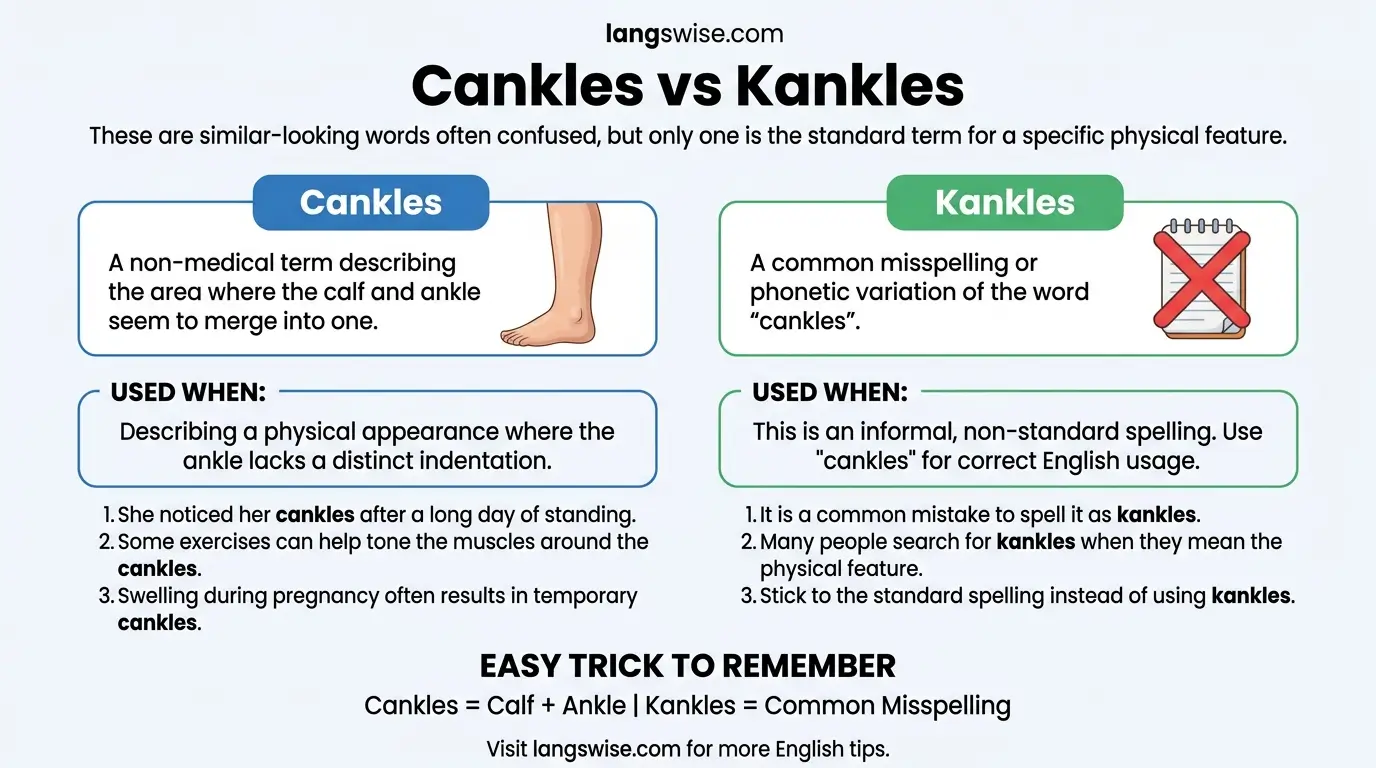
Have you ever typed “cankles or kankles” into Google and wondered which spelling is correct? You are not alone. Both forms appear online, but they are not equally common.
Cankles is the standard and much more widely recognized spelling. It is an informal word made by blending calf and ankle. It describes an ankle area where the calf and ankle appear to have little visible separation.
Major dictionaries and reference sources list cankle/cankles, while kankle/kankles is generally treated as an alternative spelling.
People search for “cankles or kankles” for several reasons. They may be checking a spelling before writing, trying to understand a social media post, or looking for the meaning of a word they have seen online.
This guide gives you the quick answer first. It then explains the word’s origin, spelling differences, common mistakes, usage, and what spelling to choose in professional writing.
Cankles or Kankles Quick Answer
Cankles is the preferred spelling.
The word cankle combines calf + ankle. The plural is cankles. It is an informal term for a thick or less-defined ankle area. The word is not a formal medical diagnosis.
Kankle and kankles are alternative spellings. They can be found online, but they are much less common.
| Variation | Meaning | Recommended? |
| cankle | Singular form | Yes |
| cankles | Plural form | Yes — preferred |
| kankle | Alternative spelling | Sometimes |
| kankles | Alternative plural spelling | Less common |
Example:
“People often use the word cankles to describe a lack of visible definition between the calf and ankle.”
One important point: cankles is slang, not a medical diagnosis. Swelling around the ankle can have many causes, so the slang word should not be used to diagnose a health condition.
The Origin of Cankles or Kankles
The word cankle is a blend, also called a portmanteau. It comes from the words calf and ankle.
The term became visible in popular English in the early 2000s. WordSpy records examples from around 2000 onward, including newspaper usage in the United States.
There is also an interesting earlier use of the word. A 1996 postmodern essay by science-fiction writer Don Webb used “cankle” as a playful invented word. That early use did not have the modern body-related meaning.
The modern sense became more established in the early 2000s. The 2001 film Shallow Hal also helped expose the word to a wider popular audience.
Why are there two spellings?
The spelling kankles likely exists because people hear the word rather than see its written origin. The word sounds like “kankle”, so some writers use k instead of c.
However, the spelling with c better shows the connection to calf. That is one reason cankle/cankles became the established form.
It is also important not to confuse kankles with the Lithuanian musical instrument kanklės. That is an entirely different word.
British English vs American English Spelling
Unlike words such as colour/color or centre/center, cankles is not mainly a British-versus-American spelling difference.
Both British and American English can use cankles. The key difference is frequency and context, not a formal spelling rule.
| Feature | American English | British English |
| Preferred form | cankles | cankles |
| Alternative | kankles | kankles |
| Word type | Informal/slang | Informal/slang |
| Origin | calf + ankle | calf + ankle |
| Formal medical term? | No | No |
| Best choice in general writing | cankles | cankles |
The word has appeared in British media as well as American sources. For example, the London Evening Standard discussed “cankles” in a 2012 lifestyle article.
So, if you are wondering whether British English requires kankles while American English requires cankles, the answer is no.
Cankles is the safer spelling in both varieties of English.
Which Spelling Should You Use?
For most readers, use cankles.
If you write for a US audience
Use cankles. It is the established spelling found in major English-language reference sources.
If you write for a UK or Commonwealth audience
Use cankles as well. British sources use the same spelling.
If you write for a global audience
Cankles is the best choice because it is easier for readers to recognize and search for.
If you are writing professionally
Be careful with the word itself. It is informal and can sound judgmental because it is often used to describe someone’s body.
In health, fitness, or medical content, a neutral phrase such as “reduced ankle definition” or “ankle swelling” may be more appropriate, depending on what you mean.
Common Mistakes with Cankles or Kankles
Mistake 1: Assuming “kankles” is the British spelling
It is not.
Correct:
“Cankles is the more common spelling.”
Mistake 2: Writing “cankle” when you mean more than one
The singular is cankle.
The plural is cankles.
Correct:
“She used the word cankle to describe one ankle.”
“She used the word cankles to describe both ankles.”
Mistake 3: Treating cankles as a medical diagnosis
Cankles is an informal slang term. It does not identify a specific medical condition.
Mistake 4: Assuming everyone with thick ankles has a health problem
Ankle and lower-leg shape varies naturally. Swelling can also have many different causes. A slang label cannot tell you why someone’s ankles look a certain way.
Mistake 5: Using “cankles” in sensitive professional writing
The term can be insulting or body-shaming. In formal health or workplace writing, choose neutral language.
Cankles or Kankles in Everyday Examples
The following examples show how the word may appear in different types of writing.
In an email
Informal:
“I came across the term ‘cankles’ and wanted to check the correct spelling before using it.”
Professional:
“Please note that ‘cankles’ is an informal term and may not be suitable for formal health communication.”
In a news article
“The article discussed the growing use of the informal term ‘cankles’ in popular culture.”
News writing should explain unusual slang when readers may not know it.
On social media
“I kept seeing the word ‘cankles’ online, so I finally looked up what it means.”
Social media often uses informal language, so you may see both cankles and kankles.
In formal writing
For academic, medical, or professional content, it is usually better to explain the physical feature in neutral terms rather than rely on slang.
For example:
“The ankle area may have less visible definition between the calf and ankle.”
This is clearer and more professional than using a slang term.
Cankles or Kankles Google Trends & Usage Data
People often search “cankles or kankles” because they are unsure which spelling to use. Search behavior can also reflect curiosity about the meaning of the term.
However, Google Trends data should be read carefully. Google Trends reports relative search interest, not the total number of searches.
A higher Trends score does not automatically mean that a word has more total searches than another word in every country or time period.
For SEO purposes, cankles is the stronger primary keyword because dictionaries and word references identify it as the established spelling. Kankles works well as a secondary keyword and spelling variation.
Search context can also change the results. Someone searching:
- “cankles meaning”
- “what are cankles”
- “cankles or kankles”
- “how to spell cankles”
- “kankles meaning”
may have the same basic spelling question but a different search intent.
For content creators, the best approach is to use cankles naturally as the main term while mentioning kankles as an alternative.
Keyword comparison
| Keyword | Best use | Spelling status |
| cankles | Main keyword | Preferred |
| cankle | Singular searches | Standard |
| kankles | Alternative spelling searches | Less common |
| kankle | Singular alternative | Less common |
| cankles or kankles | Comparison/search-intent keyword | Useful SEO phrase |
FAQs About Cankles or Kankles
Is it cankles or kankles?
Cankles is the preferred spelling. Kankles is an alternative spelling, but it is less common.
What does cankles mean?
Cankles is informal slang for an ankle area that appears thick or has little visible separation from the calf.
Is cankles a medical term?
No. Cankles is slang, not a formal medical diagnosis.
Is kankles a misspelling?
Not always. Kankle is recognized as an alternative spelling of cankle, although the c-spelling is more established.
Is cankles American or British English?
It is used in both American and British English. It is not a spelling difference like color/colour.
Why is it called cankles?
The word is a blend of calf and ankle.
Should I use cankles in formal writing?
Usually, no. Because it is informal slang and can sound negative or judgmental, neutral wording is often better in professional, medical, or academic writing.
Conclusion
If you are wondering about cankles or kankles, the simple answer is cankles. It is the standard and more widely recognized spelling. The word is a blend of calf and ankle, and it became popular in the early 2000s.
Kankles does appear as an alternative spelling, but it is not a special British spelling. Both British and American English can use cankles.
For SEO, websites, blogs, and general writing, make cankles your main keyword. You can mention kankles naturally because some people search for the alternative spelling. This helps answer both spelling and meaning questions.
One final point matters. Cankles is slang, not a medical diagnosis. If you are writing about health, use neutral language and avoid assuming that the appearance of someone’s ankles shows a specific condition.
So, when in doubt, remember: cankles is the preferred spelling; kankles is an alternative.
