

Have you ever stopped while writing and asked yourself, “Is it wander or wonder?” You are not alone. These two words look almost the same, and they can sound very similar in casual speech. Yet they have very different meanings.
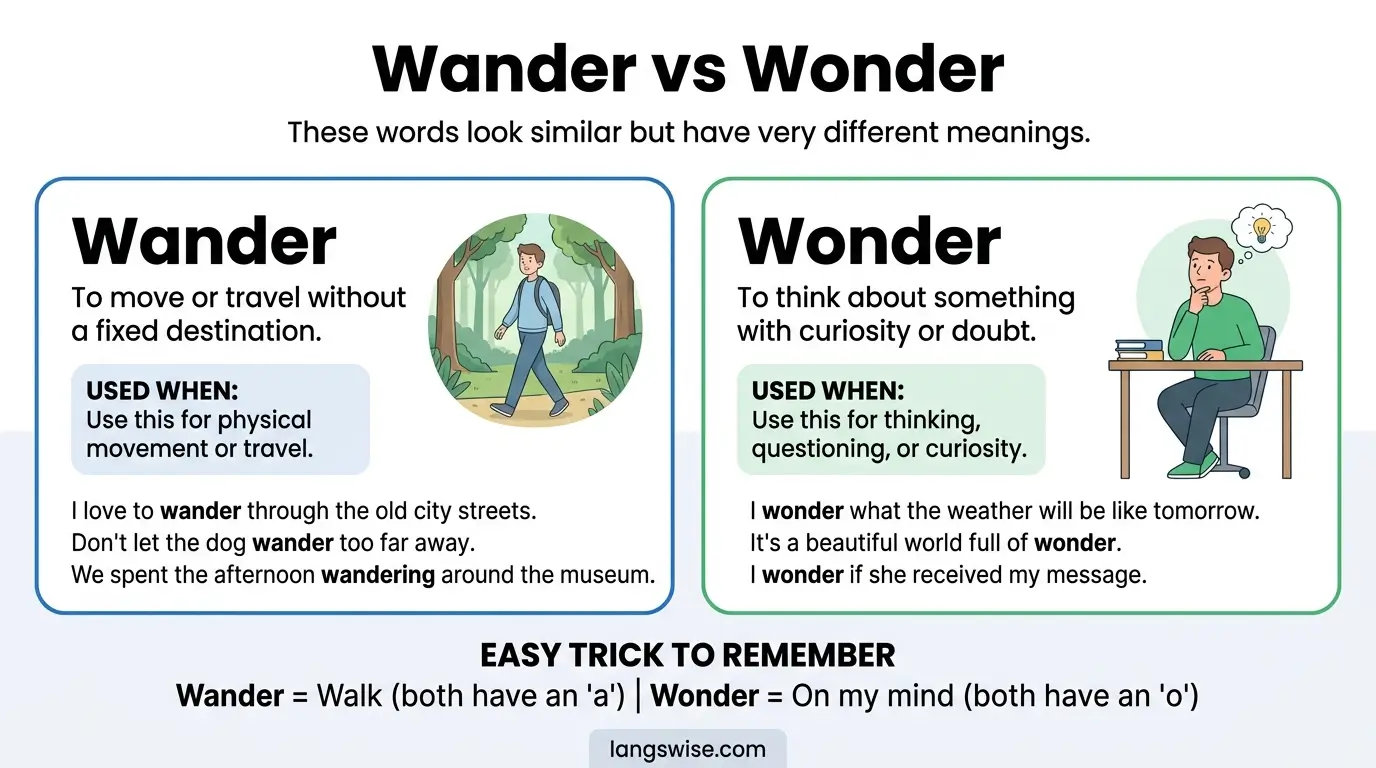
The word wander is about movement. It means to move around without a fixed path, plan, or goal. For example, “We wandered around the old town.”
The word wonder is about the mind. It can mean to feel curious, ask yourself a question, or feel amazed. For example, “I wonder why she left.”
People search for “wander or wonder” because one small letter can change the meaning of a sentence. Spell-check may not catch the error because both words are correctly spelled. The real question is not which word is “correct.” It is which word fits your meaning.
This guide explains the difference in simple English. You will learn the origin of both words, British and American usage, common mistakes, examples, and practical tips for choosing the right word.
Wander or Wonder Quick Answer
Wander means to move or travel without a clear direction or purpose.
Wonder means to think, question, feel curious, or feel amazed.
| Word | Simple meaning | Example |
| Wander | Move without a fixed path | We wandered around the city. |
| Wonder | Think or feel curious | I wonder where he went. |
Easy memory trick
Wander = walk or move.
Wonder = think or question.
Compare these sentences:
- We wandered through the park.
- I wondered why the park was closed.
- My mind began to wander during the meeting.
- She looked at the stars in wonder.
So, if the sentence is about movement or drifting, use wander.
If it is about curiosity, questions, doubt, or amazement, use wonder.
The Origin of Wander or Wonder
Although wander and wonder look alike today, they do not come from the same word.
Where does “wander” come from?
Wander comes from Old English wandrian, meaning “to move about aimlessly” or “wander.” It later passed through Middle English as wandren. The word is linked to older Germanic words associated with roaming and moving.
Over time, its meaning expanded. It could describe a person walking without a destination, a person going off course, or even thoughts losing focus.
For example:
My mind began to wander during the lecture.
This use makes sense because thoughts can “drift” away from the main subject.
Where does “wonder” come from?
Wonder comes from Old English wundor, meaning a strange or marvelous thing. The related verb came from Old English wundrian, meaning to be amazed, admire, or feel wonder.
Later, wonder also developed the meaning of being curious or uncertain.
For example:
I wonder what happened.
Here, the speaker wants to know something.
The two words therefore have different histories. Their similar modern spelling is not a British or American spelling difference. They simply happen to look and sound close.
British English vs American English Spelling
Unlike colour/color, centre/center, or travelling/traveling, there is no standard British-versus-American spelling difference for wander and wonder.
Both varieties use:
- wander
- wonder
- wandering
- wondering
- wandered
- wondered
The main difference can be pronunciation, because accents vary. However, the spelling and core meanings stay the same.
Comparison table
| Form | British English | American English | Meaning |
| Wander | wander | wander | Move without a fixed course |
| Wonder | wonder | wonder | Think, question, or feel amazed |
| Wandering | wandering | wandering | Moving or drifting |
| Wondering | wondering | wondering | Thinking or feeling curious |
| Wandered | wandered | wandered | Moved without a fixed path |
| Wondered | wondered | wondered | Thought or questioned |
So, if you are writing for readers in the UK, US, Canada, Australia, or another English-speaking region, you do not need to change the spelling.
The key is to choose the word that matches your meaning.
Which Spelling Should You Use?
The answer is simple: use the word that expresses your intended meaning.
For US readers
Use wander when you mean moving around without a fixed destination.
We wandered around downtown after dinner.
Use wonder when you mean curiosity or uncertainty.
I wonder when the meeting will end.
For UK and Commonwealth readers
The same rule applies.
They wandered through the village.
I wonder why the shop is closed.
British, Australian, Canadian, and other English varieties generally use the same spellings for these words.
For a global audience
Do not choose based on British or American spelling. There is no meaningful regional spelling choice here.
Instead, check the meaning.
Movement → wander.
Thought or curiosity → wonder.
This is especially important for professional writing, where a wrong word can change the meaning of a sentence.
Common Mistakes with Wander or Wonder
These words are easy to mix up. Here are the most common errors.
Mistake 1: “I wander why”
Incorrect:
I wander why he left.
Correct:
I wonder why he left.
You are asking yourself a question, so wonder is correct.
Mistake 2: “We wondered around the city”
Incorrect:
We wondered around the city.
Correct:
We wandered around the city.
The sentence describes movement, so use wandered.
Mistake 3: “My mind wondered”
Usually incorrect:
My mind wondered during the lesson.
Correct:
My mind wandered during the lesson.
The expression “my mind wandered” means your attention drifted away.
Mistake 4: “I wonder around the park”
If you mean walking without a plan, write:
I wander around the park.
Not:
I wonder around the park.
Mistake 5: Confusing “wondering” and “wandering”
Compare:
I was wondering where she went.
This means you were thinking about the question.
I was wandering around the neighborhood.
This means you were walking around without a fixed route.
A useful test is:
Can you replace the word with “walk” or “move”?
If yes, choose wander.
Can you replace it with “think,” “ask,” or “be curious”?
If yes, choose wonder.
Wander or Wonder in Everyday Examples
The difference becomes clear when you see the words in real situations.
In emails
Wonder:
I was wondering if you could send me the updated report.
Here, wondering is used to make a polite request.
Wander:
I wandered around the office while waiting for the meeting to begin.
Here, wandered describes movement.
In news writing
Wonder:
Many residents are wondering whether the new policy will affect local businesses.
Wander:
The hikers wandered off the marked trail.
News writing often uses both words, but for completely different purposes.
In social media
Wander:
Sometimes you just need to wander through a new city without a plan.
Wonder:
Ever wonder what life would look like if you took a different path?
In formal writing
Wonder:
Researchers wonder whether the results can be repeated.
Wander:
The discussion began to wander away from the main topic.
Notice that wander does not always describe physical movement. It can also describe thoughts, attention, discussions, or stories that move away from their main point.
Wander vs Wonder: Variations Side by Side
| Variation | Meaning | Example |
| wander | Move without direction | I wander through the market. |
| wandered | Moved without direction | We wandered through the streets. |
| wandering | Moving or drifting | She was wandering around town. |
| wonder | Think or feel curious | I wonder what happened. |
| wondered | Thought or questioned | He wondered why she left. |
| wondering | Thinking or questioning | They are wondering what to do. |
| wonder (noun) | Amazement | The child looked at the stars in wonder. |
Wander or Wonder Google Trends & Usage Data
Search interest in “wander or wonder” is mainly tied to language questions. People usually search the phrase when they are unsure which word belongs in a sentence. Current language resources also describe the pair as commonly confused words.
Google Trends measures relative search interest, not the total number of times a word is used. It also allows searches to be compared by location and time.
The broader words have different usage patterns:
- Wander often appears in travel, walking, nature, lifestyle, and creative writing.
- Wonder is common in questions, education, personal writing, news, and everyday conversation.
- Wander or wonder is mainly a grammar and spelling query.
This difference matters for SEO. A page targeting “wander or wonder” should answer the user’s question quickly before giving deeper information.
For content creators, teachers, and editors, the strongest related search intent is usually built around phrases such as:
- wander or wonder meaning
- wander vs wonder
- difference between wander and wonder
- is it wander or wonder
- wander or wonder examples
- wandering or wondering
- wandered or wondered
The important point is that these are different words, not regional spellings.
FAQs About Wander or Wonder
Is it “wander” or “wonder”?
Both are correct words. Use wander for movement without a fixed direction. Use wonder for curiosity, questioning, doubt, or amazement.
What is the easiest way to remember wander and wonder?
Remember:
Wander = walk.
Wonder = think.
This simple trick works for most everyday sentences.
Is “I wander why” correct?
No, not when you mean that you are curious about something.
Write:
I wonder why he is late.
Is “I wonder around the city” correct?
No, if you mean walking around without a plan.
Write:
I wander around the city.
Is “my mind wandered” correct?
Yes. My mind wandered means your thoughts or attention drifted away from what you were focusing on.
Are wander and wonder different British and American spellings?
No. Both British and American English use wander and wonder. The issue is meaning, not regional spelling.
Can wander and wonder appear in the same sentence?
Yes.
We wandered through the museum and wondered about its history.
Here, wandered describes movement, while wondered describes curiosity.
Conclusion
The difference between wander or wonder is simple once you focus on meaning.
Wander is about movement, drifting, or losing a fixed path. You can wander through a city, wander around a park, or let your mind wander.
Wonder is about thought, curiosity, doubt, or amazement. You can wonder why something happened, wonder whether something is true, or look at something in wonder.
These words are spelled the same in British and American English. So you do not need to choose a regional spelling. You need to choose the word that fits your sentence.
When you are unsure, use this quick test: if the idea is movement, choose wander. If the idea is thinking or curiosity, choose wonder.
This small rule can prevent many common spelling mistakes in emails, schoolwork, social media posts, articles, and professional writing.
Once you connect wander with movement and wonder with thought, the difference becomes easy to remember.
