

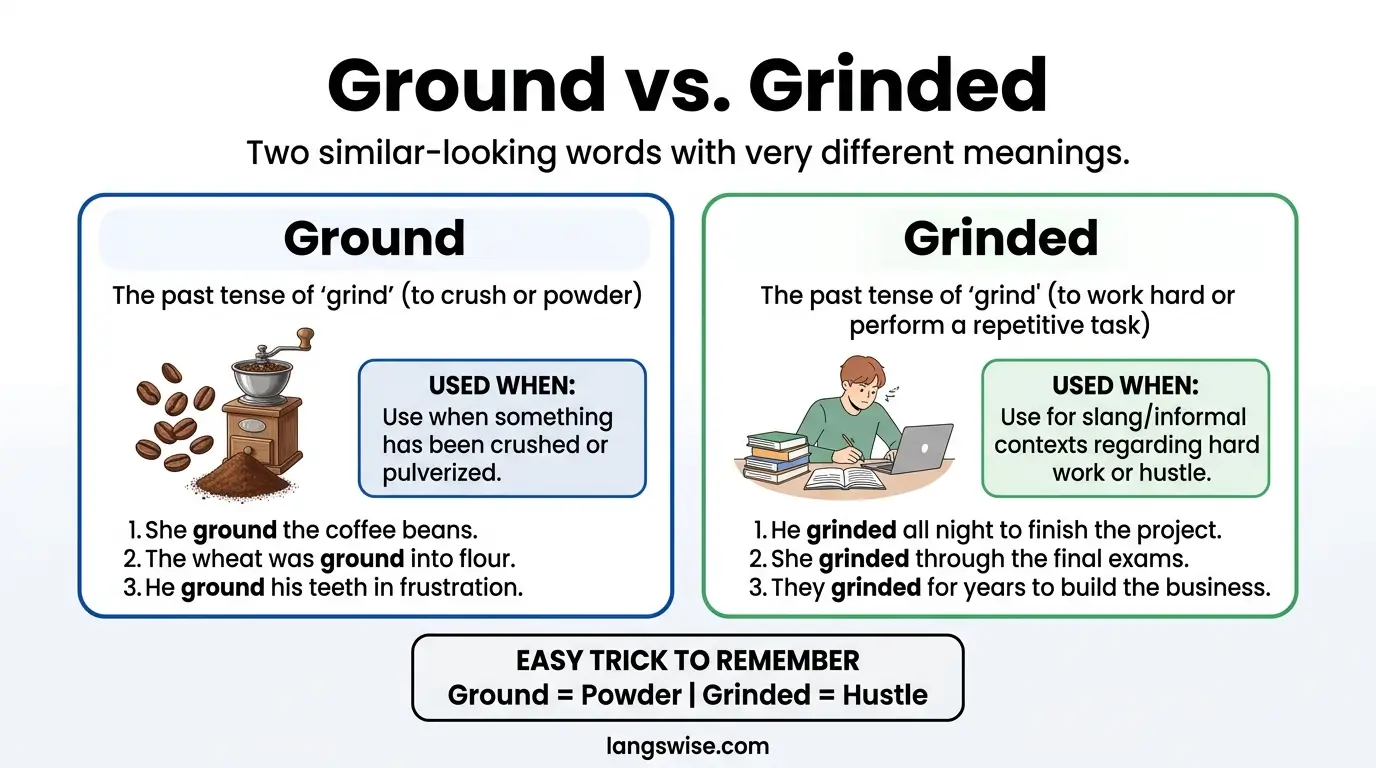
Have you ever stopped while writing and wondered, “Is it grinded or ground?” You are not alone. This small grammar question can cause big confusion because both forms appear online, in speech, and in different types of writing.
The confusion usually starts with the verb grind. Many English verbs form their past tense by adding -ed. For example, work becomes worked, and play becomes played.
So it seems natural to say grinded. However, grind is an irregular verb. Its standard past tense and past participle are both ground. Cambridge Dictionary lists ground as the past tense and past participle of grind.
Still, you may see grinded in gaming, sports, music, social media, and other informal settings. In these areas, the word can have a newer or specialized meaning.
So, which one should you use? This guide explains grinded or ground, their history, differences, examples, and the safest choice for professional writing.
Grinded or Ground Quick Answer
Ground is the standard past tense and past participle of grind.
The basic forms are:
- Present: grind
- Past tense: ground
- Past participle: ground
- Present participle: grinding
Examples
Correct standard English:
- I ground the coffee beans this morning.
- She ground the spices before cooking.
- The machine ground the grain into flour.
- We have ground the pepper already.
So, if you are writing an essay, report, email, article, or business document, ground is normally the best choice.
But what about “grinded”?
Grinded does appear in modern English. It is especially common in some gaming and sports contexts. For example:
He grinded for hours to reach the next level.
In this type of informal language, grinded can be used as a specialized form. Wiktionary notes that grinded is often used in sports and video-game senses of grind.
The simple rule is:
Traditional meaning → ground
Some modern slang or specialized meanings → grinded may appear
The Origin of Grinded or Ground
The word grind is old. It comes from Old English grindan, with roots in older Germanic language.
Its original meaning was linked to crushing, rubbing, or reducing something through friction. Collins traces the word through Middle English grinden and Old English grindan.
Unlike regular verbs, grind does not form its past tense by simply adding -ed.
This is because English has many irregular verbs that changed over hundreds of years. Their past forms developed through older patterns rather than the modern -ed rule.
For example:
| Present | Past | Past Participle |
| grind | ground | ground |
| find | found | found |
| bind | bound | bound |
| wind | wound | wound |
The pattern is not something modern speakers can always predict. It is simply part of the history of the English language.
Why did “grinded” appear?
English speakers often create regular forms for irregular verbs. This is called regularization.
Because grind ends in a consonant sound and many English past verbs use -ed, speakers may naturally produce grinded.
Historical sources also show that grinded is not completely new. It has appeared in English for centuries. Modern usage has given it a stronger presence in areas such as sports and gaming.
This does not mean grinded has replaced ground in standard English. Ground remains the normal form for the traditional meaning of grind.
British English vs American English Spelling
One important point is easy to miss:
British English and American English generally use the same form: ground.
There is no major British-versus-American spelling rule that changes ground to grinded.
Cambridge lists ground as the past tense and past participle of grind, while Collins also gives ground as the standard form in both American and British English.
Comparison table
| Feature | British English | American English |
| Present | grind | grind |
| Past tense | ground | ground |
| Past participle | ground | ground |
| Present participle | grinding | grinding |
| Informal/specialized form | grinded may appear | grinded may appear |
| Formal writing | use ground | use ground |
Examples
British English:
I ground the coffee beans before breakfast.
American English:
I ground the coffee beans before breakfast.
Both sentences are correct.
The difference is not really British spelling versus American spelling. It is mainly about standard English versus informal or specialized usage.
Which Spelling Should You Use?
Your best choice depends on your audience and the meaning of the sentence.
For US English
Use ground in:
- School essays
- Business emails
- Reports
- News writing
- Academic work
- Professional documents
- Formal websites
Example:
The factory ground the material into a fine powder.
For UK and Commonwealth English
The same advice applies.
Use ground for standard writing:
The mill ground the wheat into flour.
For global English
If your readers come from different countries, ground is the safest choice.
It is widely recognized and accepted in standard English.
What about gaming?
Gaming is different.
In gaming, grind often means repeating tasks to gain experience, levels, items, money, or other rewards. In that context, grinded is common in informal online language.
For example:
I grinded all weekend to unlock the new character.
A more traditional form would be:
I ground away at the task all weekend.
But the second sentence does not carry the same modern gaming feel.
For professional writing, however, it is safer to avoid grinded unless you are deliberately discussing gaming language or another specialized use.
Common Mistakes with Grinded or Ground
Here are some of the most common mistakes.
Mistake 1: Using “grinded” for coffee
Incorrect in standard English:
I grinded the coffee beans.
Better:
I ground the coffee beans.
Cambridge gives ground as the past form for crushing substances such as coffee and pepper.
Mistake 2: Using “grinded” in formal writing
Avoid:
The machine grinded the material into powder.
Use:
The machine ground the material into powder.
Mistake 3: Assuming “grinded” is always wrong
This is also too simple.
You may see grinded in gaming, sports, and other informal contexts. Some dictionaries and usage sources recognize these specialized uses.
So context matters.
Mistake 4: Confusing “ground” with the noun
Ground has several meanings.
It can be:
- The past tense of grind
- The past participle of grind
- The earth or surface
- An area of land
- A reason or basis
- A type of food product, as in ground coffee
For example:
She ground the coffee beans.
Here, ground is the past tense of grind.
But:
The children played on the ground.
Here, ground is a noun.
Grinded or Ground in Everyday Examples
Seeing the words in real situations makes the difference easier to remember.
In emails
Professional:
I ground the samples into a fine powder before testing them.
Avoid:
I grinded the samples into a fine powder.
In news writing
Standard news writing normally uses ground:
The machine ground the grain into flour.
Sports writing can sometimes use grinded in an informal or specialized sense. Grammarist notes that this use has appeared in American sports commentary and writing.
On social media
You may see:
I grinded all night to finish the project.
This is casual and understandable.
However, if you are posting professional content, ground or a clearer phrase may be better.
In gaming
Here, grinded is especially common:
We grinded for hours to get better equipment.
The word grind has developed a strong gaming sense involving repeated actions to gain progress.
In formal writing
Use ground:
The researchers ground the samples before analysis.
In food writing
Use ground:
Add freshly ground black pepper.
This is a very common standard expression.
Grinded or Ground Comparison Table
| Form | Main use | Example | Standard for formal English? |
| grind | Present tense | I grind coffee every morning. | Yes |
| ground | Standard past tense | I ground the coffee yesterday. | Yes |
| ground | Standard past participle | I have ground the coffee. | Yes |
| grinding | -ing form | I am grinding the coffee. | Yes |
| grinded | Informal/specialized past form | I grinded for hours in the game. | Usually no |
| ground | Adjective | freshly ground coffee | Yes |
The key distinction is simple: ground is the standard form, while grinded has developed special uses in modern informal language.
Grinded or Ground Google Trends & Usage Data
People search for “grinded or ground” because the answer is not always obvious. The regular-looking form grinded appears often enough online to create doubt, especially in gaming, sports, and social media.
Search interest should be treated carefully. Google Trends measures search interest, not grammatical correctness. A word can be popular in searches or online communities without being the best choice for formal writing.
Usage sources show an important pattern:
- Ground remains the standard form for traditional meanings.
- Grinded appears more often in specialized contexts.
- Gaming and sports are important areas where grinded is seen.
- Informal online communities can use grinded more freely.
- Formal and edited writing generally favors ground.
Historical usage research also shows that grinded has existed for a long time. Garner’s Modern English Usage describes standard grind → ground → ground while noting the growth of grinded in some uses.
What does this mean by country?
There is no simple rule such as:
US = grinded
UK = ground
That would be misleading.
Both American and British standard English use ground. The difference is more strongly linked to context, community, and meaning than to national spelling rules.
If you are writing for an international audience, use ground for the traditional meaning. It is the clearest and safest option.
FAQs About Grinded or Ground
Is it “grinded” or “ground”?
Ground is the standard past tense and past participle of grind.
Example:
I ground the coffee beans.
Is “grinded” a real word?
Yes, grinded appears in modern English, especially in informal, gaming, sports, and other specialized contexts. It is not the normal standard form for the traditional meaning of grind.
Is “I grinded” grammatically correct?
For standard English, use:
I ground.
In some informal contexts, especially gaming, I grinded is widely used.
What is the past tense of “grind”?
The standard past tense is ground.
Example:
She ground the spices yesterday.
What is the past participle of “grind”?
The standard past participle is also ground.
Example:
She has ground the spices.
Is “ground” British or American?
Ground is standard in both British and American English. It is not a British-only form.
Is “grinded” correct in gaming?
Yes, grinded is common in gaming language. It can describe repeated play or effort to gain levels, items, or other rewards.
Should I use “grinded” in an essay?
Usually, no. Use ground unless your essay is specifically discussing gaming slang, sports language, or another context where grinded is relevant.
Is “ground” an irregular verb form?
Yes. The standard forms are:
grind → ground → ground
You cannot form the standard past tense simply by adding -ed.
Which is safer for professional writing?
Ground is the safer choice.
Use it in business writing, academic work, formal articles, reports, and professional communication.
Conclusion
When choosing between grinded or ground, remember one simple rule: ground is the standard past tense and past participle of grind.
This is true in both British and American English. If you are writing a school essay, business email, report, article, or other formal text, ground is almost always the right choice.
For example, write “I ground the coffee beans”, not “I grinded the coffee beans.” The same rule applies to many traditional meanings of grind, such as crushing food, processing materials, sharpening objects, or causing friction.
However, English changes with time and context. Grinded is now common in some informal settings, especially gaming and sports. It can be useful when you want to match the language of a particular community.
If you are unsure, choose ground. It is standard, clear, widely understood, and appropriate for professional readers. Use grinded only when the context supports its specialized or informal meaning.
