
Have you ever typed “expresso” and then wondered if it should be “espresso”? You are not alone. This is a common spelling question, especially for English learners, coffee lovers, writers, and anyone creating professional content.
The confusion is easy to understand. When people say espresso quickly, the first sounds can resemble “ex-.” English also has many familiar words beginning with ex-, such as express, export, and experience. This makes expresso feel natural, even though espresso is the standard spelling in English.
This article gives you the quick answer first. It also explains the history behind both forms, compares British and American English, and shows which spelling you should use in professional writing.
If you are searching for “espresso or expresso,” the goal is simple: understand which form is standard, why the confusion exists, and how to use the word correctly.
Espresso or Expresso Quick Answer
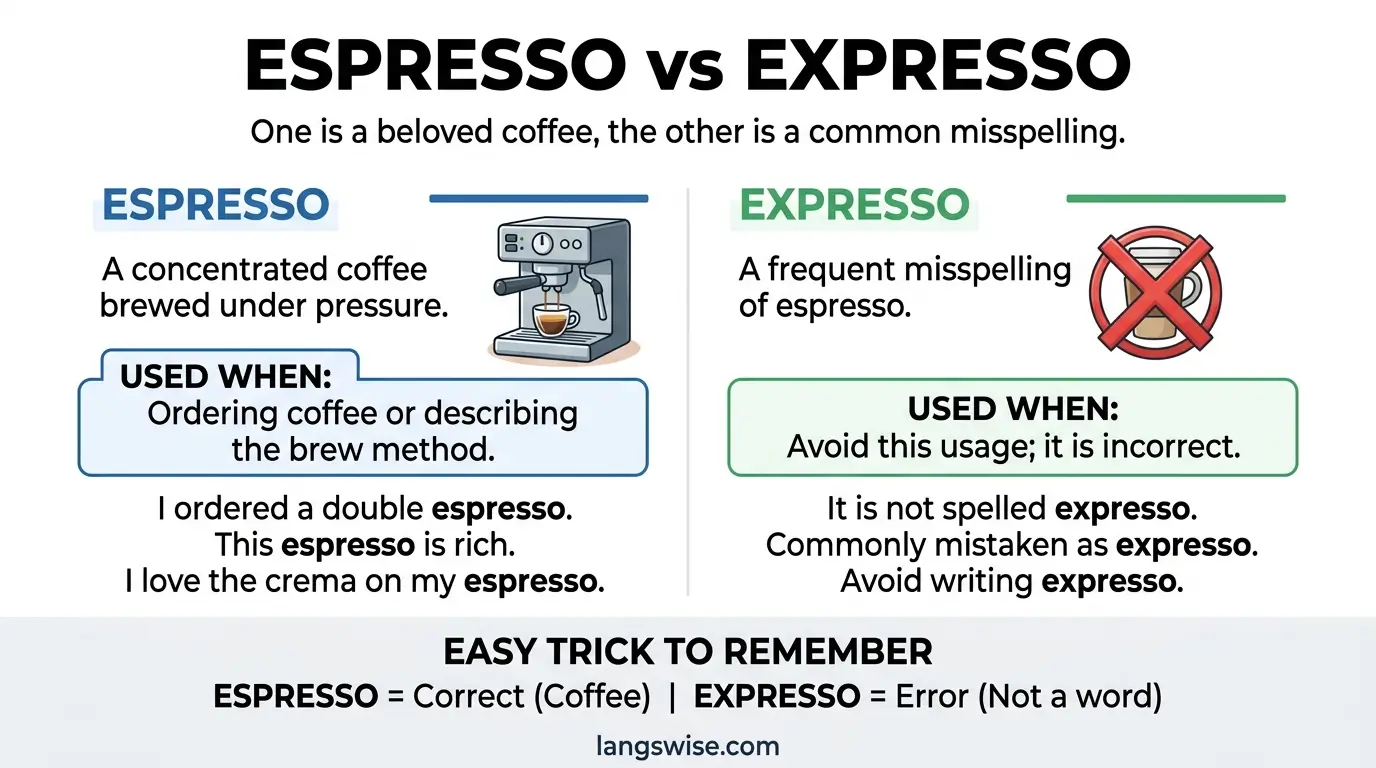
Espresso is the standard spelling you should use in English.
Expresso is also found in English, but it is generally treated as a variant or nonstandard form.
Examples:
- ✅ I ordered an espresso.
- ❌ I ordered an expresso.
- ✅ She bought an espresso machine.
- ❌ She bought an expresso machine.
- ✅ Would you like a double espresso?
- ❌ Would you like a double expresso?
The simple rule is:
Use “espresso” in standard and professional English.
The Origin of Espresso or Expresso
The word espresso comes from Italian. It is connected to the idea of pressing or expressing. This relates to how espresso coffee is made by forcing hot water through finely ground coffee under pressure.
The original Italian spelling is:
espresso
The alternative spelling expresso developed through English usage. One reason is the influence of the familiar English word express. Speakers may naturally connect the sound of espresso with words beginning with ex-.
This explains why expresso can sound correct even when espresso is the preferred spelling.
The spelling expresso has existed in English for many years. It is not simply a recent internet mistake. However, its status is different from espresso. In standard English writing, espresso remains the safer and more widely accepted form.
Another source of confusion is that expresso appears in some other languages. This can make the spelling seem more natural to multilingual speakers.
British English vs American English Spelling
Unlike words such as colour/color or centre/center, espresso does not have separate standard British and American spellings.
Both British and American English normally use:
espresso
The main difference is pronunciation, not spelling.
| Feature | British English | American English |
| Standard spelling | espresso | espresso |
| Variant seen in use | expresso | expresso |
| Recommended formal spelling | espresso | espresso |
| Meaning | Strong coffee made under pressure | Strong coffee made under pressure |
| Example | “I ordered an espresso.” | “I ordered an espresso.” |
| Pronunciation | Often ends with an “oh” sound | Often ends with an “oh” sound |
So, whether you are writing for readers in London, New York, Toronto, Sydney, or elsewhere, espresso is the safest standard spelling.
Espresso or Expresso: Comparison Table
| Word or phrase | Standard? | Recommended for formal writing? | Example |
| espresso | Yes | Yes | “She ordered an espresso.” |
| expresso | Variant/nonstandard | No | “She ordered an expresso.” |
| espresso machine | Yes | Yes | “The espresso machine is new.” |
| expresso machine | Variant/nonstandard | No | “The expresso machine is new.” |
| double espresso | Yes | Yes | “I would like a double espresso.” |
| double expresso | Variant/nonstandard | No | “I would like a double expresso.” |
| espresso coffee | Yes | Yes | “He drinks espresso coffee.” |
| expresso coffee | Variant/nonstandard | No | “He drinks expresso coffee.” |
Which Spelling Should You Use?
The safest professional choice is simple:
For a US audience
Use espresso.
Example:
“The restaurant serves Italian espresso.”
For a UK or Commonwealth audience
Use espresso.
Example:
“Would you like an espresso after dinner?”
For a global audience
Use espresso.
It is the clearest choice for websites, menus, articles, business communication, academic writing, and marketing.
For SEO writing
Use espresso as your main keyword.
You can still mention expresso because people search for it. This helps answer the user’s search intent without treating it as the preferred spelling.
For example:
“If you searched for ‘espresso or expresso,’ the standard spelling is espresso.”
This approach is useful for SEO because it answers the exact question people are asking while keeping the content accurate.
Common Mistakes with Espresso or Expresso
1. Writing “expresso”
❌ I would like an expresso.
✅ I would like an espresso.
2. Writing “expresso machine”
❌ Our expresso machine is broken.
✅ Our espresso machine is broken.
3. Assuming “espresso” means “fast”
The spelling may look related to express, but the word has Italian roots and is connected to the process of preparing coffee under pressure.
4. Changing the spelling by accent
British and American English both normally use espresso.
The pronunciation can vary, but the standard spelling stays the same.
5. Using both forms without a reason
In professional writing, choose espresso and use it consistently.
6. Saying “expresso” is completely impossible
This is too strong. Expresso does appear in English usage and is recorded by some dictionaries.
The more accurate statement is:
Espresso is the standard spelling, while expresso is a variant or nonstandard form.
Espresso or Expresso in Everyday Examples
The spelling can appear in many types of writing.
In an email
“Would you like to meet for an espresso after the meeting?”
Use espresso in workplace emails and professional messages.
In a news article
“The café has introduced a new range of espresso drinks.”
News writing normally uses the standard spelling.
On social media
“Morning espresso before a busy day.”
Social media is informal, but espresso remains the clearest choice.
In formal writing
“Espresso is prepared by forcing hot water through finely ground coffee.”
Use espresso in reports, academic work, business documents, and educational content.
On a café menu
Common examples include:
- Single espresso
- Double espresso
- Espresso macchiato
- Espresso tonic
- Iced espresso
- Espresso latte
In casual speech
You may hear someone say “expresso.” Usually, they mean the same coffee drink called espresso.
Hearing the variant does not mean that the speaker is referring to a different type of coffee.
Espresso or Expresso Google Trends & Usage Data
Google Trends can help explain why people search for “espresso or expresso.”
Search interest does not always show which spelling is correct. People often search for a word because they are unsure about it.
For example, someone who types “expresso” into Google may actually be asking:
“Is expresso the correct spelling?”
This means that searches for expresso do not necessarily show that people prefer it. They may simply show spelling confusion.
Search behavior can also vary by country and context. Coffee-related searches may focus on drinks, machines, recipes, cafés, and coffee culture. Spelling searches are more likely to include phrases such as:
- espresso or expresso
- is expresso correct
- how do you spell espresso
- espresso spelling
- expresso meaning
- espresso pronunciation
For SEO, this creates a useful opportunity.
Use espresso as the main term, but naturally include expresso and related questions in the article. Do not repeat the wrong spelling too often just to increase keyword density.
Search engines are good at understanding related words and search intent. Helpful content is more important than forced keyword repetition.
FAQs About Espresso or Expresso
Is espresso or expresso correct?
Espresso is the standard spelling in English. Expresso is a variant that appears in English usage but is best avoided in formal writing.
Is “expresso” a real word?
Yes, expresso appears in English usage and some dictionaries record it as a variant. However, espresso is the standard form.
Why do people say “expresso”?
The pronunciation may be influenced by the familiar English word express. The first sounds of espresso can also make the ex- spelling seem natural.
Is espresso British or American?
Espresso is used in both British and American English. The spelling is the same in both varieties.
Does espresso mean “express coffee”?
No. The word comes from Italian and is connected to the process of preparing coffee under pressure. Its similarity to express helped influence the alternative spelling expresso.
Should I write “espresso machine” or “expresso machine”?
Write espresso machine.
Example:
“We bought a new espresso machine.”
How do you pronounce espresso?
The pronunciation varies slightly between accents. In both British and American English, the word begins with an es- sound rather than an ex- sound.
Is “expresso” wrong?
In standard professional English, espresso is the preferred spelling. Expresso is used by some speakers and writers, so it is better described as a variant or nonstandard form rather than pretending it never exists.
Conclusion
When choosing between espresso or expresso, use espresso in standard English. It is the established spelling and the safest choice for professional communication.
The confusion around expresso is easy to understand. The word sounds somewhat like express, and English speakers often connect unfamiliar words with familiar spelling patterns. Over time, expresso has appeared in everyday speech and writing and has been recorded as a variant in some dictionaries.
Still, if your goal is clear and professional English, espresso is the spelling to choose. Use it in emails, articles, menus, academic writing, social media posts, business documents, and SEO content.
The key rule is simple:
Espresso = standard spelling.
Expresso = variant or nonstandard form you may encounter.
So, the next time you write about coffee, order a drink, create a menu, or publish an article, choose espresso.

Langswise explains English grammar, spelling and vocabulary in simple, practical guides.