

Have you ever stopped while writing and wondered: “Should I say unsatisfied or dissatisfied?” You are not alone.
These two words look and sound similar, and both describe a lack of satisfaction. Yet they are not always used in the same way.
People search for “unsatisfied or dissatisfied” because the words can overlap in everyday English. The confusion becomes greater in emails, customer reviews, academic writing, business reports, and formal documents. Choosing the right word can make your writing sound clearer and more natural.
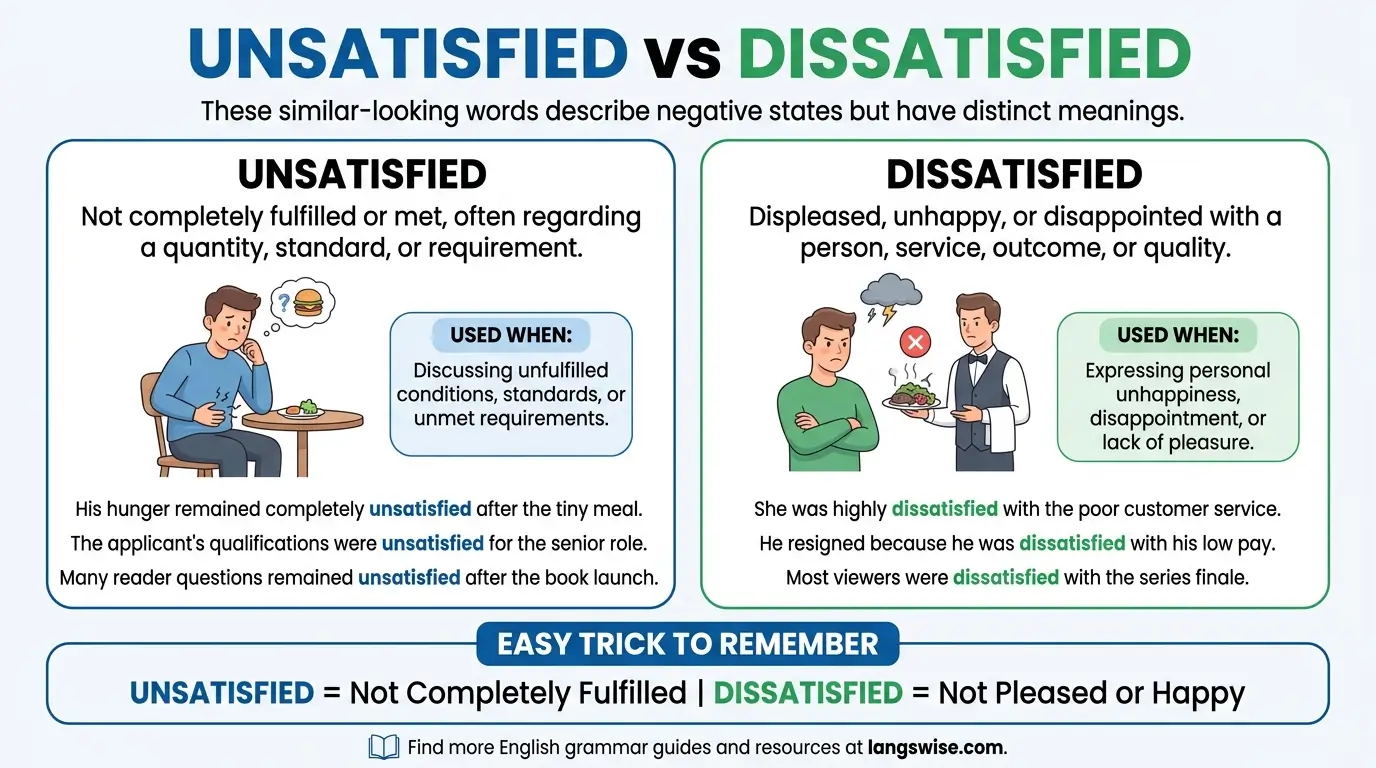
The good news is simple: both words are correct. The main difference is context. Dissatisfied usually describes a person who is unhappy, displeased, or disappointed with something. Unsatisfied often describes a need, wish, desire, question, or expectation that remains unfulfilled.
This guide explains unsatisfied or dissatisfied, their meanings, origins, spelling, usage, common mistakes, and examples. It also explains whether British and American English use different spellings.
Unsatisfied or Dissatisfied Quick Answer
Both unsatisfied and dissatisfied are correct English words.
The easiest rule is:
- Dissatisfied = unhappy or displeased with something.
- Unsatisfied = not fulfilled, completed, or met.
For example:
- I was dissatisfied with the customer service.
- My curiosity remained unsatisfied.
- The customer was dissatisfied with the product.
- The demand for housing remains unsatisfied.
Cambridge defines dissatisfied as being unhappy with something because it is not as good as it should be.
It defines unsatisfied as feeling that something is not enough or not good enough, or as a wish or demand that has not been fulfilled.
A useful memory trick is:
Dissatisfied = displeased.
Unsatisfied = unfulfilled.
There is overlap, so the rule is not absolute. Oxford, for example, lists unsatisfied for both unmet needs and a person who did not get what they hoped for.
The Origin of Unsatisfied or Dissatisfied
The two words are built from the word satisfied, but they use different prefixes.
The origin of “unsatisfied”
Unsatisfied is formed from:
un- + satisfied
The prefix un- often means “not.” Therefore, unsatisfied means “not satisfied.”
It can describe something that has not been fulfilled or completed.
Examples include:
- unsatisfied demand
- unsatisfied need
- unsatisfied curiosity
- unsatisfied desire
- an unsatisfied customer
The word can also describe a person who still feels that something is lacking. Cambridge gives examples involving hunger, wishes, curiosity, and demand.
The origin of “dissatisfied”
Dissatisfied is formed with dis- plus satisfied.
The prefix dis- has long been used in English to express separation, opposition, or negation. The related noun dissatisfaction has a recorded history going back to the 17th century. Collins gives the word origin as dis- + satisfaction.
Today, dissatisfied often has a stronger connection with displeasure or disappointment.
For example:
The customer was dissatisfied with the service.
This tells us that the customer was unhappy with the service.
Why do the spellings differ?
The difference is not a British-versus-American spelling rule.
The words use different prefixes:
| Word | Prefix | Basic idea |
| Unsatisfied | un- | not satisfied |
| Dissatisfied | dis- | displeased or not satisfied |
So unsatisfied and dissatisfied are not alternative spellings of one word. They are two separate words with related meanings.
British English vs American English Spelling
One important point is easy to miss: British and American English spell both words the same way.
There is no standard British spelling such as dissatisfed or an American alternative such as unsatisfyed.
The correct spellings are:
- unsatisfied
- dissatisfied
The main difference is meaning and context, not regional spelling.
Comparison table
| Feature | British English | American English |
| Unhappy with a service | dissatisfied | dissatisfied |
| Need not fulfilled | unsatisfied | unsatisfied |
| Customer complaint | dissatisfied | dissatisfied |
| Unfulfilled desire | unsatisfied | unsatisfied |
| Correct spelling | unsatisfied / dissatisfied | unsatisfied / dissatisfied |
Cambridge lists both words in British and American English dictionaries with the same spellings.
So, if you are writing for a US or UK audience, you do not need to change the spelling.
Which Spelling Should You Use?
Your choice should depend on what you mean, not where your readers live.
For US English
Use dissatisfied when talking about complaints, poor service, bad products, or disappointment.
Example:
Many customers were dissatisfied with the new policy.
Use unsatisfied when something remains unmet.
Example:
Several customer needs remain unsatisfied.
For UK and Commonwealth English
The same rule works.
Dissatisfied:
She was dissatisfied with the quality of the service.
Unsatisfied:
His desire for a better solution remained unsatisfied.
For global English
If you write for an international audience, choose the word that gives the clearest meaning.
For business writing, dissatisfied is often the safer choice when discussing customer complaints or negative experiences.
For needs, demands, desires, curiosity, or something that remains unfulfilled, unsatisfied is often more precise.
Common Mistakes with Unsatisfied or Dissatisfied
Mistake 1: Treating the words as exact synonyms
The words can overlap, but they are not always interchangeable.
Better:
The customer was dissatisfied with the service.
The demand remained unsatisfied.
Mistake 2: Using “dissatisfied” for every unmet need
Not every unmet condition describes an unhappy person.
Less precise:
The demand was dissatisfied.
Better:
The demand remained unsatisfied.
A demand can be unsatisfied. A person can be dissatisfied.
Mistake 3: Using “unsatisfied” when describing a complaint
When someone is clearly unhappy with a service or product, dissatisfied is usually the natural choice.
Better:
The customer was dissatisfied with the delayed delivery.
Mistake 4: Assuming one word is British and the other is American
This is incorrect.
Both unsatisfied and dissatisfied are used in both British and American English.
Mistake 5: Confusing “unsatisfied” with “unsatisfactory”
These words are related but different.
- Unsatisfied describes a person or something that has not been fulfilled.
- Unsatisfactory describes something that is not good enough.
Example:
The customer was dissatisfied.
The service was unsatisfactory.
Unsatisfied or Dissatisfied in Everyday Examples
In emails
For a complaint:
I am dissatisfied with the service I received.
For an unmet requirement:
The requirement remains unsatisfied.
A professional complaint might say:
I am dissatisfied with the response time and would appreciate a prompt solution.
In news writing
News reports often use dissatisfied when discussing public opinion.
Many voters were dissatisfied with the government’s decision.
Unsatisfied can describe needs or demands:
Several communities still have unsatisfied housing needs.
On social media
Social media language is often informal:
Really dissatisfied with this update.
Or:
I am still unsatisfied with the explanation.
Both can be correct. The intended meaning matters.
In formal writing
Formal writing often uses the words in precise contexts.
Participants expressed dissatisfaction with the process.
Several requirements remained unsatisfied.
The committee was dissatisfied with the results.
Notice that dissatisfaction is the noun form of dissatisfied. Cambridge defines it as a lack of satisfaction.
Unsatisfied or Dissatisfied Google Trends & Usage Data
Search interest in “unsatisfied or dissatisfied” is mainly connected with English learning, grammar questions, customer-service writing, and professional communication.
Google Trends data should be read as relative search interest, not as a count of total searches. A Trends score of 100 represents the highest search interest for the selected terms, time period, and location. It does not mean 100 searches.
For this topic, search behavior commonly falls into several groups:
| Search context | Likely interest |
| English grammar | High |
| Word meaning | High |
| Customer service | High |
| Business writing | Moderate to high |
| Academic writing | Moderate |
| Everyday conversation | Broad use |
| ESL learning | High |
The two words also appear in different language contexts. Dissatisfied is strongly associated with complaints, services, products, and negative experiences. Unsatisfied is common with needs, demands, curiosity, desires, and other things that remain unfulfilled. Dictionary examples support these usage patterns.
Searches can also vary by country because English learners often search for comparisons such as “dissatisfied vs unsatisfied,” “unsatisfied meaning,” and “dissatisfied meaning.”
The key SEO and language point is this: people searching for “unsatisfied or dissatisfied” usually want a simple answer about which word fits their sentence. Context is more useful than treating one word as universally correct.
Unsatisfied vs Dissatisfied: Side-by-Side Comparison
| Feature | Unsatisfied | Dissatisfied |
| Basic meaning | Not fulfilled | Not pleased |
| Main idea | Something is still unmet | Someone is unhappy |
| Common with needs | Yes | Less common |
| Common with demands | Yes | Less common |
| Common with curiosity | Yes | Rare |
| Common with customer complaints | Sometimes | Yes |
| Common with poor service | Possible | Very common |
| Emotional strength | Often neutral | Often more negative |
| British spelling | Unsatisfied | Dissatisfied |
| American spelling | Unsatisfied | Dissatisfied |
| Example | An unsatisfied need | A dissatisfied customer |
The distinction is useful, but do not treat it as an unbreakable grammar rule. English allows some overlap. Collins, for example, lists unsatisfied among the synonyms of dissatisfied.
FAQs About Unsatisfied or Dissatisfied
Is “unsatisfied” a correct word?
Yes. Unsatisfied is a standard English adjective. It can describe a person, need, demand, desire, or other condition that has not been fulfilled.
Is “dissatisfied” a correct word?
Yes. Dissatisfied is also a standard English adjective. It usually means unhappy or displeased with something.
What is the main difference between unsatisfied and dissatisfied?
A useful rule is:
Dissatisfied = displeased.
Unsatisfied = unfulfilled.
For example, you can be dissatisfied with a hotel, while a need can remain unsatisfied.
Which is better for customer complaints?
Dissatisfied is usually the better choice.
The customer was dissatisfied with the service.
This sounds natural and professional.
Can I say “unsatisfied customer”?
Yes. The phrase is grammatically possible. However, dissatisfied customer is often the more natural choice when you mean that the customer is unhappy with a product or service.
Is there a British spelling and an American spelling?
No. Both varieties use the same spellings:
unsatisfied and dissatisfied.
The difference is about usage and meaning, not regional spelling.
Which word should I use in formal writing?
Choose based on meaning. Use dissatisfied for displeasure or complaints. Use unsatisfied for unmet needs, demands, desires, or conditions.
Conclusion
When deciding between unsatisfied or dissatisfied, remember that both words are correct. The difference is mainly one of meaning and context.
Use dissatisfied when a person is unhappy, disappointed, or displeased with something. It is especially common in customer service, complaints, product reviews, and business writing. For example, “The customer was dissatisfied with the service.”
Use unsatisfied when something remains unfulfilled or unmet. It works well with words such as need, demand, desire, curiosity, and wish. For example, “The demand remains unsatisfied.”
There is also no British-versus-American spelling difference. Both varieties of English use unsatisfied and dissatisfied.
The simplest memory rule is “dissatisfied = displeased” and “unsatisfied = unfulfilled.” However, English has some overlap, so context always matters.
When in doubt, ask what you are describing: a person’s displeasure or something that has not been fulfilled? That question will usually lead you to the right word.
