

Have you ever typed “tennant” and wondered if it should be “tenant”? You are not alone. The phrase “tennant or tenant” is a common spelling search because both forms look natural, especially when typing quickly.
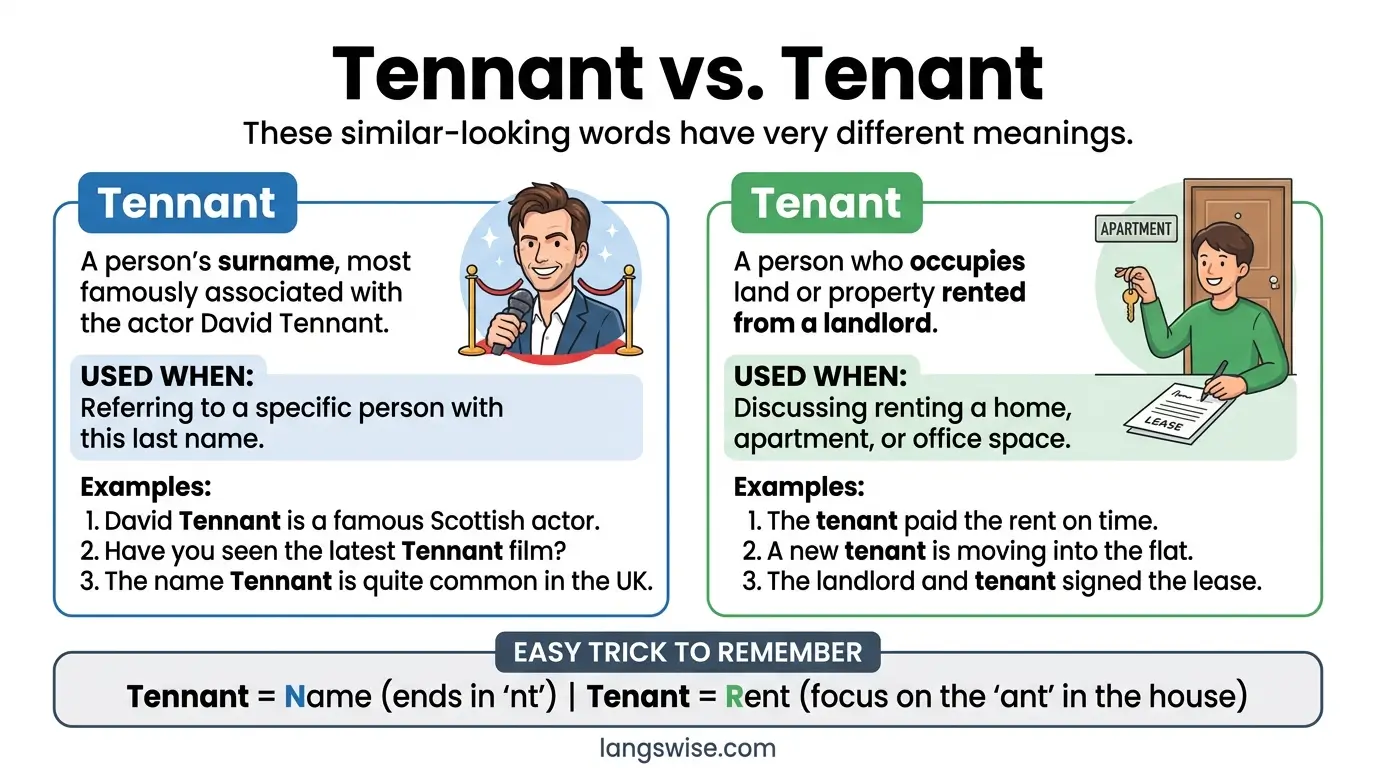
The correct spelling of the word is tenant. It means a person who rents or occupies property owned by someone else.
For example, “The tenant pays rent every month.” Tennant is not the standard spelling of this common English word. However, Tennant can appear as a proper name or surname.
This small spelling difference matters. A wrong spelling can make an email, rental agreement, website, or business document look less professional. It can also cause confusion when people search for information about renting property.
In this guide, we explain tennant or tenant in simple terms. You will learn the correct spelling, its history, British and American usage, common mistakes, real-world examples, and practical advice for professional writing.
Tennant or Tenant Quick Answer
The correct spelling is tenant.
- Tenant ✅ = a person who rents or occupies property.
- Tennant ❌ = not the standard spelling of the common word.
- Tennant ✅ = may be correct when it is a person’s name or surname.
Examples
Correct:
The tenant must pay the rent by Friday.
Incorrect:
The tennant must pay the rent by Friday.
Correct as a name:
David Tennant is a Scottish actor.
So, when you mean a person who rents a house, apartment, office, or other property, use tenant.
The Origin of Tennant or Tenant
The word tenant has a long history. It entered English in the Middle English period and comes from Anglo-French and Old French. The Old French word tenant was related to tenir, meaning “to hold.” The deeper Latin source is tenēre, meaning “to hold, keep, or possess.”
The word originally had a strong legal and property meaning. In the early 14th century, tenant referred to a person who held land by title or lease. By the late 14th century, its more familiar meaning developed: someone who holds property under a landlord.
Older forms included spellings such as tenaunt. English spelling changed over time as words moved from French and other languages into English.
The extra n in tennant is not a modern British or American spelling rule. It is simply a common spelling error when people remember the sound of the word rather than its standard written form.
The related word tenancy also comes from tenant and refers to the state or period of being a tenant.
British English vs American English Spelling
Unlike some English words, tenant does not have separate British and American spellings.
Both major varieties use:
tenant ✅
There is no standard British spelling tennant and no standard American spelling tennant.
| Variety | Correct spelling | Incorrect common form |
| American English | tenant | tennant |
| British English | tenant | tennant |
| Canadian English | tenant | tennant |
| Australian English | tenant | tennant |
| New Zealand English | tenant | tennant |
| Global English | tenant | tennant |
This makes the choice easy. If you are writing about someone who rents property, use tenant, regardless of the country.
For example:
- US: “The tenant signed the lease.”
- UK: “The tenant signed the tenancy agreement.”
- Australia: “The tenant must follow the rental conditions.”
The spelling of tenant stays the same.
Which Spelling Should You Use?
Use tenant whenever you mean a person who rents or occupies property.
For US readers
Use tenant in rental agreements, emails, legal documents, property listings, and everyday writing.
Example:
The tenant is responsible for keeping the apartment clean.
For UK and Commonwealth readers
Use tenant as well.
You may also see related terms such as tenancy, landlord, and tenancy agreement.
Example:
The tenant signed a new tenancy agreement.
For global audiences
Always choose tenant. It is the standard spelling and will be understood across English-speaking markets.
One important exception
Tennant can be a proper name. For example, David Tennant is the surname of the actor. In that case, the spelling must remain Tennant because names follow their established spelling.
Common Mistakes with Tennant or Tenant
The most common mistake is adding an extra n.
Mistake 1: Writing “tennant”
❌ The tennant paid the rent.
✅ The tenant paid the rent.
Mistake 2: Assuming British English uses “tennant”
❌ British English: tennant
✅ British English: tenant
There is no British spelling change here.
Mistake 3: Confusing a name with the common noun
Tennant can be a surname.
Tenant is the common noun for someone who rents property.
Compare:
The tenant rented the apartment.
David Tennant appeared in the television series.
Mistake 4: Using “tenant” when you mean “landlord”
A tenant rents or occupies property.
A landlord owns or manages property and rents it to a tenant.
❌ The tenant owns the building and collects rent.
✅ The landlord owns the building and collects rent.
Tennant or Tenant in Everyday Examples
The correct spelling becomes easy when you see it in real situations.
In emails
Dear Tenant,
Please remember that your rent is due on the first day of each month.
In a rental agreement
The tenant agrees to pay the monthly rent on time.
In news writing
The tenant was asked to leave the property after the lease ended.
On social media
Looking for a new apartment as a tenant can be stressful.
In formal writing
The tenant is responsible for complying with the terms of the lease.
In property listings
Suitable for a single tenant or professional couple.
As a person’s name
David Tennant is known for his work in television and film.
These examples show why context matters. Tenant is the property word. Tennant may be a person’s name.
Tennant or Tenant Google Trends & Usage Data
Searches for “tennant or tenant” usually come from people checking spelling rather than choosing between two accepted regional forms.
The important usage point is that tenant is the standard English word in major English-speaking countries. Dictionaries in both British and American contexts use tenant, while tennant is not an alternative standard spelling.
Search behavior can vary by country because people may encounter different rental terms. For example, UK users often see tenancy agreement, while US users commonly see lease agreement. But the noun tenant remains unchanged.
A useful SEO distinction is:
| Search or variation | Correct? | Meaning |
| tennant or tenant | Search query | People checking spelling |
| tenant | ✅ | Person who rents property |
| tennant | ❌ as a common noun | Common spelling error |
| Tennant | ✅ | Possible surname or proper name |
| tenant meaning | ✅ | Search for definition |
| tenant spelling | ✅ | Search for correct spelling |
| tenant vs landlord | ✅ | Search comparing rental roles |
For SEO, the phrase “tennant or tenant” is useful because it reflects a real spelling question. The page should answer the question quickly, then explain the difference in depth.
Tennant vs Tenant Comparison Table
| Feature | Tenant | Tennant |
| Standard English word | ✅ Yes | ❌ No |
| Person who rents property | ✅ Yes | ❌ No |
| Used in US English | ✅ Yes | ❌ No |
| Used in UK English | ✅ Yes | ❌ No |
| Used in legal/property writing | ✅ Yes | ❌ No |
| Can be a surname | Rarely | ✅ Yes |
| Example | “The tenant paid rent.” | “David Tennant is an actor.” |
The simplest rule is:
Property renter = tenant.
Surname = possibly Tennant.
FAQs About Tennant or Tenant
Is it tenant or tennant?
The correct spelling is tenant when you mean someone who rents or occupies property.
Is “tennant” ever correct?
Yes, Tennant can be correct as a surname or proper name. It is not the standard spelling for a person who rents property.
Is tenant spelled differently in British English?
No. British English uses tenant, just like American English.
What does tenant mean?
A tenant is a person who occupies or rents property belonging to another person, usually in exchange for rent.
What is the difference between a tenant and a landlord?
A tenant rents or occupies the property. A landlord owns or manages the property and rents it to the tenant.
Why do people spell tenant as tennant?
The extra n is a common spelling mistake. People may add the second n because of the pronunciation or because Tennant exists as a surname.
How can I remember the correct spelling?
Use this simple memory trick:
ten + ant = tenant
Remember that the common property word has only one n in the middle.
Conclusion
When choosing between tennant or tenant, the answer is simple: tenant is the correct spelling for a person who rents or occupies property.
The word has a long history. It comes through Anglo-French and Old French from tenir, meaning “to hold,” with roots in Latin tenēre. Its connection with holding land helps explain its historical property meaning.
There is no separate British or American spelling. Writers in the US, UK, Canada, Australia, and other English-speaking regions should use tenant.
The spelling Tennant can still be correct when it is a surname, such as the name of actor David Tennant. That is a proper-name issue, not a spelling variation of the property word.
For emails, contracts, rental listings, websites, schoolwork, and professional documents, remember one simple rule: a person who rents property is a tenant. If you are unsure, choose tenant. It is the safe and standard spelling worldwide.
