

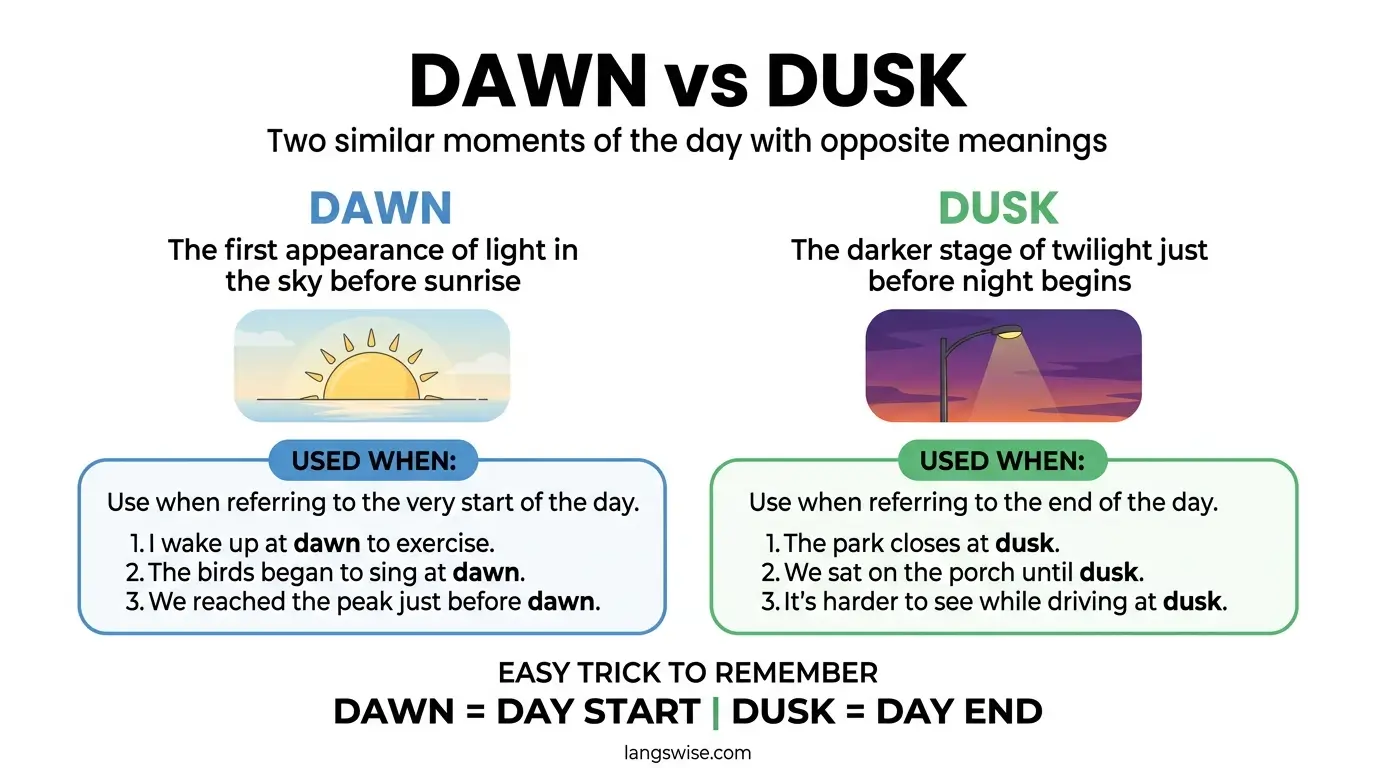
Have you ever wondered whether dawn or dusk comes first? You are not alone. These two words describe opposite parts of the day, but they are easy to mix up. Both describe the changing light around sunrise and sunset, so the confusion is common.
The simple answer is this: dawn is in the early morning, while dusk is in the evening. Dawn happens before sunrise. Dusk happens after sunset, as daylight fades into night.
People search for “dawn or dusk” for many reasons. They may want to know which word to use in an email, understand a weather report, write a travel guide, or choose the right word for a photo caption. English learners also often confuse dawn, dusk, sunrise, sunset, and twilight.
This guide explains the meaning of dawn or dusk, their origins, spelling, British and American usage, common mistakes, and everyday examples. It also gives simple advice for writers who want to use these words correctly.
Dawn or Dusk Quick Answer
Dawn means the first light of the day. It happens before sunrise.
Dusk means the fading light at the end of the day. It happens after sunset.
A simple way to remember them is:
Dawn starts the day. Dusk ends the day.
Examples
- “We left home at dawn.”
- “The birds became quiet at dusk.”
- “The hikers reached the village before dawn.”
- “The park closes at dusk.”
Dawn and dusk are not the same as sunrise and sunset.
Dawn → Sunrise → Day → Sunset → Dusk → Night
Dawn is the light that appears before the sun rises. Dusk is the light that remains after the sun has set.
The Origin of Dawn or Dusk
The words dawn and dusk have different histories.
Origin of “Dawn”
The word dawn comes from Old English dagian, meaning “to become day.” It is linked to dæg, the Old English word for “day.”
The modern word developed through Middle English forms. Its meaning stayed closely linked to the beginning of daylight.
Over time, dawn became both a noun and a verb.
As a noun:
- “We arrived at dawn.”
As a verb:
- “It began to dawn.”
The word also gained a figurative meaning:
- “The truth finally dawned on him.”
This means that he suddenly understood something.
Origin of “Dusk”
Dusk has a different history. It comes from Middle English forms such as dosc, which described something dark, shadowy, or not bright. The modern noun meaning “the fading light between day and night” developed later.
The word is therefore strongly connected with darkness and the end of daylight.
Why Do People Think the Spellings Differ?
Many English words have different British and American spellings. For example:
- colour / color
- favourite / favorite
- centre / center
But dawn and dusk are not like these words.
The standard spelling is the same in both major forms of English:
- British English: dawn
- American English: dawn
- British English: dusk
- American English: dusk
So the main issue is meaning, not spelling.
British English vs American English Spelling
There is no standard British-American spelling difference for “dawn” or “dusk.”
Both forms use the same spellings.
| Word | British English | American English | Difference |
| Dawn | dawn | dawn | None |
| Dusk | dusk | dusk | None |
| Sunrise | sunrise | sunrise | None |
| Sunset | sunset | sunset | None |
| Twilight | twilight | twilight | None |
Some differences can appear in style and word choice, but not in the spelling of dawn or dusk.
For example, an American writer may choose “sunrise” in a casual sentence:
“We watched the sunrise.”
A British writer may use “dawn” in a similar descriptive context:
“We watched the dawn.”
However, both words are fully correct in both varieties of English.
The same is true for dusk and sunset. Dusk focuses on fading light, while sunset focuses more directly on the sun going below the horizon.
Which Spelling Should You Use?
There is only one standard spelling for each word:
- Use dawn for early morning light.
- Use dusk for fading evening light.
Your choice should depend on your meaning and audience, not on British versus American spelling.
For a US audience
Use dawn and dusk when they express the exact idea you need.
Examples:
- “The race starts at dawn.”
- “The trail closes at dusk.”
“Sunrise” and “sunset” are also common choices when you are talking specifically about the sun appearing or disappearing.
For UK and Commonwealth audiences
The same spellings apply:
- dawn
- dusk
- sunrise
- sunset
There is no need to change the spelling.
For a global audience
Choose the clearest word.
If you mean the beginning of daylight, use dawn.
If you mean the fading light in the evening, use dusk.
If you mean the actual rising or setting of the sun, use sunrise or sunset.
Common Mistakes with Dawn or Dusk
Mistake 1: Saying dawn happens after sunrise
Incorrect:
“We arrived at dawn, just after the sun came up.”
Better:
“We arrived at dawn, just before the sun came up.”
Dawn refers to the early light before sunrise.
Mistake 2: Saying dusk is early morning
Incorrect:
“The fishermen left at dusk to start their morning trip.”
Better:
“The fishermen left at dawn to start their morning trip.”
Dusk belongs to the evening.
Mistake 3: Treating dusk and sunset as exact synonyms
Sunset is the time when the sun goes below the horizon.
Dusk is the period of fading light that follows sunset.
They are closely related, but they are not exactly the same.
Mistake 4: Confusing dawn with sunrise
Dawn begins before sunrise.
A simple sequence is:
Dawn → Sunrise → Daylight
Mistake 5: Confusing dusk with sunset
The basic sequence is:
Daylight → Sunset → Dusk → Night
Mistake 6: Looking for a US spelling of “dawn”
There is no separate American spelling.
Dawn is correct in both British and American English.
The same applies to dusk.
Dawn or Dusk in Everyday Examples
These words are common in many types of writing.
In Emails
Dawn:
“I will leave before dawn to avoid the morning traffic.”
Dusk:
“Please return to the campsite before dusk.”
These sentences are clear and natural.
In News Writing
News reports often use these words to describe when an event happened.
Examples:
“Rescue teams began their search at dawn.”
“The road was closed at dusk.”
The words can make a report shorter and more descriptive.
On Social Media
Both words work well in captions.
Examples:
“A quiet walk at dawn.”
“The mountains looked amazing at dusk.”
They are also common in travel, nature, and photography posts.
In Formal Writing
Dawn and dusk can sound precise and professional:
“The operation began at dawn.”
“Visitors must leave the area by dusk.”
They can also create a strong descriptive tone in essays and reports.
In Literature
Writers often use dawn to suggest:
- a new beginning
- hope
- change
- discovery
Dusk can suggest:
- an ending
- calm
- uncertainty
- darkness
- transition
These figurative meanings are not fixed rules, but they are common writing patterns.
Dawn or Dusk Google Trends & Usage Data
Search interest around “dawn or dusk” is best understood as an informational search rather than a single high-volume commercial keyword.
Google Trends measures relative search interest, not an exact number of searches. Interest can also change by country, season, and search context. Because of this, a fixed worldwide search-volume number for “dawn or dusk” should not be treated as permanent.
Searches around the topic commonly include questions such as:
- “Is dawn before sunrise?”
- “Is dusk after sunset?”
- “What is the difference between dawn and dusk?”
- “Dawn vs dusk”
- “Sunset vs dusk”
- “Dawn vs sunrise”
The topic can attract interest from several groups:
- English learners
- Students
- Writers
- Photographers
- Travelers
- Nature lovers
- People checking sunrise or sunset times
Context also affects usage. Nature and wildlife content often uses dawn and dusk because many animals are active around these periods.
Research on wildlife behavior, for example, regularly distinguishes dawn and dusk as separate periods.
For SEO, related terms such as dawn vs dusk, difference between dawn and dusk, dawn meaning, dusk meaning, dawn vs sunrise, and dusk vs sunset can help cover the user’s wider search intent.
Comparison Table: Keyword Variations Side by Side
| Keyword | Meaning | Time | Best Use |
| Dawn | First light of morning | Before sunrise | Morning light |
| Sunrise | Sun appears above the horizon | Around sunrise | The sun rising |
| Daybreak | Beginning of daylight | Early morning | General description |
| Twilight | Soft light around day-night transitions | Morning or evening | General or scientific use |
| Sunset | Sun goes below the horizon | Evening | The sun setting |
| Dusk | Fading light after sunset | Evening | Evening light |
| Night | Period without daylight | After dusk | Darkness |
This table shows why the terms can be confused. They are related, but they describe different points or periods.
FAQs About Dawn or Dusk
Is dawn the same as sunrise?
No. Dawn comes before sunrise. Dawn is the first light of the day, while sunrise is when the sun appears above the horizon.
Is dusk the same as sunset?
No. Sunset happens before dusk. Dusk describes the fading light after sunset.
Which comes first, dawn or dusk?
Dawn comes first in the daily cycle. Dawn occurs in the morning. Dusk occurs in the evening.
Is dawn morning or evening?
Dawn is morning. It marks the transition from night to daylight.
Is dusk morning or evening?
Dusk is evening. It marks the transition from daylight toward night.
Are “dawn” and “dusk” spelled differently in British and American English?
No. Both varieties spell them dawn and dusk.
What is an easy way to remember dawn and dusk?
Remember:
Dawn = day begins.
Dusk = day ends.
Can “dawn” have a figurative meaning?
Yes. “Dawn” can mean that something becomes clear or begins to develop.
For example:
“It dawned on me that I had made a mistake.”
It can also describe the beginning of an era:
“The dawn of a new age.”
Conclusion
Understanding dawn or dusk is simple once you remember their place in the daily cycle. Dawn is the first light of morning, before sunrise. Dusk is the fading light of evening, after sunset.
The two words have different origins. Dawn is linked to the Old English word dagian, meaning “to become day,” while dusk developed from older words connected with darkness and shadow.
There is also no British-versus-American spelling problem here. The correct spellings are dawn and dusk in both forms of English. The real challenge is choosing the word that matches the time and meaning.
For professional writing, use dawn when you mean early morning light and dusk when you mean fading evening light. Use sunrise when you mean the sun rising and sunset when you mean the sun setting.
For SEO content, cover related searches such as “dawn vs dusk,” “dawn vs sunrise,” and “dusk vs sunset.” This helps answer the wider questions readers may have.
The easiest rule remains: dawn starts the day; dusk ends it.
