

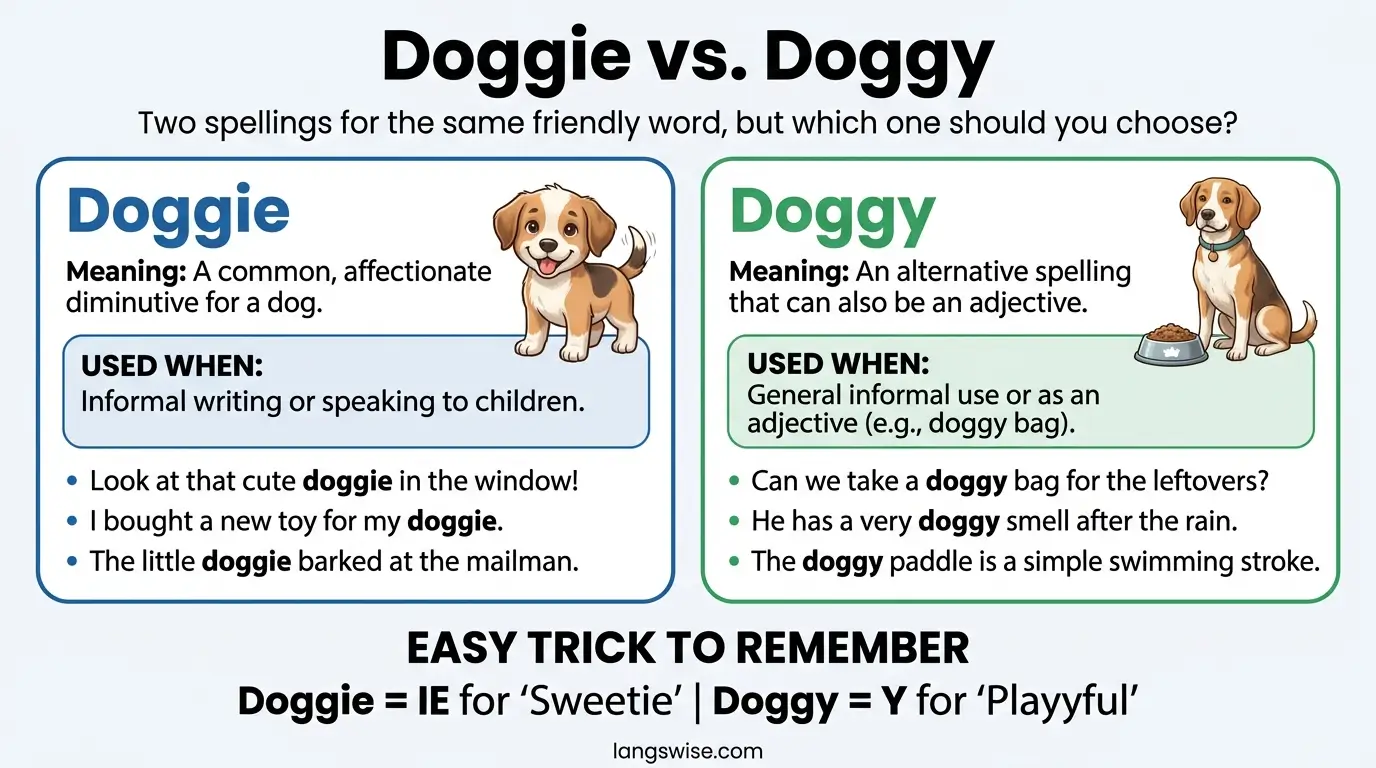
Have you ever typed “doggie or doggy” and stopped to wonder which spelling is correct? You are not alone. Both doggie and doggy are common English spellings, and both can describe a dog in a cute, informal, or affectionate way.
The confusion usually comes from the fact that English often allows more than one spelling for the same informal word. Unlike some spelling differences that separate British and American English, doggie and doggy are mainly variant spellings rather than strict US-versus-UK forms.
So, should you write “cute doggie” or “cute doggy”? In most everyday situations, either spelling is acceptable. However, one form may look more natural depending on your audience, writing style, and context.
In this guide, we will explain the difference between doggie or doggy, where the words came from, how they are used in British and American English, and which spelling works best in casual and professional writing.
Doggie or Doggy Quick Answer
Doggie and doggy are both correct spellings.
Both words are informal terms for a dog, often used when speaking affectionately about a dog or to children.
Examples:
- “Look at that cute doggie!”
- “The little doggy is sleeping.”
- “My doggie loves going for walks.”
- “That doggy has a very long tail.”
Quick comparison
| Spelling | Correct? | Meaning | Common use |
| Doggie | Yes | A dog, usually affectionately | Casual, cute, child-friendly |
| Doggy | Yes | A dog, usually affectionately | Casual, cute, child-friendly |
| Dog | Yes | Standard word for a dog | All contexts |
If you are writing something formal, simply use dog. If you want a warm, playful, or affectionate tone, doggie or doggy can work.
The Origin of Doggie or Doggy
The words doggie and doggy come from the basic English word dog.
Both forms use a common English pattern: adding a suffix to make a word sound smaller, younger, cuter, or more affectionate.
The endings -ie and -y can both serve this purpose.
For example:
- dog → doggie
- dog → doggy
- cat → kitty
- pig → piggy
- bird → birdie
The spelling difference developed naturally through English usage. English has many words with alternative spellings, especially informal and affectionate terms.
Doggie uses the -ie ending, while doggy uses -y. The pronunciation can be very similar, although speakers may give the words slightly different sounds depending on dialect and context.
Neither spelling is simply a “misspelling” of the other. Both have established use.
British English vs American English Spelling
Unlike words such as colour/color or centre/center, doggie/doggy is not a major British-versus-American spelling distinction.
Both forms can appear in British and American English.
However, individual speakers, publications, children’s books, brands, and websites may prefer one spelling.
| Feature | Doggie | Doggy |
| Meaning | Affectionate/informal dog | Affectionate/informal dog |
| British English | Used | Used |
| American English | Used | Used |
| Formal writing | Usually avoid | Usually avoid |
| Children’s language | Common | Common |
| Social media | Common | Common |
| Standard alternative | Dog | Dog |
Why do both spellings exist?
English spelling is not always perfectly consistent. Informal words can develop different forms through speech, regional preferences, publishing traditions, and personal style.
That is why you may see doggie in one book and doggy in another without either being incorrect.
Which Spelling Should You Use?
The best spelling depends on your audience and the tone of your writing.
For American readers
Both doggie and doggy are understandable and acceptable in informal writing.
If you are writing a children’s story, social media post, or casual message, choose the form that fits your style.
For British and Commonwealth readers
The same basic rule applies. Both spellings can be found in informal English.
If your publication follows a particular house style, use the spelling preferred by that style guide.
For a global audience
If clarity is your main goal, dog is the safest choice.
For example:
- Informal: “Look at that adorable doggy!”
- Neutral: “Look at that adorable dog!”
For professional writing
Avoid doggie and doggy when you need a formal or technical tone.
Instead, use:
- dog
- domestic dog
- canine
- the animal
- the pet
For example:
Informal: “The doggie was taken to the vet.”
Professional: “The dog was taken to the veterinarian.”
Common Mistakes with Doggie or Doggy
Mistake 1: Thinking one spelling is always wrong
It is incorrect to assume that doggie is always right and doggy is always wrong, or vice versa.
Correct: “Cute doggie!”
Correct: “Cute doggy!”
Mistake 2: Using the word in formal writing
Both forms are informal.
Instead of:
“The doggy displayed unusual behavior.”
A formal report could say:
“The dog displayed unusual behavior.”
Mistake 3: Confusing “doggy” with “doggy-style”
The word doggy can appear in different expressions. Context matters.
For ordinary affectionate speech about a dog, the meaning is usually clear.
Mistake 4: Assuming the spelling changes the meaning
In most everyday use, doggie and doggy mean essentially the same thing.
The main difference is spelling and style, not meaning.
Doggie or Doggy in Everyday Examples
In emails
Informal:
“Thanks for looking after my doggie while I was away!”
Professional:
“Thank you for taking care of my dog while I was away.”
In news writing
News articles normally use dog rather than doggie or doggy.
Example:
“The dog was rescued after being trapped in the house.”
This is clearer and more professional.
On social media
Both forms work well:
“My doggie knows exactly when dinner is coming!”
or:
“My doggy is ready for the weekend!”
Social media allows playful language, so either spelling can fit.
In children’s writing
Both forms can create a friendly, playful tone:
“The little doggie wagged its tail.”
“The happy doggy ran across the garden.”
In formal writing
Use dog:
“The dog requires regular exercise and veterinary care.”
This keeps the tone professional and precise.
Doggie or Doggy Google Trends & Usage Data
Search interest for doggie and doggy can vary by country, period, and context.
Google Trends can be useful for comparing search interest, but it is important to understand what the numbers mean. Google Trends generally measures relative search interest, not the total number of words used in everyday speech or writing.
Search behavior can also be affected by:
- Children’s content
- Pet websites
- Social media
- Dog products
- Songs and entertainment
- Regional spelling preferences
- Seasonal interest in pets
The two spellings may also behave differently depending on the search phrase. For example, people searching for a definition may use “doggie meaning,” while people looking for cute pet content may search for phrases such as “cute doggy.”
For SEO, this means you do not necessarily need to choose only one spelling. A useful article can naturally mention both “doggie” and “doggy” while focusing on the user’s actual question.
Doggie vs Doggy: Comparison Table
| Variation | Meaning | Tone | Best context |
| doggie | Dog | Cute, affectionate | Casual speech, children, social media |
| doggy | Dog | Cute, affectionate | Casual speech, children, social media |
| dog | Dog | Neutral | Everyday and professional writing |
| canine | Dog or member of the dog family | Formal/technical | Scientific and professional writing |
FAQs About Doggie or Doggy
Is “doggie” or “doggy” correct?
Both doggie and doggy are correct informal spellings. They are commonly used as affectionate terms for a dog.
Is “doggy” more correct than “doggie”?
No. Neither spelling is universally more correct. Both have established usage.
Is “doggie” American or British?
Doggie can be used in both American and British English. It is not exclusively associated with one variety.
Is “doggy” a real word?
Yes. Doggy is an established English word and is commonly used informally to mean a dog.
Should I use “doggie” in formal writing?
Usually, no. Use dog instead when writing reports, academic material, business content, or other formal documents.
Which spelling is better for SEO: doggie or doggy?
If your target keyword is “doggie or doggy,” use that exact phrase naturally. You can also mention both doggie and doggy throughout the article to cover related searches.
Can doggie and doggy mean different things?
Usually, no. In ordinary conversation, they both refer affectionately to a dog. Context can give the word a slightly different tone, but the basic meaning is the same.
Conclusion
So, doggie or doggy? The simple answer is that both spellings are correct. They are informal, affectionate ways to refer to a dog, and neither spelling is limited strictly to British or American English.
The main difference is stylistic. Doggie uses the -ie ending, while doggy uses the -y ending. Both forms appear in casual speech, children’s language, social media, and other friendly contexts.
If you are writing for a professional, academic, or formal audience, dog is usually the better choice. It is neutral, clear, and widely understood.
For casual content, choose either doggie or doggy based on your preferred style and audience. Most readers will understand both immediately.
For SEO, the important point is to address both forms naturally. If someone searches “doggie or doggy,” they usually want a quick spelling answer. Give them that answer first, then explain the history, regional usage, examples, and context.

Langswise explains English grammar, spelling and vocabulary in simple, practical guides.