

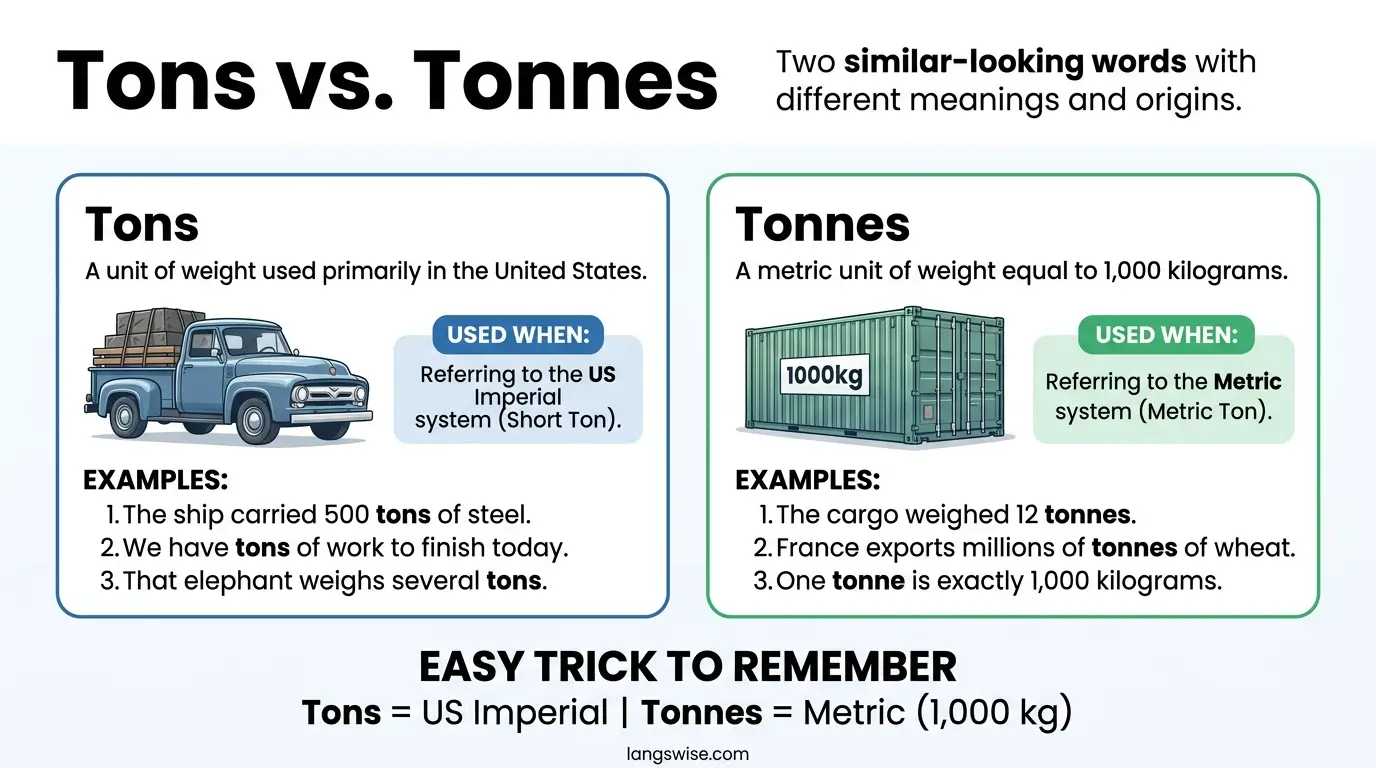
Have you ever stopped before writing a sentence and wondered, “Should I write tons or tonnes?”
You are not alone. Both forms are correct, but they are used in different types of English and can refer to different units of weight.
The confusion often starts because tons and tonnes sound almost the same. They also look like simple spelling variations. In fact, there can be a measurement difference too.
A US ton is 2,000 pounds, or about 907 kilograms. A tonne is 1,000 kilograms, or about 2,205 pounds.
People search for “tons or tonnes” when writing emails, reports, essays, news stories, product descriptions, and technical documents.
They want to know which spelling is correct and which word fits their audience.
The good news is simple: tons is common in American English, while tonnes is the standard spelling for the metric unit in British English and much international writing.
This guide explains the difference, history, usage, and best choice for professional writing.
Tons or Tonnes Quick Answer
Both “tons” and “tonnes” are correct.
The right choice depends on your English variety and the unit you mean.
- Tons — common in American English.
- Tonnes — common in British English and many countries using the metric system.
- 1 tonne = 1,000 kilograms.
- 1 US ton = 2,000 pounds, or about 907 kilograms.
- 1 UK long ton = 2,240 pounds, or about 1,016 kilograms.
Examples
American English:
The factory produces 50 tons of steel each year.
British English:
The factory produces 50 tonnes of steel each year.
If you mean the metric unit and want to avoid confusion for an international audience, metric tonnes or metric tons can make the meaning clear.
Tons vs Tonnes at a Glance
| Word | Main use | Weight |
| tons | US customary usage | 2,000 lb / 907 kg |
| tonnes | Metric usage | 1,000 kg / 2,205 lb |
| long tons | Traditional British measurement | 2,240 lb / 1,016 kg |
| metric tons | US term for 1,000 kg | 1,000 kg |
The key point is that tons and tonnes are not always just spelling variants. The unit may be different.
The Origin of Tons or Tonnes
The word ton has a long history. Oxford traces ton to Middle English tun, with both spellings used for a large container and for weight.
The different senses became more clearly separated in the late 17th century.
The older word was linked to a tun, a large barrel or container. Over time, the word became connected with a measure of weight.
The word tonne appeared later. Oxford gives its origin as the late 19th century, from French, and links it to ton.
Collins dates the English use of tonne to around 1900–05 and also identifies French as its source.
The spelling tonne became useful for the metric unit of 1,000 kilograms. This helped distinguish it from older ton measurements.
So, why do we have two spellings?
The answer is partly history and measurement systems. Different countries developed and kept different systems of measurement.
The United States retained the short ton as a common unit, while most of the world moved toward the metric system.
Today, tonne is strongly associated with the metric unit, while ton can mean several different units depending on the country and context.
British English vs American English Spelling
The simplest spelling rule is:
American English → tons
British English → tonnes when referring to the metric unit.
For example:
- US: The shipment weighs 20 tons.
- UK: The shipment weighs 20 tonnes.
However, there is an important detail. In the United States, ton normally means the short ton unless the writer says metric ton. In Britain, ton can refer to the long ton, while tonne means 1,000 kilograms.
Comparison Table
| Feature | American English | British English |
| Common metric spelling | metric tons | tonnes |
| Common spelling | tons | tonnes |
| US short ton | 2,000 lb | 2,000 lb if specifically meant |
| UK long ton | 2,240 lb | 2,240 lb |
| Metric tonne | 1,000 kg | 1,000 kg |
| Example | 10 metric tons | 10 tonnes |
| Informal “a lot” | tons of work | tons of work |
One more point matters for writers: “tons” can also be an informal expression meaning a large amount.
For example:
I have tons of work today.
Here, tons does not describe a measured weight. It simply means a lot. Cambridge and Oxford both list this informal use.
Which Spelling Should You Use?
Choose the spelling that matches your audience, country, and measurement system.
For US readers
Use tons for the US unit.
Example:
The truck can carry 10 tons.
If you mean 1,000 kilograms, use metric tons:
The shipment contains 10 metric tons of grain.
This avoids confusion.
For UK readers
Use tonnes for the metric unit.
Example:
The company exported 10 tonnes of wheat.
Use tons only when the context calls for a ton measurement or an informal expression.
For Commonwealth audiences
Countries such as Australia commonly use tonnes for the metric unit. Canadian English can use both ton and tonne, so the best choice depends on the publication and style guide.
For global audiences
If your readers come from many countries, clarity matters more than saving one word.
A good choice is:
The project will remove 500 tonnes of carbon dioxide each year.
Or, for a US-focused audience:
The project will remove 500 metric tons of carbon dioxide each year.
For scientific, engineering, environmental, and international business writing, stating metric can be useful when there is any chance of confusion.
Common Mistakes with Tons or Tonnes
Mistake 1: Treating every ton as 1,000 kg
This is not always correct.
A US ton is about 907 kg, while a tonne is exactly 1,000 kg.
Better:
The machine weighs 5 tonnes.
Or:
The machine weighs 5 metric tons.
Mistake 2: Assuming “tonne” is simply a British spelling of “ton”
This is only partly true.
The words are closely related, but they can identify different units.
Mistake 3: Mixing styles in one document
Avoid writing:
The factory produces 100 tons of steel.
The next section says it produces 100 tonnes.
If both refer to the same metric measurement, choose one style and use it consistently.
Mistake 4: Using “tons” when writing for a UK audience
This can look like American English.
US style:
50 tons of waste
UK style:
50 tonnes of waste
Mistake 5: Forgetting the informal meaning
“Tons of” often means “a lot of.”
She has tons of experience.
This does not mean she has a literal measurement of weight.
Mistake 6: Confusing short tons and long tons
A short ton is 2,000 pounds. A long ton is 2,240 pounds. Neither is exactly the same as a metric tonne.
Tons or Tonnes in Everyday Examples
The best spelling can change with the audience and type of writing.
In Emails
US English:
We expect to ship 25 tons of material next week.
UK English:
We expect to ship 25 tonnes of material next week.
In News Writing
A British news report may say:
The company produced 2,000 tonnes of steel last year.
An American report may use:
The company produced 2,000 tons of steel last year.
The exact unit should always be clear from the publication’s style and context.
On Social Media
The word can be informal:
I have tons of work to finish today!
Here, tons means “a lot.”
A UK user might write:
We collected three tonnes of waste this weekend
Here, tonnes refers to a real measurement
In Formal Writing
For a technical or academic audience, be precise:
The study recorded 15 tonnes of waste
For US readers:
The study recorded 15 metric tons of waste
This is clearer than simply writing “tons” when the measurement system matters.
In Business Writing
Consistency is important.
If a company uses metric measurements, write:
Annual production increased to 20,000 tonnes
If the company reports in US customary units:
Annual production increased to 20,000 tons
Always follow the company’s style guide when one exists
Tons or Tonnes Google Trends & Usage Data
People search for “tons or tonnes” because both forms appear online. Search interest also changes by country, language variety, and topic.
Google Trends does not normally provide a simple worldwide count such as “X million people searched for tons.” Instead, it uses a relative scale.
Search interest is normalized by location and time, with the most popular point in the selected comparison receiving a value of 100.
This means claims such as “tons is exactly three times more popular than tonnes” should be treated carefully unless they come from a clearly defined Google Trends comparison.
General Usage Pattern
The broad pattern is easy to understand:
| Search or writing context | More likely form |
| United States | tons |
| United Kingdom | tonnes |
| Australia | tonnes |
| International scientific writing | tonnes / metric tons |
| US technical writing | metric tons |
| Informal “a lot” | tons |
| UK environmental reports | tonnes |
Google Trends data should also be read in context. A search for “tons” can include many meanings, including the weight unit and the informal phrase “tons of.”
This makes direct comparisons between the two words less precise.
The practical SEO lesson is important: search popularity should not override language accuracy. If your site targets US readers, use tons naturally.
If it targets UK readers, use tonnes. If the audience is international, explain the unit clearly.
Comparison Table: Tons or Tonnes Variations
| Variation | Meaning | Typical audience | Example |
| tons | Usually US short tons | US English | 10 tons of coal |
| tonnes | Metric tonnes | UK and many international audiences | 10 tonnes of coal |
| ton | Can mean different ton units | Depends on country | 10 tons of steel |
| tonne | 1,000 kg | Metric usage | 10 tonnes of steel |
| metric ton | 1,000 kg | Especially US English | 10 metric tons of steel |
| short ton | 2,000 lb | US | 10 short tons |
| long ton | 2,240 lb | UK/traditional usage | 10 long tons |
FAQs About Tons or Tonnes
Is “tons” or “tonnes” correct?
Both are correct. Tons is common in American English, while tonnes is the standard term for the metric unit in British English and many international contexts.
Is a tonne the same as a ton?
Not always. A tonne is 1,000 kg. A US ton is 2,000 pounds, or about 907 kg.
Which is British, tons or tonnes?
For the metric unit, tonnes is the usual British spelling.
Which is American, tons or tonnes?
Tons is the usual American spelling. In US writing, metric tons is often used when the writer means 1,000 kg.
Is “tonnes” spelled with an e?
Yes. The spelling is tonnes in the plural and tonne in the singular.
Example:
One tonne of steel.
Ten tonnes of steel.
Why do Americans use “tons”?
The United States commonly uses the short ton, which is 2,000 pounds. The word ton has a much older history and developed several measurement meanings over time.
Should I use tons or tonnes in SEO content?
Use the form that matches your target audience. For US SEO, tons is natural. For UK SEO, tonnes is usually better. For global content, include both naturally and explain the difference.
Can “tons” mean “a lot”?
Yes. In informal English, tons of means a large amount.
Example:
We have tons of options.
This use is not a measurement.
Conclusion: Tons or Tonnes?
The choice between tons or tonnes is simple once you know the audience and the unit.
Tonnes means 1,000 kilograms and is widely used in metric countries, including the UK and Australia.
Tons is common in American English, where an unqualified ton usually means 2,000 pounds.
The two words are closely related, but they should not always be treated as identical. A US ton is about 907 kilograms, while a tonne is 1,000 kilograms.
Traditional British usage also includes the long ton, which is 2,240 pounds.
For professional writing, always think about your readers first. Use tons for a US audience, tonnes for a UK or metric audience, and metric tons when writing for Americans but referring to 1,000 kilograms.
For international content, clarity and consistency matter most. If the measurement could cause confusion, state the unit clearly. And remember: when tons means “a lot,” it has nothing to do with weight.
