

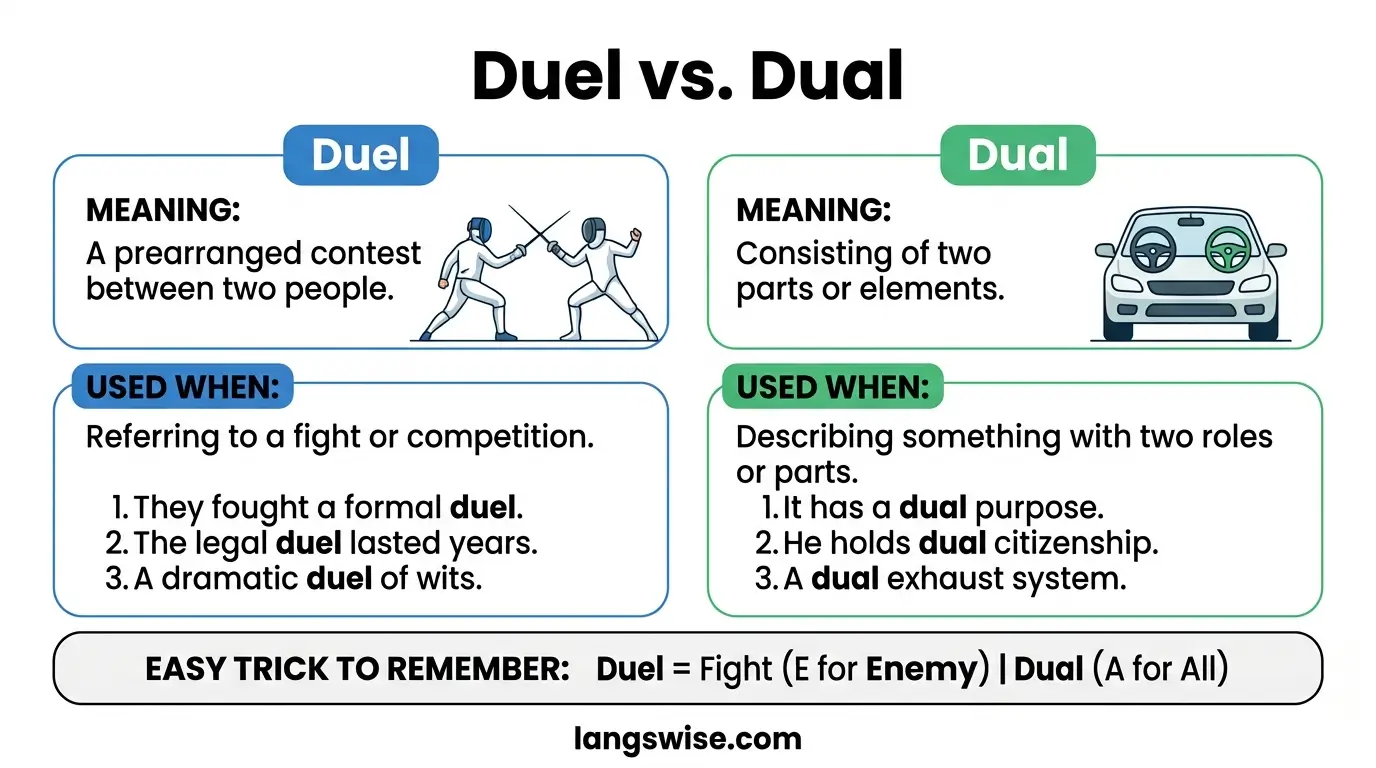
Have you ever typed “duel or dual” and stopped to ask which word is correct? You are not alone. These two words sound almost the same, but they have very different meanings.
One describes a fight between two people. The other describes something with two parts, uses, or sides.This small spelling difference can change the meaning of a sentence.
For example, “a duel” means a formal fight between two people. “A dual system” means a system with two parts. Using the wrong word can make an email, article, or school assignment confusing.
People search for “duel or dual” because English has many words that sound alike but have different spellings and meanings. These words are called homophones. Knowing the difference helps you write with confidence.
This guide gives you a quick answer first. Then, it explains the origin of both words, spelling differences, common mistakes, and everyday examples. It also gives practical advice for US, UK, Commonwealth, and global English users.
Duel or Dual Quick Answer
Duel means a fight or contest between two people.
Dual means having two parts, sides, or functions.
Examples
- Duel: The two knights fought a duel.
- Dual: The phone has a dual-camera system.
- Duel: The rivals agreed to a duel.
- Dual: She has dual citizenship.
Easy memory trick
Think of duel as a fight between two people.
Think of dual as two of something.
| Word | Meaning | Example |
| Duel | A fight or contest between two people | They fought a duel. |
| Dual | Having two parts or functions | It has a dual purpose. |
So, if you mean two, you usually want dual. If you mean a fight, you want duel.
The Origin of Duel or Dual
Although duel and dual look and sound similar, they come from different language roots.
Duel comes from the Latin word duellum, meaning a war or combat. Over time, it came to describe a fight between two people, often fought under agreed rules.
The word entered English through French and became linked with formal one-to-one combat.
Dual comes from the Latin word dualis, meaning “twofold” or “of two.” It developed from the Latin word duo, meaning “two.”
Their similar sounds are partly responsible for the confusion.
The words have also developed different meanings over time:
- Duel → a one-to-one fight or contest
- Dual → something involving two parts, choices, roles, or functions
The spelling difference helps separate these meanings in written English.
For example:
The two men prepared for a duel.
But:
The machine has a dual function.
The first sentence describes combat. The second describes something with two functions.
British English vs American English Spelling
There is no major British-versus-American spelling difference between duel and dual.
Both British English and American English use:
- duel for a fight or one-to-one contest
- dual for something involving two parts
Comparison
| Meaning | British English | American English | Example |
| Fight between two people | duel | duel | They fought a duel. |
| Having two parts | dual | dual | It has a dual purpose. |
| Fight as a verb | duel | duel | The rivals will duel. |
| Having two roles | dual | dual | He has a dual role. |
So, unlike words such as colour/color or centre/center, duel and dual do not normally change spelling between British and American English.
This makes the choice simple: choose the word based on meaning, not the country of your audience.
Which Spelling Should You Use?
Use duel when you are talking about a fight, battle, or contest between two people.
Use dual when you are talking about two parts, two roles, two purposes, or two functions.
For US English
American readers use the same spellings:
- a duel
- a dual role
- duel with an opponent
- dual citizenship
For UK and Commonwealth English
British and Commonwealth readers also use the same spellings:
- a duel
- a dual system
- duel between rivals
- dual nationality
For global English
If you write for an international audience, focus on the meaning. There is no need to change either spelling for British or American readers.
A useful rule is:
Fight = duel. Two parts = dual.
Common Mistakes with Duel or Dual
The most common mistake is using duel when the sentence needs dual.
Mistake 1: “Dual” when you mean a fight
Incorrect:
The two warriors had a dual.
Correct:
The two warriors had a duel.
Mistake 2: “Duel” when you mean two functions
Incorrect:
This tool has a duel purpose.
Correct:
This tool has a dual purpose.
Mistake 3: Confusing “dual” with “duel” in technology
Technology often uses the word dual because products can have two features.
Correct examples include:
- dual SIM
- dual camera
- dual monitors
- dual-band router
- dual-core processor
Mistake 4: Thinking they are spelling variants
They are not spelling variants of the same word.
Duel and dual are different words with different meanings.
Duel or Dual in Everyday Examples
The best way to remember the difference is to see the words in real sentences.
In Emails
The two candidates will duel in the final debate.
We need a dual approach to solve the problem.
In News
The two political rivals faced off in a verbal duel.
The company announced a dual investment strategy.
On Social Media
Tonight’s boxing match feels like a modern duel.
This phone has a dual-camera setup.
In Formal Writing
The study examines the dual role of technology in education.
Historical records describe the famous duel between the two men.
In Business
The manager has a dual role in the company.
The competitors entered a fierce market duel.
In Education
The course has a dual focus on theory and practice.
The novel includes a dramatic duel between its main characters.
Duel or Dual Google Trends & Usage Data
Search interest for “duel or dual” usually comes from people who are unsure which spelling fits a sentence. This makes the keyword a useful example of a spelling and word-choice query.
Search behavior can vary by country and context. Searches for dual are often connected with technology, business, education, and product features.
Searches for duel are more often connected with games, sports, history, books, films, and fiction.
For example:
- Dual → dual SIM, dual camera, dual citizenship, dual purpose
- Duel → sword duel, final duel, duel game, historic duel
Google Trends can also show different levels of interest by country and over time. However, search volume should not be treated as a measure of which spelling is “correct.” Both spellings are correct. Their meanings are different.
For SEO writers, the key lesson is simple: match the searcher’s intent. Someone searching “duel or dual” usually wants a quick definition, clear examples, and help choosing the correct word.
Duel vs Dual: Side-by-Side Comparison
| Feature | Duel | Dual |
| Meaning | A fight or contest between two | Having two parts or functions |
| Word type | Noun and verb | Adjective |
| Main idea | Conflict between two | Twofold or double |
| Example | They fought a duel. | She has a dual role. |
| Common phrases | sword duel, verbal duel | dual purpose, dual citizenship |
| British spelling | duel | dual |
| American spelling | duel | dual |
| Related idea | Fight | Two |
FAQs About Duel or Dual
Is it “duel” or “dual”?
Both are correct words, but they have different meanings. Use duel for a fight or contest between two people. Use dual for something with two parts or functions.
What is the difference between duel and dual?
Duel means a one-to-one fight or contest. Dual means having two parts, roles, or functions.
Is “dual purpose” correct?
Yes. Dual purpose means something has two purposes.
Example:
This tool has a dual purpose.
Is “duel purpose” correct?
No. If you mean something has two purposes, the correct phrase is dual purpose.
Is “duel citizenship” correct?
No. The correct phrase is dual citizenship because it means citizenship in two countries.
Is “duel” the British spelling and “dual” the American spelling?
No. This is a common misunderstanding. Both duel and dual are used in British and American English. The correct choice depends on meaning.
How can I remember duel vs dual?
Use this simple rule:
Duel = fight.
Dual = two.
If the sentence is about combat, choose duel. If it is about two parts or functions, choose dual.
Conclusion
The difference between duel or dual is easy once you connect each word with its meaning. Duel means a fight or contest between two people. Dual means having two parts, roles, sides, or functions.
These words sound alike, which is why they often cause confusion. However, they are not different British and American spellings. Both duel and dual are used in both forms of English.
When writing, ask yourself what you mean. If you are describing combat, use duel. If you are describing something that involves two, use dual.
This simple test works in emails, schoolwork, business writing, news articles, and everyday conversation.
Remember the easiest rule: duel means fight, while dual means two. Once you learn this distinction, you can avoid one of the most common word-choice mistakes in English and write with greater confidence.
