

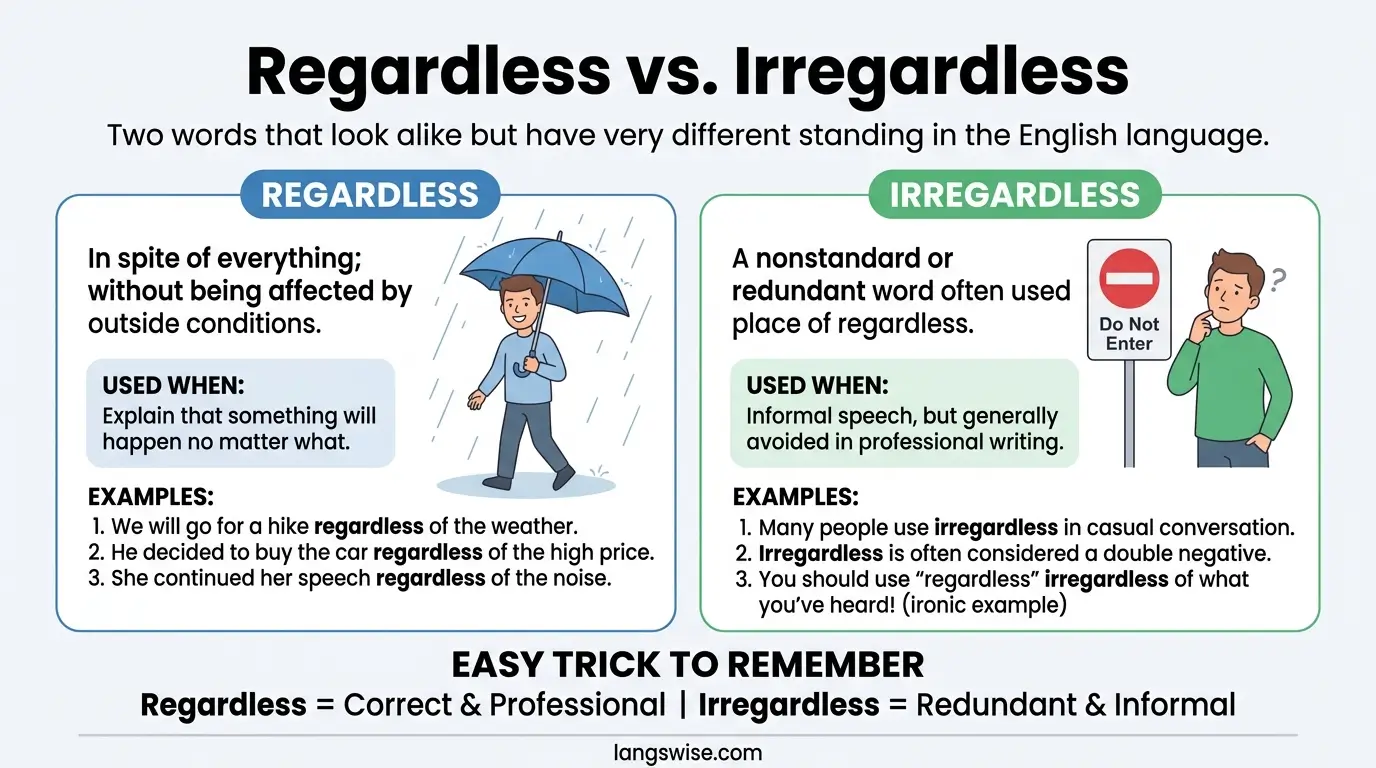
If you have ever stopped before writing “irregardless” or “regardless,” you are not alone. Many people search for “irregardless or regardless” because the two words look and sound very similar. Yet they do not have the same place in standard English.
The main confusion comes from everyday speech. Some people say “irregardless” and mean “regardless.” Others see it as a mistake because the word seems to contain two negative parts: ir- and -less.
This can make writers wonder which word is correct in an email, school paper, article, or business message.
The quick answer is simple: regardless is the standard and safest choice. Irregardless is a real word in some dictionaries, but it is often labeled nonstandard. It may sound natural in casual speech, but many readers still see it as incorrect.
This guide explains the difference, the history of both words, common mistakes, spelling rules, real-life examples, and which form you should use for your audience.
Irregardless or Regardless Quick Answer
Use “regardless” in standard English.
Regardless means:
- Despite something
- Without being affected by something
- No matter what happens
Examples
- Regardless of the weather, we will travel.
- She finished the project regardless of the cost.
- Regardless of what others think, he made his choice.
Irregardless is often used with the same meaning. However, it is widely seen as nonstandard.
Comparison Table: Irregardless vs Regardless
| Word | Meaning | Standard English? | Best Use |
| Regardless | Despite; no matter what | Yes | School, work, news, formal writing |
| Irregardless | Used to mean “regardless” | Often nonstandard | Casual speech only, if at all |
Professional advice: When you are unsure, always choose regardless.
The Origin of Irregardless or Regardless
The word regardless comes from the idea of acting without regard for something. In simple terms, it means not letting a fact, problem, or condition change your action.
For example:
Regardless of the rain, the game continued.
Here, the rain does not change what happens.
The word irregardless appeared later in American speech. It likely developed as a blend of words such as irrespective and regardless.
Because both words carry a similar idea, speakers may have combined them.
This is one reason spelling and usage differences can develop. Languages change through speech. People hear similar words, mix patterns, and create new forms.
The prefix ir- can suggest “not” in some English words, such as:
- Irregular
- Irresponsible
- Irrelevant
The ending -less can also suggest “without,” as in:
- Careless
- Fearless
- Endless
Because of this, some people think irregardless is a double negative. However, its history and modern use are more complex. The main issue is not simply grammar. The bigger issue is standard usage.
Today, regardless remains the accepted choice in formal and professional English.
British English vs American English Spelling
The question “irregardless or regardless” is mainly about word choice, not a major spelling difference between British and American English.
In both British and American English, regardless is the standard form.
Comparison Table
| Usage | American English | British English | Recommended Choice |
| Standard writing | Regardless | Regardless | Regardless |
| Formal writing | Regardless | Regardless | Regardless |
| Business writing | Regardless | Regardless | Regardless |
| Casual speech | Irregardless may be heard | Less common, but understood | Regardless |
| Dictionaries | Some list “irregardless” as nonstandard | Standard references favor “regardless” | Regardless |
British and American English do have many spelling differences. For example:
| American English | British English |
| Color | Colour |
| Organize | Organise |
| Center | Centre |
| Traveling | Travelling |
But regardless does not change.
This means you do not need to choose one spelling for the US and another for the UK. The same standard word works across both forms of English.
Which Spelling Should You Use?
The best choice depends on your audience, but the answer is almost always the same: use “regardless.”
For a US Audience
Use regardless in:
- Business emails
- School work
- Job applications
- News articles
- Website content
- Reports
Some Americans use irregardless in casual speech. Still, it may distract readers in professional writing.
For a UK or Commonwealth Audience
Use regardless.
This is the clear standard choice for readers in the UK, Canada, Australia, New Zealand, and other English-speaking regions.
For a Global Audience
Use regardless.
When writing for an international audience, clear and widely accepted English matters. “Regardless” is easy to understand and avoids confusion.
Best Rule to Remember
If your writing matters, use “regardless.”
This simple rule works in almost every situation.
Common Mistakes with Irregardless or Regardless
Here are some common errors and easy corrections.
Mistake 1: Using “Irregardless” in Formal Writing
Less suitable:
Irregardless of the results, we will continue.
Better:
Regardless of the results, we will continue.
The second version is clearer and more professional.
Mistake 2: Writing “Irregardless of” When You Mean “Regardless of”
Incorrect for standard writing:
Irregardless of the cost, we bought it.
Correct:
Regardless of the cost, we bought it.
Mistake 3: Confusing “Regardless” with “Irrespective”
Both words can have a similar meaning.
- Regardless of the cost, we continued.
- Irrespective of the cost, we continued.
However, irrespective can sound more formal.
Mistake 4: Using “Regardless” Without Clear Context
This sentence is possible but can sound incomplete:
Regardless, we continued.
A clearer option may be:
Regardless of the problem, we continued.
Or:
The problem remained. Regardless, we continued.
Mistake 5: Thinking “Irregardless” Is Always a Double Negative
This is a common explanation, but it is too simple. The word has been used to mean regardless, not the opposite of regardless.
Still, because many readers see it as incorrect, it is best to avoid it in formal writing.
Irregardless or Regardless in Everyday Examples
Understanding real-life use can make the difference easier to remember.
In Emails
Professional:
Regardless of the delay, we expect to complete the project this week.
Less suitable for work:
Irregardless of the delay, we expect to complete the project this week.
For professional emails, use regardless.
In News Writing
The event continued regardless of the heavy rain.
News writing often aims for clear and standard language. “Regardless” is the better choice.
On Social Media
A casual post may say:
Irregardless, I am going!
People may understand the meaning. However, some users may correct or criticize the word.
A safer version is:
Regardless, I am going!
In Formal Writing
Regardless of the challenges, the company achieved its goals.
This sounds clear, direct, and professional.
In Everyday Conversation
You may hear:
Irregardless of what happens, I will be there.
The speaker usually means:
Regardless of what happens, I will be there.
In speech, language can be more flexible. In writing, standard usage is usually the better choice.
Irregardless or Regardless Google Trends & Usage Data
Search interest in “irregardless or regardless” often comes from a simple question: Is “irregardless” a real word, or is it wrong?
The answer depends on what “real” means.
“Irregardless” appears in dictionaries and has been used in speech and writing for many years. However, many dictionaries label it as nonstandard.
That means the word exists and is understood, but it is not widely accepted as standard English.
Usage also depends on country and context.
In the United States
The term irregardless is more likely to appear in searches and discussions about grammar. It is often used in casual speech and is a common topic in language debates.
In the United Kingdom and Other English-Speaking Countries
Regardless is the expected standard form. “Irregardless” may be understood, but it is less suitable for formal writing.
In Global English
People learning English often search for this keyword because they want a safe answer for exams, work, and professional communication.
The safest choice across countries is clear:
Regardless is standard, widely accepted, and professional.
Search interest around the keyword also rises because people often see “irregardless” in online comments, social media posts, or spoken conversations and want to check whether it is correct.
Quick Comparison: Keyword Variations
| Variation | Meaning | Standard? | Where to Use |
| Regardless | Despite; no matter what | Yes | Everywhere |
| Irregardless | Used to mean regardless | Often nonstandard | Avoid in formal writing |
| Regardless of | Despite something | Yes | Formal and informal writing |
| Irrespective of | Without considering something | Yes | More formal writing |
| No matter | Regardless of what happens | Yes | Everyday English |
Example Comparison
- Regardless of the weather, we will go.
- Irrespective of the weather, we will go.
- No matter the weather, we will go.
All three standard options work, but regardless of is often the simplest and most natural choice.
FAQs About Irregardless or Regardless
Is “irregardless” a real word?
Yes, irregardless appears in some dictionaries. However, it is often labeled nonstandard. For formal and professional writing, use regardless.
Which is correct: irregardless or regardless?
Regardless is the standard and recommended choice.
Is “irregardless” wrong?
It is widely considered nonstandard. People may understand it, but many readers and editors see it as incorrect or unnecessary.
Why do people say “irregardless”?
The word may have developed through the influence of similar words, such as irrespective and regardless. It became part of informal speech for some speakers.
Is “irregardless” a double negative?
Not exactly in the usual grammatical sense. Although ir- and -less can both suggest negative meanings in other words, “irregardless” is used to mean the same as “regardless.” The bigger issue is that it is nonstandard.
Can I use “irregardless” in a business email?
It is best not to. Use regardless to sound clear and professional.
Is “regardless” used in both British and American English?
Yes. Regardless is standard in both British and American English.
What is a better alternative to “irregardless”?
Use:
- Regardless
- Regardless of
- Irrespective of
- No matter
The best choice depends on the sentence and tone.
Conclusion
The debate over “irregardless or regardless” is easy to solve once you know the difference. Regardless is the standard word and the best choice for almost every type of writing.
You can use it in emails, school work, articles, reports, news content, and professional documents without worrying about your audience or location.
Irregardless is more complicated. It is a word that has appeared in dictionaries and has a long history in informal speech.
However, many people still view it as nonstandard. Because of this, it can weaken professional writing or distract your reader from your main message.
There is also no British versus American spelling choice here. Both forms of English use regardless as the standard option. If you write for a global audience, the same advice applies.
The simplest rule is also the best one: use “regardless” when you want clear, correct, and professional English. If you mean “despite something” or “no matter what,” “regardless” will almost always give you the right result.
