

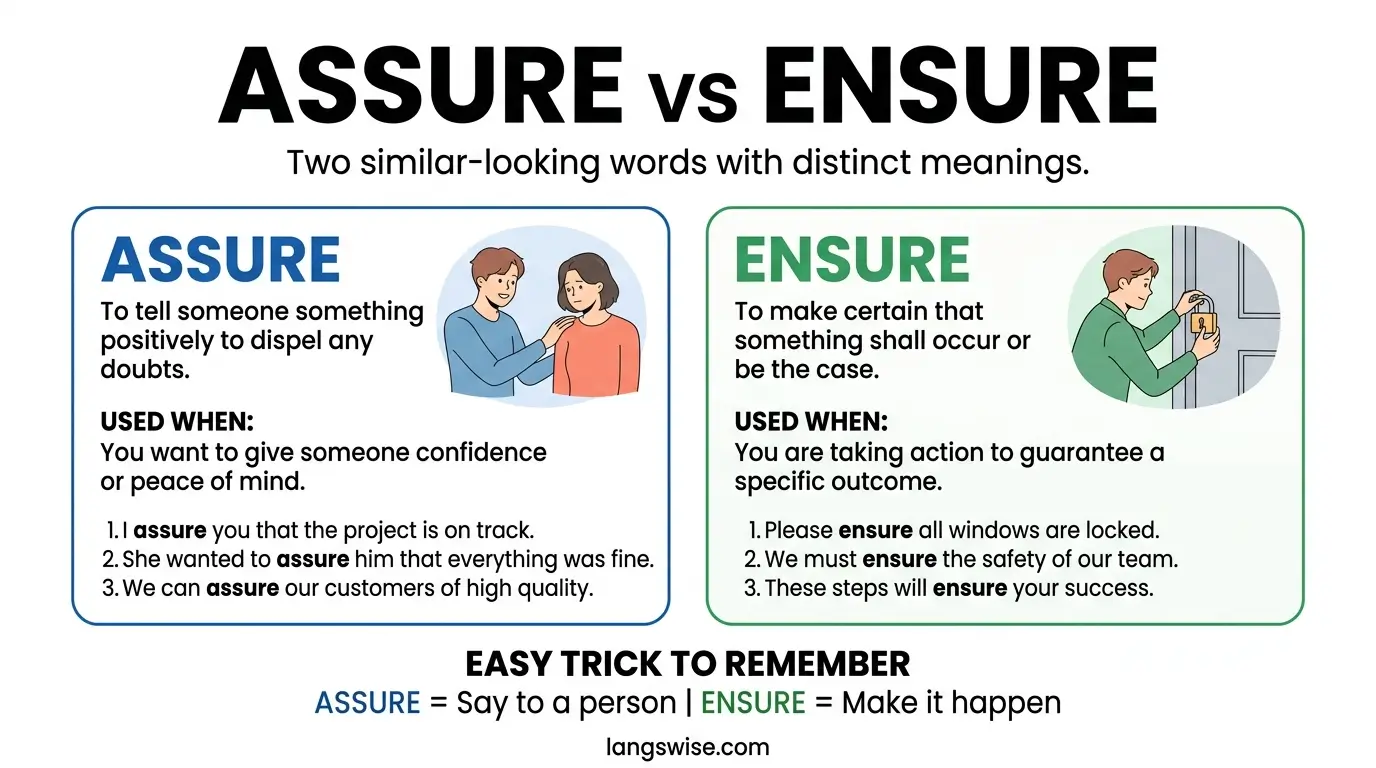
Have you ever stopped while writing an email and wondered, “Should I write assure or ensure?” You are not alone.
These two words look almost the same, sound similar, and both relate to making something certain. That makes them easy to mix up.
The good news is simple: assure usually relates to a person, while ensure usually relates to an action, result, or condition.
For example, you can assure someone that everything is fine, but you ensure that everything is ready.
People search for “assure or ensure” because the difference is small but important. The wrong word can make an email, report, essay, or business message sound less precise.
The confusion becomes even greater because English has many words with similar forms, such as insure, which has a strong connection with insurance.
This guide explains the difference in simple terms. You will learn where the words came from, whether British and American English spell them differently, how to use them in everyday writing, and which word works best in professional situations.
Assure or Ensure Quick Answer
Assure means to tell someone something confidently or remove their doubts.
Ensure means to make sure that something happens or is true.
| Word | Simple meaning | Example |
| Assure | Give someone confidence | I assure you that the report is accurate. |
| Ensure | Make something certain | Please ensure that the report is accurate. |
Easy rule to remember
- Assure a person.
- Ensure a result.
For example:
- Correct: I assure you that we will help.
- Correct: We will ensure that you receive help.
- Incorrect for the usual meaning: I ensure you that we will help.
There is some overlap. Dictionaries note that assure can sometimes have the meaning “ensure.” However, modern professional writing is clearer when you use assure for confidence or promises and ensure for making an outcome certain.
The Origin of Assure or Ensure
The words assure and ensure have a shared history. Both are connected to older French and Latin words linked to the idea of being sure, safe, or secure.
Assure entered English from Middle English assuren, from Old French asseurer, and ultimately from Latin roots related to securus, meaning “secure.”
Ensure also has a long history. Etymological sources trace it to late Middle English and Anglo-French enseurer, formed from elements meaning roughly “make” and “sure.”
This shared background helps explain why the words look and sound alike.
Over time, English gave the words slightly different jobs. Assure became strongly linked with giving confidence to people. Ensure became strongly linked with making an event, condition, or result certain.
The spelling difference is therefore not simply a modern spelling rule. It comes from the different historical forms that developed from related roots.
It is also useful to remember insure. This word shares the same broad history, but today it is most strongly associated with insurance.
British English vs American English Spelling
Unlike colour/color or centre/center, assure and ensure do not have separate British and American spellings.
Both British English and American English normally use:
- assure
- ensure
- assured
- ensured
- assuring
- ensuring
The main difference is meaning and usage, not spelling.
| Feature | British English | American English |
| Assure | assure | assure |
| Ensure | ensure | ensure |
| Past form | assured / ensured | assured / ensured |
| “Give confidence” | assure | assure |
| “Make certain” | ensure | ensure |
| Insurance word | insure; some special British uses of assure | insure |
For example, these sentences are correct in both varieties:
I assure you that the information is correct.
Please ensure that all forms are signed.
There are some historical and regional differences in how assure, ensure, and insure may overlap. Collins notes that British English has some additional uses of assure connected with insurance.
However, for general international writing, the clearest approach is to use assure for people and ensure for results.
Assure or Ensure: Comparison Table
| Context | Use | Example |
| Reassuring a customer | Assure | We assure you that your data is safe. |
| Promising someone something | Assure | I assure you that we will respond. |
| Making an outcome certain | Ensure | This process will ensure better results. |
| Checking that something happens | Ensure | Please ensure that the door is locked. |
| Following instructions | Ensure | Ensure all fields are complete. |
| Guaranteeing quality | Ensure | These checks ensure product quality. |
Which Spelling Should You Use?
The answer is easy: use the same spellings in both American and British English.
The choice depends on what you mean.
For a US audience
Use assure when you are speaking to a person:
I assure you that your request is being reviewed.
Use ensure when you are talking about making something happen:
Please ensure that your request is complete.
For a UK or Commonwealth audience
The same basic rule works:
We assure customers that their information is secure.
New checks will ensure better service.
British English has some broader traditional uses for assure, especially in insurance-related contexts, but these are less important for most everyday writing.
For a global audience
Ensure is often the safest choice when you mean “make sure” or “guarantee an outcome.”
For example:
Please ensure that all documents are attached.
This is clear in business, academic, technical, and international English.
When you are directly giving someone confidence, use assure:
We assure our customers that their information is protected.
Microsoft’s style guidance follows the same useful distinction: ensure means make sure or guarantee, while assure means state positively or make someone confident.
Common Mistakes with Assure or Ensure
Mistake 1: Using “ensure” with a person
Incorrect or awkward:
I ensure you that everything is fine.
Better:
I assure you that everything is fine.
The person is receiving confidence, so assure is the better choice.
Mistake 2: Using “assure” for a process
Less clear:
Please assure that the files are backed up.
Better:
Please ensure that the files are backed up.
The sentence is about making sure a process or condition happens.
Mistake 3: Thinking they are British and American spellings
This is a common misunderstanding.
Assure is not the British version of ensure, and ensure is not the American version of assure.
Both words are used in both varieties of English.
Mistake 4: Confusing “ensure” with “insure”
Use ensure when you mean “make certain”:
We must ensure that the system works.
Use insure when you mean insurance:
We need to insure the vehicle.
Merriam-Webster notes that insure can sometimes overlap with “make certain,” but its major modern use is connected with insurance.
Mistake 5: Overusing “assure”
In business writing, writers sometimes use assure when they really mean ensure.
Compare:
We assure compliance with the rules.
We ensure compliance with the rules.
The second sentence is normally clearer because compliance is an outcome that must be achieved.
Assure or Ensure in Everyday Examples
In emails
Assure:
I assure you that we are looking into the issue.
Ensure:
Please ensure that you include your order number.
In customer service
Assure:
We assure you that your complaint is being reviewed.
Here, the company is giving confidence to the customer.
In news writing
Ensure:
Officials introduced new measures to ensure public safety.
This is about measures designed to produce a result.
On social media
Assure:
We assure our followers that your feedback matters.
Ensure:
These new steps will ensure faster service.
In formal writing
Ensure:
The study used several checks to ensure accurate results.
Assure:
The director assured employees that no changes were planned.
In academic writing
Ensure is often useful when describing methods:
Researchers followed strict procedures to ensure reliable results.
Use assure when describing what a person said to remove doubt:
The researcher assured participants that their responses were confidential.
Assure or Ensure Google Trends & Usage Data
Search interest in “assure or ensure” reflects a common language problem: people want a fast answer before choosing a word in an email, essay, report, or other piece of writing.
Exact Google Trends numbers can change by date, country, search category, and selected time period. For that reason, it is better not to treat a single search-interest score as a permanent measure of word popularity.
The broader usage pattern is clear. Ensure is common in business, technical, legal, policy, academic, and instructional writing because these fields often discuss processes and results.
Assure appears often when a person, company, or official gives confidence or makes a promise. Dictionary evidence also shows this distinction in modern usage.
Searches about these words are especially useful in international English because writers in countries such as the United States, United Kingdom, Canada, Australia, India, and Pakistan may encounter both words in professional and educational settings.
The important point is this:
Search popularity does not decide which word is correct. Meaning decides.
Assure vs Ensure vs Insure
| Word | Main meaning | Example |
| Assure | Give confidence to a person | I assure you that we will help. |
| Ensure | Make something certain | We must ensure that the plan works. |
| Insure | Provide insurance or coverage | We insured the car against damage. |
This three-word distinction is also recommended by Microsoft’s international style guidance because it improves clarity for a worldwide audience.
FAQs About Assure or Ensure
Is “assure” or “ensure” correct?
Both are correct words. The correct choice depends on meaning. Assure usually means to give a person confidence. Ensure usually means to make something certain.
Can I say “I ensure you”?
Usually, no. In normal modern English, say:
I assure you that everything is fine.
Use ensure for an outcome:
We will ensure that everything is ready.
Is “ensure” British or American English?
Both. Ensure is standard in both British and American English.
Is “assure” British or American English?
Both. Assure is also used in both varieties.
Is “ensure” more formal than “assure”?
Not exactly. They have different main uses. Ensure is very common in formal and professional writing because it often describes procedures, conditions, and results.
What is the easiest way to remember assure vs ensure?
Remember:
Assure = a person.
Ensure = an outcome.
For example:
I assure you.
I ensure success.
This is not an absolute rule for every historical or dictionary use, but it is an excellent guide for modern professional writing.
What about “insure”?
Use insure mainly when you mean insurance or financial protection:
We insured the house against fire.
For “make sure,” use ensure:
We took steps to ensure the house was safe.
Conclusion
The difference between assure or ensure is easier than it first appears. Both words are correct, and neither is simply the British or American spelling of the other.
Use assure when you are giving confidence, making a promise, or removing doubt from a person. For example, “I assure you that the report is accurate.”
Use ensure when you mean to make something certain or make sure that an action or result happens. For example, “Please ensure that the report is accurate.”
The words have related histories, which helps explain their similar spelling and meaning. However, modern English gives them different common roles.
This distinction is useful in emails, business writing, academic work, news, and everyday communication.
If you are unsure, use the simple test: Are you reassuring a person? Choose assure. Are you making an outcome certain? Choose ensure. Also remember insure, which is mainly connected with insurance.
Once you learn this simple pattern, choosing between these three similar words becomes much easier.
