

Have you ever written “mum” and wondered if it should be “mom” instead? Or perhaps you have seen both spellings and wondered which one is correct.
You are not alone. The search “mum or mom” is common because English changes from one country to another.
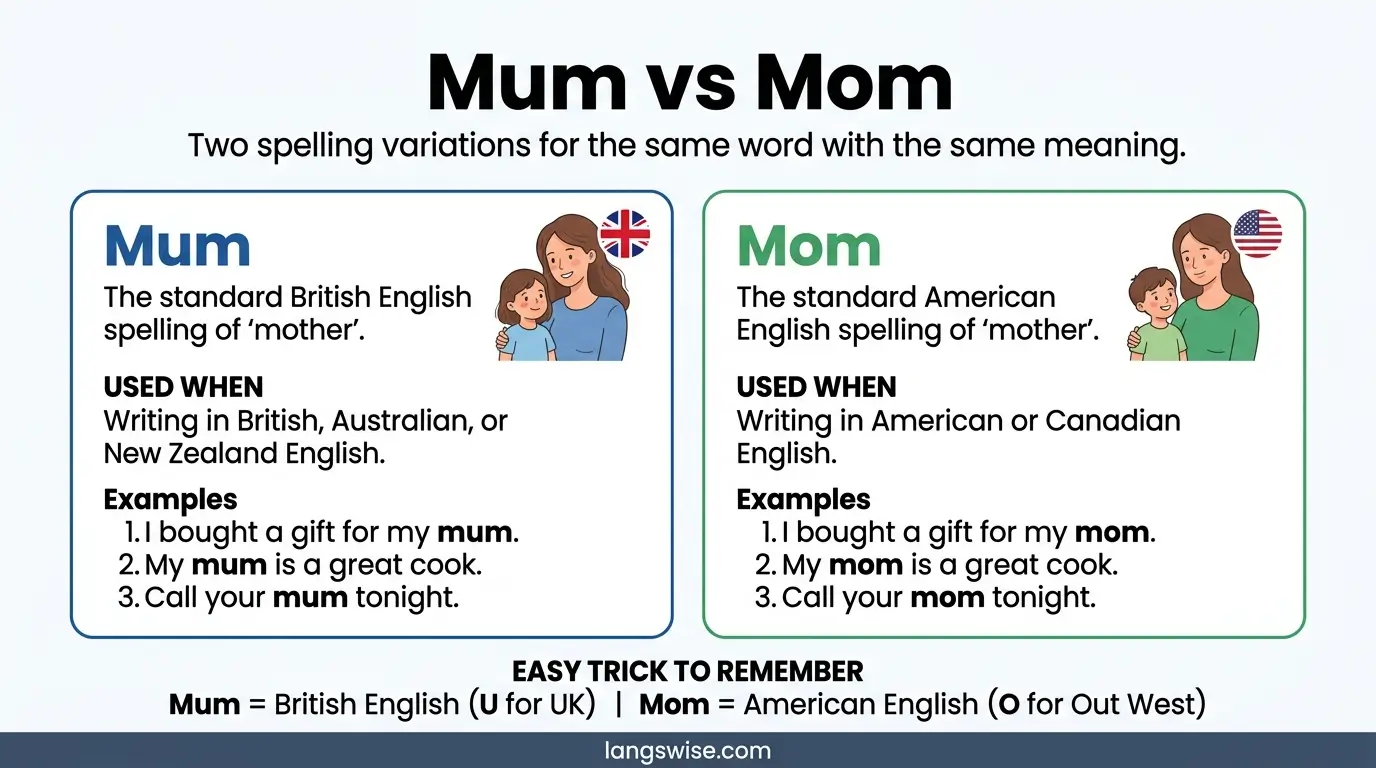
The good news is simple: both “mum” and “mom” are correct. They have the same basic meaning: a mother. The main difference is regional English.
“Mom” is the standard informal word in American English, while “mum” is common in British English, Australian English, and New Zealand English.
This small spelling difference can cause confusion for students, bloggers, writers, and English learners. It can also matter when writing for a specific country.
This guide explains mum or mom, where the words came from, when to use each spelling, common mistakes, and how usage differs around the world. By the end, you will know which form is best for your audience.
Mum or Mom Quick Answer
“Mum” and “mom” are both correct. The choice depends mainly on the type of English you are using.
- Mom → standard American English
- Mum → standard British English
- Mum → also common in Australia and New Zealand
- Mam → used in some parts of Britain and Ireland
- Mother → more formal and widely understood
Examples
American English:
I called my mom last night.
British English:
I called my mum last night.
Australian English:
My mum is coming home soon.
The meaning does not change. Only the regional form changes.
So, if you are writing for people in the United States, use mom. If you are writing for readers in the UK, use mum.
The Origin of Mum or Mom
The words mum and mom are informal forms of “mother.” They are linked to older forms such as mama, mamma, mummy, mommy, mam, and other family words.
The word mum meaning “mother” is recorded from the early 19th century. Etymonline dates this use to 1823 and describes it as a shortened form of “mummy.”
The word mom appeared later in recorded American English. Etymonline dates “mom” to 1867 and describes it as an American English shortening, possibly from “mommy.”
The deeper history goes back to simple forms such as ma and mama. Similar words for mother appear in many languages.
The Oxford English Dictionary notes that “mother” itself is an old Germanic word and is related to forms found across many Indo-European languages.
Why are there two spellings?
English developed differently in different regions.
British English kept the spelling mum, while American English developed and established mom as the usual form.
These are not two different words with different meanings. They are regional forms of the same informal idea.
It is also worth noting that mum has other meanings. For example, “keep mum” means to stay quiet. That meaning has a different history from “mum” meaning mother.
British English vs American English Spelling
The easiest rule is:
British English → mum
American English → mom
This is similar to other regional spelling differences in English. The important point is to match your spelling to your audience.
| Feature | British English | American English |
| Informal word for mother | Mum | Mom |
| Example | My mum is here. | My mom is here. |
| Common spelling | Mum | Mom |
| Formal alternative | Mother | Mother |
| Main region | UK | USA |
| Common in Australia | Yes | Less common |
| Common in New Zealand | Yes | Less common |
Mum or Mom variations side by side
| Word | Meaning | Main usage | Example |
| Mum | Mother | UK, Australia, New Zealand | My mum called me. |
| Mom | Mother | USA | My mom called me. |
| Mam | Mother | Some UK and Irish regions | My mam lives nearby. |
| Mama | Mother | Many English varieties | Mama is cooking. |
| Mommy | Mother | Mainly American, childlike | Mommy, can you help me? |
| Mummy | Mother | Mainly British, childlike | Mummy, look at this. |
| Mother | Female parent | Formal/global | My mother is a teacher. |
There is no need to “correct” mum to mom or mom to mum unless you are changing the regional style.
Which Spelling Should You Use?
The best spelling depends on your readers.
For a US audience: Use “mom”
If your readers are mainly American, mom is the natural choice.
Examples:
- My mom works in Chicago.
- I bought a gift for my mom.
- My mom taught me how to cook.
This is also the better choice for US-focused websites, school work, advertising, and local content.
For a UK audience: Use “mum”
For British readers, mum is the normal choice.
Examples:
- My mum works in London.
- I bought a gift for my mum.
- My mum taught me how to cook.
Using “mom” in a British context is understandable, but it can sound American.
For Australia and New Zealand: Use “mum”
Mum is also widely used in Australian and New Zealand English.
Examples:
- I called my mum.
- Happy Mother’s Day, Mum!
- My mum loves gardening.
For a global audience
If your website serves readers from many countries, either form can work. The key is consistency.
You can also use mother when the context is formal and you want to avoid regional differences.
For example:
The child’s mother attended the meeting.
This works naturally in both British and American English.
SEO advice
If you are writing online, choose the spelling that matches your target market.
- US SEO → mom
- UK SEO → mum
- Australian SEO → mum
- New Zealand SEO → mum
- Global SEO → consider using “mum or mom” in the title or article when explaining the difference
This lets you target people who search for the spelling question itself.
Common Mistakes with Mum or Mom
Mistake 1: Thinking one spelling is wrong
Incorrect idea:
“Mom” is the only correct spelling.
or:
“Mum” is the only correct spelling.
Better understanding: Both are correct. They belong to different regional forms of English.
Mistake 2: Mixing English styles
A writer may use mom in one paragraph and mum in another without a reason.
For example:
My mom lives in London. My mum works at a school.
If the writer is using one variety of English, this can look inconsistent.
Better:
My mum lives in London. My mum works at a school.
Or:
My mom lives in New York. My mom works at a school.
Mistake 3: Using “mum” when you mean “mother” in a formal context
“Mum” is informal.
In a formal report, this may sound better:
The child’s mother attended the meeting.
Instead of:
The child’s mum attended the meeting.
However, “mum” is perfectly fine when the writing is personal, conversational, quoted, or informal.
Mistake 4: Confusing “mum” with “silent”
The word mum can have another meaning.
Please keep mum about the surprise.
Here, mum means “silent” or “quiet.” It does not mean “mother.” This sense of “mum” has a much older history.
Mum or Mom in Everyday Examples
The best spelling often depends on the audience and setting.
In emails
American English:
Hi Mom,
I will call you after work.
British English:
Hi Mum,
I will call you after work.
Both are natural.
In news writing
A US publication may write:
The young mom returned to work after the birth of her child.
A UK publication is more likely to write:
The young mum returned to work after the birth of her child.
For formal news writing, mother is also common.
On social media
People normally use the word that matches their local English.
Examples:
Happy birthday to the best mum ever! ❤️
Happy birthday to the best mom ever! ❤️
Social media is also more flexible. People may use a different form because of family background, popular culture, or personal preference.
In formal writing
For formal documents, mother is usually the safest choice.
Example:
The child’s mother signed the form.
But if you are quoting someone, keep the original wording:
“My mom always encouraged me,” she said.
In school writing
Follow the English style expected by your school.
For British English:
My mum is very supportive.
For American English:
My mom is very supportive.
Consistency matters more than choosing one spelling as “better.”
Mum or Mom Google Trends & Usage Data
Search interest for “mum” and “mom” reflects the strong regional split in English.
In general, mom is strongly associated with the United States, while mum is strongly associated with the United Kingdom, Australia, and New Zealand.
Language references also identify “mum” as chiefly British and “mom” as the standard American form.
Google Trends should be understood as a measure of search interest, not a measure of which spelling is grammatically correct.
Search patterns can also change because of context. For example, searches may rise around:
- Mother’s Day
- family and parenting topics
- spelling questions
- school assignments
- social media posts
- gifts for mothers
- movies and TV shows
American media also exposes people around the world to mom, while British, Australian, and New Zealand media commonly use mum.
For SEO, this creates a useful lesson: search popularity does not mean correctness. A US website should normally target “mom,” while a UK website should normally target “mum.”
If your goal is to answer the spelling question itself, the combined keyword “mum or mom” is useful because it matches the way people search when they are unsure.
Comparison Table: Mum or Mom Variations
| Variation | Meaning | Main audience | Style | Example |
| Mum | Mother | UK, Australia, New Zealand | Informal | My mum is home. |
| Mom | Mother | USA | Informal | My mom is home. |
| Mam | Mother | Some UK/Ireland regions | Informal/regional | My mam is home. |
| Mama | Mother | Broad/global | Informal/affectionate | Mama is here. |
| Mommy | Mother | Mainly US | Childlike | Mommy, look! |
| Mummy | Mother | Mainly UK | Childlike | Mummy, look! |
| Mother | Female parent | Global | Formal/neutral | My mother is home. |
FAQs About Mum or Mom
Is “mum” or “mom” correct?
Both are correct. Mom is standard in American English, while mum is standard in British English and common in Australia and New Zealand.
Is “mum” British or American?
Mum is mainly associated with British English. It is also widely used in Australian and New Zealand English.
Is “mom” only American?
“Mom” is strongly associated with American English, but people outside the US may use it because of family background, media, or personal preference.
Can I use “mom” in the UK?
Yes. British readers will understand it, but mum is the usual British spelling.
Can I use “mum” in America?
Yes, Americans will understand it. However, mom is the normal American spelling.
Is “mam” also correct?
Yes. Mam is used in some regional forms of English, especially in parts of Britain and Ireland. It is not the standard spelling everywhere.
Which is better for formal writing: mum, mom, or mother?
Mother is usually the safest formal choice. Use mum or mom when the tone is personal, informal, or when quoting someone.
Which spelling should I use for SEO?
Use mom for a US audience and mum for UK, Australian, or New Zealand audiences. If your article explains the difference, using “mum or mom” as the target keyword can address both search intent and regional usage.
Conclusion
The answer to “mum or mom” is simple: both spellings are correct. The difference is mainly regional, not grammatical.
Use mom when writing in American English. It is the standard informal word for mother in the United States.
Use mum when writing in British English, and it is also common in Australia and New Zealand. Some parts of Britain and Ireland use mam as a regional form.
For formal writing, mother is often the best choice because it works across English varieties. For personal writing, emails, conversations, and social media, both “mum” and “mom” are natural when they match the speaker’s variety of English.
The most important rule is to know your audience and stay consistent. Do not change “mum” to “mom” simply because you think one is more correct. Neither is universally better.
For SEO, follow the same principle. Target mom for US readers, mum for UK and Commonwealth readers, or use “mum or mom” when your article is specifically answering the spelling question.
In short: British English uses “mum,” American English uses “mom,” and both are correct.
