
Have you ever typed “jinks or jinx” and stopped to wonder which spelling is right? You are not alone. These two words look and sound very similar, but they do not usually mean the same thing.
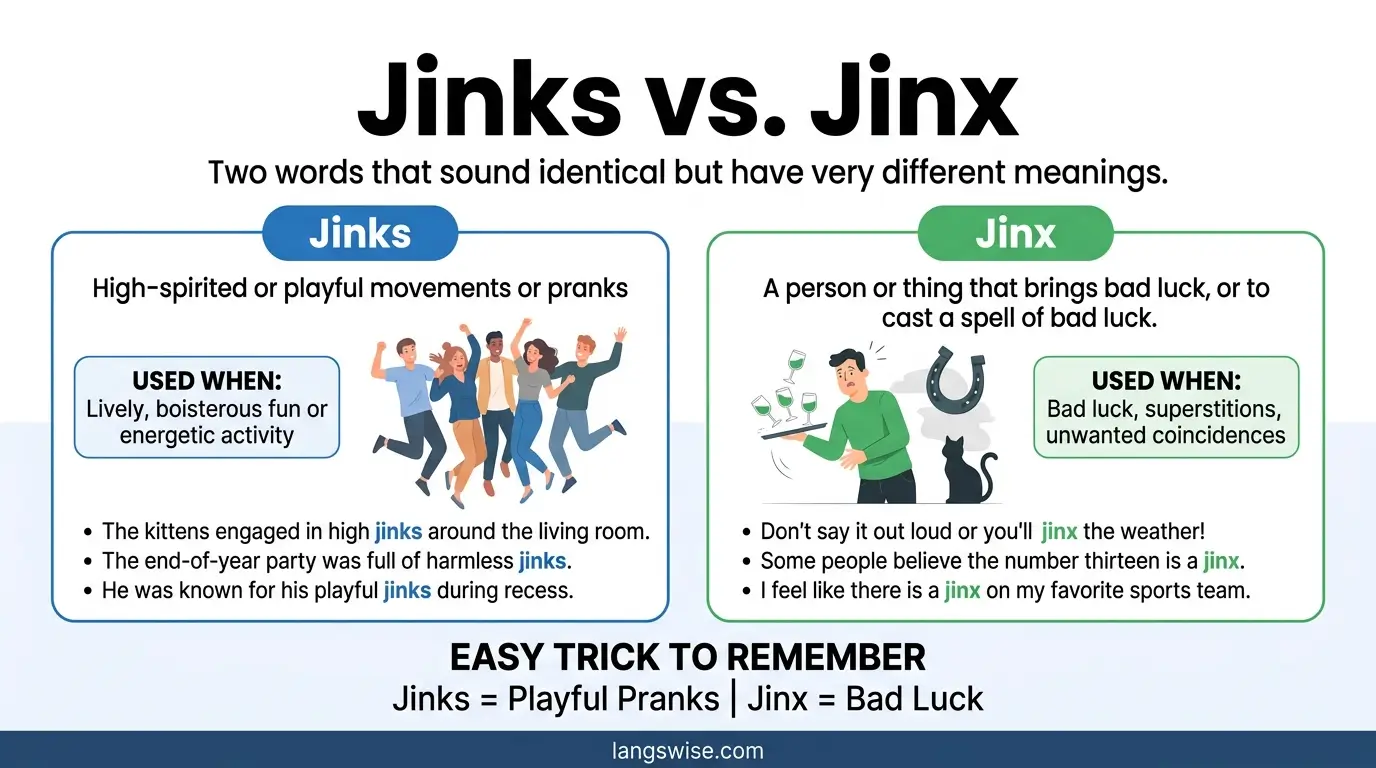
The correct choice depends on what you want to say. Jinx is the common word for bad luck, a person or thing believed to cause bad luck, or the act of bringing bad luck. For example, “I hope I do not jinx the game.”
Jinks, on the other hand, is mainly seen in the phrase “high jinks,” which means noisy, playful, or mischievous behavior.
It can also appear as the plural form of jink, a less common word linked with quick or evasive movement.
This guide explains jinks or jinx, their meanings, origins, spelling, British and American usage, common mistakes, and real-life examples. By the end, you will know exactly which word to use.
Jinks or Jinx Quick Answer
If you mean bad luck, the correct word is jinx.
- Jinx = bad luck, a source of bad luck, or to bring bad luck.
- Jinks = usually part of high jinks, meaning playful, wild, or mischievous behavior.
Examples
Correct:
I hope I do not jinx our chances.
That team seems to have a jinx on them.
The children were having high jinks at the party.
Incorrect for bad luck:
I hope I do not jinks our chances.
The main rule is simple:
Jinx = bad luck.
Jinks = playful or mischievous activity, usually in “high jinks.”
There is also a verb jink, which means to make a quick or sudden turn, especially to avoid something. Its third-person singular form is jinks: “The player jinks left.”
Jinks vs Jinx: Quick Comparison
| Word | Main meaning | Example |
| jinx | Bad luck or something that causes bad luck | “Do not jinx it.” |
| jinxed | Affected by bad luck | “The team seems jinxed.” |
| jinxing | Bringing bad luck | “You are jinxing our chances.” |
| jinks | Playful or mischievous behavior | “The film is full of high jinks.” |
| jinks | Moves suddenly or evasively, from jink | “The player jinks past the defender.” |
| high jinks | Lively, noisy, or mischievous activity | “The party ended with high jinks.” |
The Origin of Jinks or Jinx
The words jinks and jinx have different histories, although their forms are close enough to cause confusion.
The Origin of Jinks
Jinks is connected with the word jink. Dictionaries trace jink to older Scottish English. It referred to quick, sudden, or evasive movement.
Over time, the noun form jinks became associated with playful or mischievous activity.
The expression high jinks is much more familiar today than the standalone noun jinks. Oxford notes that high jinks originally referred to antics at drinking parties and dates back to the late 17th century.
The exact origin of jinks is not completely certain. Collins lists its word origin as the 18th century and describes it as being of unknown origin.
The Origin of Jinx
Jinx has a different story.
The modern noun jinx is associated with bad luck, a curse, or something believed to bring misfortune.
Merriam-Webster gives its first known use as 1902, while other historical sources place the word’s early American use around the beginning of the 20th century.
One proposed source is jynx, an old word for the wryneck bird. The bird was associated with magic and spells.
The spelling jynx itself goes back much further, while jinx developed as a modern American word.
The exact history is still debated. Some language historians have suggested other possible influences, including American popular culture and character names.
Why Do the Spellings Look So Similar?
The confusion is natural because jinks and jinx have almost the same pronunciation.
There is also an important connection between jinks and jink:
- jink → jinks
- jinx → jinxed, jinxing
However, they developed different meanings.
So, jinks is not the British spelling of jinx. Both words can appear in British and American English, but they serve different purposes.
British English vs American English Spelling
One of the biggest myths about jinks or jinx is that jinks is British English and jinx is American English.
That is not correct.
For the meaning bad luck, jinx is the standard spelling in both British and American English.
| Meaning | British English | American English |
| Bad luck | jinx | jinx |
| Bring bad luck | jinx | jinx |
| A person or thing causing bad luck | jinx | jinx |
| Playful/mischievous behavior | high jinks | high jinks |
| Quick evasive movement | jink | jink, chiefly British |
| Third-person form of jink | jinks | jinks |
Collins lists jinx as the word for bad luck and jinks as a word for boisterous or mischievous play.
The word jink itself is especially associated with British usage in modern learner dictionaries. Oxford defines it as moving quickly while suddenly changing direction, especially in sport.
Examples in British English
Don’t jinx the match.
The children were getting into some high jinks.
The winger jinks past the defender.
Examples in American English
Don’t jinx the game.
The movie is full of high jinks.
So there is no simple rule such as “British = jinks” and “American = jinx.”
Which Spelling Should You Use?
For most writers, the answer is easy:
If you mean bad luck, use jinx
Use jinx in:
- Emails
- Blog posts
- News articles
- School writing
- Business writing
- Social media
- Everyday conversation
- Academic or professional writing
Examples:
I don’t want to jinx our chances.
The team believes the stadium is jinxed.
Saying that before the final match might jinx us.
If you mean playful behavior, use jinks
Use jinks mainly in the expression:
high jinks
Example:
The comedy follows a group of friends and their high jinks.
If you mean sudden movement, consider jink
Example:
The footballer jinked past the defender.
For readers around the world, especially online, jinx is the safest choice when talking about bad luck.
Common Mistakes with Jinks or Jinx
Mistake 1: Writing “jinks” when you mean bad luck
Wrong:
I hope I don’t jinks the team.
Correct:
I hope I don’t jinx the team.
Mistake 2: Writing “jinx” in “high jinks”
Less standard:
The children were enjoying high jinx.
Correct:
The children were enjoying high jinks.
The expression high jinks refers to lively, playful, or mischievous behavior.
Mistake 3: Assuming jinks is a British version of jinx
This is one of the most common misunderstandings.
British speakers also use jinx when they mean bad luck.
Mistake 4: Confusing jinks with jink
Remember:
- jink = move quickly or suddenly
- jinks = third-person form of jink, or a noun linked with playful activity
- jinx = bad luck or to bring bad luck
Mistake 5: Using “jinxed” incorrectly
Jinxed is the past participle and adjective form of jinx.
Correct:
The team was jinxed by injuries.
Correct:
I think I jinxed us by talking about the win too early.
Jinks or Jinx in Everyday Examples
Knowing the dictionary definition is useful, but examples make the difference easier to remember.
In Emails
If you are writing about a possible bad outcome:
I don’t want to jinx our chances, but I think the project will finish early.
For professional emails, jinx is the correct choice when you mean bad luck.
In News
News writing may use jinx when discussing sports, politics, business, or unexpected failure:
Fans worried that the team’s long losing streak was a jinx.
The word can also appear as a verb:
The coach did not want to jinx the team’s chances.
On Social Media
Social media often uses jinx in a casual way:
We are going to win tonight. Don’t jinx it!
I said everything was going well, and then I jinxed myself.
In Formal Writing
The word jinx is acceptable in general formal writing when the meaning fits, although a more precise word such as curse, misfortune, or bad luck may be better in highly formal contexts.
Example:
The company appeared to be under a jinx after several failed launches.
For high jinks, the expression is more informal:
The report describes the team’s weekend high jinks.
In Sports
Sports are one of the strongest modern contexts for jinx.
Don’t talk about the perfect season. You might jinx it.
The connection between jinx and sports has a long history. Etymonline traces the modern American noun to early 20th-century baseball slang.
Jinks or Jinx Google Trends & Usage Data
Search interest for “jinks or jinx” is mainly driven by spelling confusion. People often encounter the two forms in different contexts and want to know whether they are interchangeable.
Google Trends is useful for comparing relative search interest, but it should not be treated as a dictionary or a count of all words used online.
Trends data measures search interest relative to the selected time and location.
For this keyword, the most useful interpretation is:
- Jinx has much broader everyday use.
- Jinks is strongly associated with “high jinks.”
- Jinx is common in discussions of luck, sports, superstition, and casual speech.
- Jinks appears less often as a standalone word.
- Searches can vary by country because people may encounter different dictionary examples, school materials, or regional uses.
Modern dictionary evidence supports this difference.
Collins defines jinks as boisterous or mischievous play, especially in high jinks, while Merriam-Webster defines jink as quick or unexpected movement and gives jinks as a plural noun for pranks or frolics.
Keyword Variations Comparison
| Search term | Main intent | Correct use |
| jinks or jinx | Spelling comparison | Asking which word is correct |
| jinx meaning | Definition | Bad luck or to bring bad luck |
| jinks meaning | Definition | Playful or mischievous behavior |
| high jinks meaning | Idiom | Playful, noisy, or mischievous activity |
| don’t jinx it | Common phrase | Don’t bring bad luck |
| jinxed meaning | Word form | Affected by bad luck |
| jinking meaning | Verb form | Moving with quick changes of direction |
FAQs About Jinks or Jinx
Is it “jinks” or “jinx”?
If you mean bad luck, use jinx.
If you mean playful or mischievous activity, jinks usually appears in high jinks.
Is “jinks” the British spelling of “jinx”?
No. Jinx is used in both British and American English for bad luck.
What does “jinx” mean?
A jinx is a person, thing, or situation believed to bring bad luck. As a verb, jinx means to bring bad luck to something.
Example:
Don’t jinx the game.
What does “jinks” mean?
Jinks can refer to playful or mischievous activity, especially in high jinks. It can also be the third-person singular form of jink, meaning to move quickly with sudden changes of direction.
Is “high jinks” or “high jinx” correct?
High jinks is the standard spelling of the expression.
Example:
The movie is full of high jinks.
Can I say “I jinxed it”?
Yes. Jinxed is the past form of the verb jinx.
Example:
I think I jinxed it by saying we would definitely win.
Which word should I use in an SEO article?
If your topic is bad luck, superstition, or bringing bad luck, use jinx.
If your article discusses the phrase high jinks, use jinks in that specific phrase. For a spelling article, naturally include both forms because users search for “jinks or jinx.”
Conclusion
The difference between jinks or jinx is simple once you separate their meanings. Jinx is the word you want when you mean bad luck, a source of bad luck, or the act of bringing bad luck. It works in both British and American English.
For example, you can say, “Don’t jinx it,” “That team is jinxed,” or “I hope I didn’t jinx our chances.”
Jinks has a different role. It is most familiar in the expression high jinks, which means lively, playful, noisy, or mischievous behavior. It can also be related to jink, a verb meaning to move quickly or suddenly in a different direction.
The key point is that jinks is not a British spelling of jinx. They are different words with different meanings. If you are talking about bad luck, choose jinx.
If you are describing playful behavior, especially in the phrase high jinks, choose jinks. This simple rule will help you write clearly for both British and American readers.
